

We’ve heard a lot about the American experience of Iraq: the internecine politicking in Green Zone, the deadly combat of The Hurt Locker, the tedium of camp life in Jarhead. In the cinematic reproduction of tumult in Iraq, one thing you never see a lot of is Iraqis. They are walk-on players in their own land, exiled to the margins of a national narrative which is all about high-tech kit and the travails of the liberators. The winners get to shape the way the story is told. "You won the world!” an Iraqi driver screams at a helicopter puttering overhead in Baghdad in Son of Babylon. Well, they don't shape it here.
We’ve heard a lot about the American experience of Iraq: the internecine politicking in Green Zone, the deadly combat of The Hurt Locker, the tedium of camp life in Jarhead. In the cinematic reproduction of tumult in Iraq, one thing you never see a lot of is Iraqis. They are walk-on players in their own land, exiled to the margins of a national narrative which is all about high-tech kit and the travails of the liberators. The winners get to shape the way the story is told. "You won the world!” an Iraqi driver screams at a helicopter puttering overhead in Baghdad in Son of Babylon. Well, they don't shape it here.
This film is a modestly proportioned, deeply affecting portrait of Iraq at ground level as the country recovers from the flesh wound of invasion and the deposing of Saddam. A woman and her grandson have caught wind that prisoners of the Baathist party are being released in the South, so they embark on an epic trek from Kurdish Iraq to find her son, his father. The journey takes them through vast desert spaces and seething cities, where ancient vehicles frequently fail and the heat is remorseless. Cut off from the rest of Iraq by language, they are thrust ever more into one another’s company as they bear down on the prison in Nasiriyah where they hope to complete their family.
The boy Ahmed is nearing the cusp of puberty, but has to take the fast road to adulthood as their trek forces him to live by his wits. They are nearly separated in Baghdad, but the rough kindness of various strangers guides them towards their goal. But when eventually they arrive, halfway through the film, at what they think is their journey’s end, there is no trace of a name on a list and they are advised to start looking for a body in mass graves. Their quest takes on the quality of a Beckettian pilgrimage as they move from hopeful ignorance to a terrible knowledge of the void. The final scenes are almost unbearable. Over one million have gone missing in Iraq in the last 40 years, the end notes explain. Of those, no more than a quarter have been unearthed from 300 mass graves.
 Director Mohamed Al-Daradji has fashioned from his own co-written script a kind of love letter to the remorseless lonely beauty of a country savaged by vast geopolitical forces, represented here by neurotic American troops at a roadblock. In this brief cameo we see them as Iraqis do - inexplicable gun-waving interlopers. But the film is careful to be even-handed. "Saddam is a bastard and the Americans are pigs," says one man who gives Ahmed and his grandmother a life.
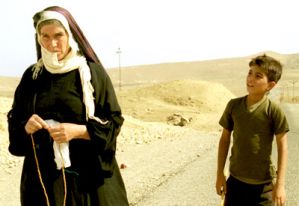
An air of ruination pervades the film. Shards of spent buildings gape black and white in the harsh sun. Notices on a board flap in a cruel wind. A long caravanserai of coffins mounted on car roofs chugs across the screen. But there is rebirth and growth too: corn swishes in fields flanked by palms. There are no dressed sets in this vision of Iraq. Everything has been shot as found. The actors play in that spirit. Yasser Talib, brandishing a wooden flute, conveys spirit and charm as Ahmed, while Shazada Hussein (both pictured above) as his grandmother gives one of those beautiful performances you often find in Middle-Eastern films, poker-faced silences punctuated by wailing panic.
Having picked up all sorts of honorifics on the international festival circuit, Son of Babylon has earned a deserved cinematic release. No film this year needs to be seen on a big screen more. Make no mistake, Al-Daradji is a film-maker steeped in history. At times it’s as if his film is haunted by the ghost of Bicycle Thieves, at others by the broad vision of Sergio Leone’s epic westerns, and strong gusts blow in from the Iranian film Blackboards, Samira Makhmalbaf’s windswept fable about Kurdish refugees after Saddam’s chemical bombing of their homeland. But in the end he is his own film-maker. Son of Babylon should be required viewing for any Western director contemplating yet another Hollywood invasion of Iraq.
Watch the trailer for Son of Babylon











Add comment