

“The film too often comes over as a prettily decorated edition of a sick spinster’s diary” was how the Monthly Film Bulletin concluded their review of The Innocents in January 1962. After seeing Jack Clayton’s intense adaptation of Henry James’s The Turn of the Screw more than 50 years on, the impression left now isn’t so much of an attractively presented chronicle of a breakdown, but a film which paints little of its substance in so clear-cut a fashion. As it is with the literary source, the audience is left to draw their own conclusions as to what is real, what is unreal, and what is all in the mind.
Brought to cinemas as part of the BFI’s GOTHIC season, The Innocents is a horror film: a psychological horror film. A favourite of Martin Scorsese, its essence resonates through more recent films like The Others and The Orphanage. It has a large, old dark house. It has creepy kids. It has a female central character. Its setting is, like its characters, isolated. It also has an eerie musical refrain which is repeated (listen to folk legend Isla Cameron singng it overleaf). And it is scary.
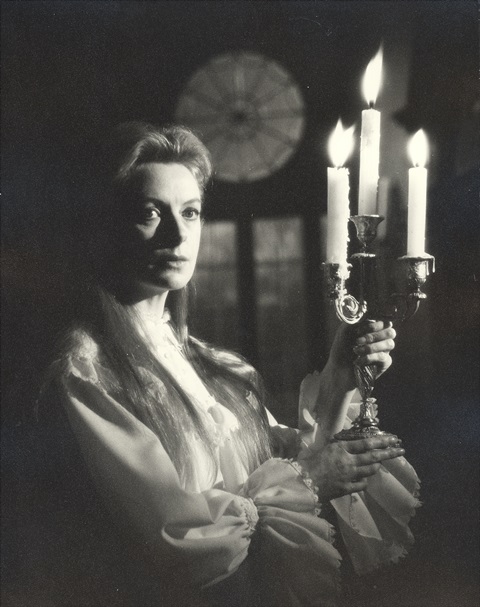 The film was also the product of a remarkable assemblage of talent. Its producer-director Clayton was a hardly prolific British auteur whose previous film Room at the Top (1958) defined the kitchen-sink drama. Yet despite their dissimilarities, both films dwell on the psychology of their central character. The screenplay was co-written by Truman Capote and William Archibald, the latter equally at home with ballet, musical and straight theatre. The Innocents drew on Archibald’s stage adaptation of The Turn of the Screw. The director of photography was Freddie Francis, who would soon move on the directing horror films for Hammer (pictured right, Deborah Kerr as Miss Giddens on a walkabout)
Although British, The Innocents is nothing like a contemporary Hammer horror film. It is more akin to Night of the Demon (1957) and The Haunting (1963), both more about atmosphere and character’s reactions to the situations they find themselves in – or think they do – than straight shocks. The dread is implied.
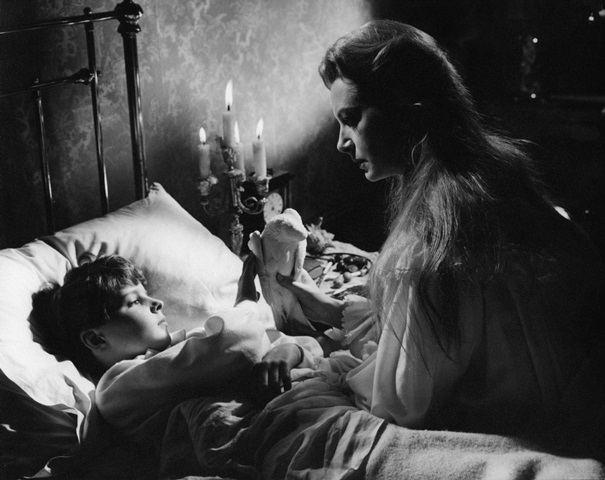 With The Innocents, the film hinges on Deborah Kerr’s Miss Giddens, the unmarried daughter of a parson taking on her first job as a governess. Her charges are orphans Miles (Martin Stephens) and Flora (Pamela Franklin). She becomes convinced the children are guided or possessed by the spirits of deceased former staff members of the household. Both Flora and Miles are super-creepy. Franklin conjures some very disturbing looks to pass across Flora’s sphinx-like face. Stephens’s Miles is a grade-A sinister kid you’d run a mile from. The sexual interaction he has with Giddens remains shocking. As does the sexual interaction she has with him (pictured left, Miss Giddens and MIles have a bedtime chat)
But it’s Kerr which the film dwells on. Reprising yet intensifying her persona from Black Narcissus (1947), she gives a high-octane portrayal of a repressed woman always on the brink of breakdown. She is convinced her experiences are real, but they may not be. Whatever the reality, they impact on her and all those around her. In protecting the innocence of the children, she keeps the iniquitous away from herself and is compelled to exorcise them. Her performance is stilted, quite theatrical and – seen now – does take a little time to get used to.
Despite the X certificate awarded on its British release which limited its potential audience, The Innocents obviously had a contemporary impact. A set-piece scene with Kerr was borrowed by Polanski a few years later for Repulsion. It still has the power to unsettle.
Listen to Isla Cameron singing "O Willow Waly" from The Innocents
Watch the trailer for The Innocents

Add comment