

It’s impossible to think of a contemporary British director or writer-director team making six consecutive masterpieces as did Michael Powell and Emeric Pressburger when they followed The Life and Death of Colonel Blimp (1943) with A Canterbury Tale (1944), I Know Where I’m Going! (1945), A Matter of Life and Death (1946), Black Narcissus (1947) and The Red Shoes (1948). Not only does the industry no longer have the means to support such an iconoclastic partnership – there has never been a writer working in the mainstream national cinema as imaginative or as fertile as Pressburger and a director with such visual genius as Powell. Variously suffused through pastoralism, Celticism and Gothicism (not forgetting Freudianism), these films brought British cinema to its Romantic climax.
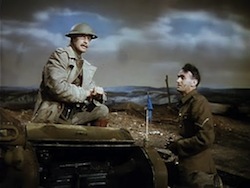
That’s a lot of “isms” already, so one more, High Toryism, won’t go amiss. Traditional conservatism, characterised by paternalism and noblesse oblige, is espoused most completely in Powell and Pressburger’s oeuvre by Clive Wynne Candy (Roger Livesey), Blimp’s upper-class English imperial officer who has to learn the harsh lesson that his honorable way of fighting, based on his experience as a VC-winning subaltern in the Boer War and as a brigadier on the Western Front (Livesey pictured below with John Laurie), is next to useless in the era of Nazism and total war.
 As an influential Home Guard general in 1943, the lesson is taught him by a brash army lieutenant, “Spud” Wilson (James McKechnie), who, in the sequences that frame the long flashback detailing Candy’s life in the previous 40 years, humiliates the old man by beginning their combat manoeuvres hours before the appointed time.
Only the recollection that he, too, was once an impetuous young officer, who disobeyed his superiors by attempting to quell anti-British propaganda spread by the German spy Kaunitz in 1903 Berlin, prompts Candy to forgive Spud.
It is on this rogue mission that Candy meets the two people who shape his destiny. He falls hopelessly in love with the English governess Edith Hunter (Deborah Kerr) who originally sent word of Kaunitz’s activities, and befriends the German officer Theo Kretschmar-Schuldorff (Anton Walbrook), with whom he duelled after assaulting Kaunitz.
Since Theo and Edith marry and Candy is obviously excluded from their union, he embarks on a lifelong quest to find a woman like her and to regain Theo’s love after their friendship is sundered by the Great War. He finds Edith surrogates in the Yorkshire nurse Barbara, whom he marries in 1918, and, widowed by her, the army driver Angela he hires on joining the Home Guard (both women played by Kerr), and he brings Theo back into his life as an enemy alien. His unconscious desire is to restore the lost idyll of triangular harmony with both parents. That Angela is Spud’s girlfriend reinforces the notion that, despite his advanced age, Candy is the Oedipal son fearful of castration by the more virile father figure. That Candy remains childless suggests he is impotent, though, strictly speaking, Blimp is not a realist text.
 The non-depiction of the Berlin duel, apart from a few saber thrusts, after the lengthy ritualistic rigmarole that precedes it, is one of Powell and Pressburger’s masterstrokes: in keeping with the refusal to show action in any of the conflicts in which Candy is involved, except for the tangential skirmishes with Kaunitz and Spud, it indicates that Blimp is not a film about war, but about the qualities that shape national character. Candy is all chivalry and gentlemanliness. Theo is a product of Prussian hauteur (a man later humbled by the rise of Nazism, to which he loses his sons, into a mood of melancholy realism). Although the South African officer Candy meets in France, who is prepared to torture soldiers of Theo’s regiment, anticipates Apartheid, that was five years off in 1943. Since Afrikaners were more the victims of British torture than vice-versa in the Boer War, it’s likely that the South African is a precursor of Nazi sympathisers in the Empire.
Blimp is not a film about war, but about the qualities that shape national character
Whatever Candy’s qualities, in 1943 Winston Churchill and Sir Percy James Grigg, the Secretary of State for War, didn’t want him around. Anticipating that the character would be an unironic transposition of David Low’s satirical cartoon character Colonel Blimp, the reactionary, self-contradicting old buffer who symbolised archaic British political attitudes like jingoism, they arrogantly sought to prevent the film from being made, the prime minister’s rationale being that it would be “propaganda detrimental to the morale of the Army” or that it would undermine its discipline. They stayed their hand because, there being no Defence Regulations enabling the Ministry of Information to suppress the film, they were reluctant to exceed their powers and incur allegations of behaving like the fascists.
 When War Office and MoI representatives saw the film, they deemed it “unlikely to attract much attention or to have any undesirable consequences on the discipline of the Army”. Churchill, who was apparently concerned that Spud’s precipitous apprehension of Candy aligned him with the Japanese attacking Pearl Harbour, tried to prevent Arthur Rank from exporting Blimp, but Brendan Bracken, the Minister of Information, contended that the film was so “boring” and “dull” it would have no effect in America and the Empire. Learning that the film’s success on the Odeon circuit made it near impossible to ban abroad, Churchill ceased to obstruct it. Powell and Pressburger got their dig in at the would-be censors by including a scene in which Candy’s BBC speech about how to fight the Germans is pulled before he can record it.
What the politicians, being ideologues, couldn’t understand is that, in its political multivalence, Blimp was pro-active British propaganda. Powell and Pressburger’s perspectives on Candy and Theo (whose friendship must, in some sense, represent that of the English director and the Jewish-Hungarian screenwriter) are scarcely fixed. The Candy of 1943 who extols civilised conduct in war is clearly wrongheaded: “War is no longer a bloodsport for gentlemen,” Theo remonstrates to him, “but a fight to the finish against the most devilish form of racism ever invented.”
 Yet the Candy of 1918 who welcomes the released prisoner of war Theo to dinner with his military pals understands that victorious nations that exact crippling reparations from defeated countries are sewing the seeds of future conflict: “The reconstruction of Germany is essential to the peace of Europe… We want to be friends,” Candy tells him. This is another remarkable scene. As Candy introduces each of his cronies to the dejected Theo, we see a range of responses – friendliness, aloofness, ambivalence, contempt. Returning home with his fellow officers by train in the next scene, Theo speaks with cynicism and disgust of his lukewarm reception and the unlikelihood of reconstruction. But his hatred has given way to despair by the early Forties when, in a three-and-a-half-minute soliloquy, much of it addressed to the camera, he wrenchingly describes to the agent at the Enemy Aliens Tribunal the misery of living in a Germany where, having lost his family and his national identity, there is nothing worth fighting for. This should have been music to Churchill’s ears.
The government’s fears about Blimp proved ungrounded. While the film remained true to its promise of paying “a tribute to the toughness and keenness of the new Army in Britain… and how far they have progressed from the Blimpery of the pre-war Army” (from a note supplied by Powell and Pressburger to Grigg) via its depiction of Spud and his men, Candy becomes the object of the discerning viewer’s deepest affection, not of ridicule. His conciliatoriness extends not only to a non-Nazi Germany but, crucially, to the young soldier who has taught him to reconsider his ineffective notions of waging war. If his attachment to the eroticised image of Edith Hunter can be construed as perverse (in the best English style), then its Romanticism casts the fond-hearted Candy as “the verray gentil parfait knyght” of The Canterbury Tales. He is inscribed thus on the tapestry of Blimp’s opening title, invoking the film’s dialogue with English history, in which the heroic iconography of the mythic gentleman-warrior is central.
Overleaf: watch the trailer for The Life and Death of Colonel Blimp












Add comment