Often it takes a generation or two before a country can address its dark days on films; Hitler didn’t feature in a central role in a German film until Downfall, in 2004. This timorousness was certainly the case in Chile, where in the immediate years following the end of General Pinochet’s dictatorship, in 1990, the local cinema was dominated by sex comedies.
But the renaissance in the country’s film industry over the past decade has been accompanied by a willingness to look back. Andres Wood’s Machuca led the way, in 2004, with a powerful child’s-view account of the days leading to the army coup against the socialist Salvador Allende. Even more striking, four years later, was Pablo Larraín’s Tony Manero – a veritably thunderbolt of a film that was so imaginatively leftfield that it spoke of the corrosive effect of repression the world over, as well as giving an entirely unexpected perspective on Saturday Night Fever.
The period is a mystery to me; it’s something that you try to understand, but you never can
The son of politicians, Larraín was born in 1976 and was still a child when it ended. And yet his fascination for the period has led not just to Tony Manero, but now to a trilogy of dictatorship films. While Manero concerned itself with the height of the repression, and Post Mortem with the beginning, the coup itself, No considers the regime’s final days.
In 1988 Pinochet gave into pressure from the international community to hold a referendum on his continued presidency. Much to the dictator’s - and everyone else’s - surprise, the Chilean people found the courage to vote "No". Larraín’s film charts the stranger-than-fiction story behind the No television campaign, with Gael Garcia Bernal starring as an amalgam of the real-life ad men whose counter-intuitively happy campaign – with the slogan "Happiness is coming" – turned the tide. It also features the great Alfredo Castro – who starred in both of the previous films, and whose Manero is arguably one of the most original and repugnant villains in the history of cinema – and the director’s wife and also regular collaborator, Antonia Zegers.
Not surprisingly, given the upbeat historical moment it depicts, No is a much lighter and more engaging film than its predecessors – a feelgood movie with a deeply serous subject – receiving standing ovations when it premiered in Cannes in 2012. It is a wonderful conclusion to a remarkable trio of films, whose Oscar nomination for best foreign language film merely confirms Larraín’s arrival as a world-class director.
 DEMETRIOS MATHEOU: Explain your fascination with Pinochet’s dictatorship?
PABLO LARRAÍN: Many people ask, "Why are guys from your generation talking about this?" I can only speak for myself. Chile divides into the people who lived during the military coup, and the people who didn’t. I didn’t. I was born under the dictatorship, and grew up hearing tales about the coup, which turned into a sealed box, an enigma that captured my imagination. The period is a mystery to me; it’s something that you try to understand, but you never can. I’m not obsessed. In between these films I’ve made an action series for HBO — cocaine dealers, bullets, car chases. Very different. But that period in Chile intrigues me. And of course it offers great dramatic possibilities.
When did you first think of ending the trllogy with the No campaign?
When we were in Cannes with Tony Manero, in 2008, and someone brought me an idea about the referendum. But my first reaction was very cautious. The previous movies I’ve made on the subject are from a private point of view, about unknown characters who are victims of their circumstances. This one is the guy who somehow changes the destiny of my country.
So what convinced you?
Just time. I got older, you become a little bit stronger. But of course other people had concerns. When we started we had to get permission to use the original campaign footage. The people who did this campaign have become pretty well-known and respected. So when I came to talk to them their first reaction was "No, no, no. Not you, not the guy from Tony Manero." I think their reaction was pretty reasonable. If the guy from Tony Manero and Post Mortem was asking to make a film about my life, I would have been worried. But we worked on the script and when they read it their reaction was beautiful, because it was a huge flashback for them. So they started to talk to us, and trust us, and gave information very generously. And then we said, "Why don’t you act in the movie?" They are all in the film, in different little characters here and there.
It’s not just the ad men. The campaign’s anchor man is clearly playing himself, as he prepares to go in front of the TV cameras. Then when you show the original footage, it’s him as he was in the Eighties. Are there many examples of that?
There are people throughout the entire film. When we wanted to recreate the shooting, we called the real people involved, who are now 24 years older, to play themselves. We didn’t use make-up, we didn't want to make them look younger. You see them as they were then, and as they are today.
Presumably, one reason for this device is to say to the audience "This is not just a period film; this is also about Chile today."
Yeah, you’ve got it. That’s my trick, that’s what I want to do, the reason I’m making this movie.
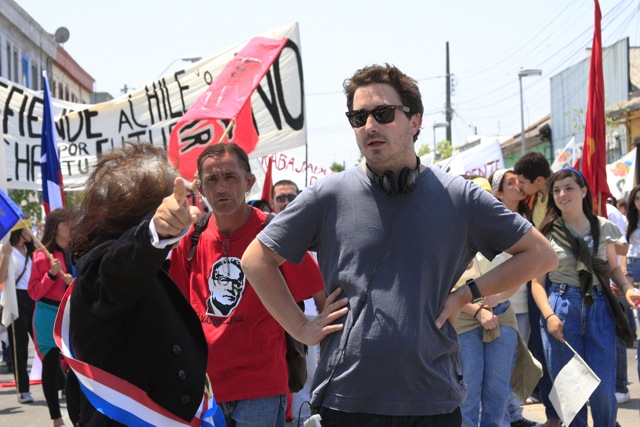 In fact, in all three films there is the sense of through-lines between then and now. Tony Manero has a commentary about the destruction of Chilean culture that still pertains.
That's right. Under Pinochet Chile became an open-market economy and, when he did that, a lot of things changed socially. We began to import a lot of stuff, cultural and economic. Pinochet was very ignorant. He probably never watched cinema in his life, he certainly didn’t care about it. His regime did enormous damage to our folk traditions. And that’s what Tony Manero is about.
I watched about eight of Gael's movies, looking for the right way to to capture that mystery
But as we see in No, Pinochet dug his own grave. He imposed this super-capitalist model, and then the guys who grew up with that model and started to connect with the world with those tools, were the ones who pushed him out. There are two sides to the No campaign. On the one hand, they had this amazing creative power, they were able to defeat Pinochet without violence. Every time I think about it, still, it’s amazing. But at the same time, they used marketing and advertising tools in order to discuss ideological issues, and that smells different, it’s dangerous.
Since then we’ve had 24 years of democracy, five governments in a row, four from the left, and all of them kept Pinochet’s socio-economic model, even strengthened it, and the rich got way richer, the poor got poorer. They defeated him but they couldn’t defeat what he created. But most people watching No won’t see that. Most people in the cinemas in Chile will simply relive those days when a society got together to defeat Pinochet. And that’s OK.
I imagine it would have been tough to sell the bleak view of Tony Manero to a Chilean audience. Has this one been different?
My two previous films didn’t work in Chile, but the Chileans who have seen No are really impressed, not because of our work, but because the real story is something that everybody remembers. If you go in the street in Chile and ask them to sing the campaign song everybody can sing it. Really.
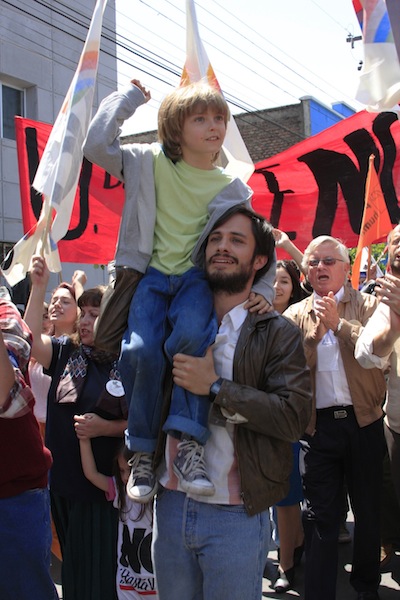 Why did you cast Gael Garcia Bernal in the lead?
He was always on the project, at least in our heads, even before we had a script. I really admire him and wanted to work with him. His character René Saavedra talks for the entire movie, but you never know what he’s really thinking. That mystery is essential to movies, I think, at least the ones I enjoy and the movies I want to make. Gael has that mystery. Before we started shooting I watched about eight of his movies, looking for the right way to frame him, to capture and hold that mystery. He’s great. He can really express something that’s not possible with words.
He’s Mexican. Can Chileans notice the accent?
Of course. It’s like the difference between London and Minnesota.
Tony Manero and Post Mortem had their comic moments, but they were essentially very dark films. This is positively feelgood. Did a part of you want to resist that?
Somehow yeah, I wanted to make it darker, but I couldn’t. When we were shooting I realised that I couldn’t go against the script and what really happened. One day I went home and said to my wife, who was acting in the film, "This is the story of our triumph, so just go for that. Enjoy the triumph."
- No is released on Friday 8 February
Watch the trailer for No