
Royal Opera House chief Tony Hall to the BBC - now what? | reviews, news & interviews
Royal Opera House chief Tony Hall to the BBC - now what?
Royal Opera House chief Tony Hall to the BBC - now what?
Hall the healer is needed at the BBC - but Covent Garden needs a tougher champion now
Thursday, 22 November 2012
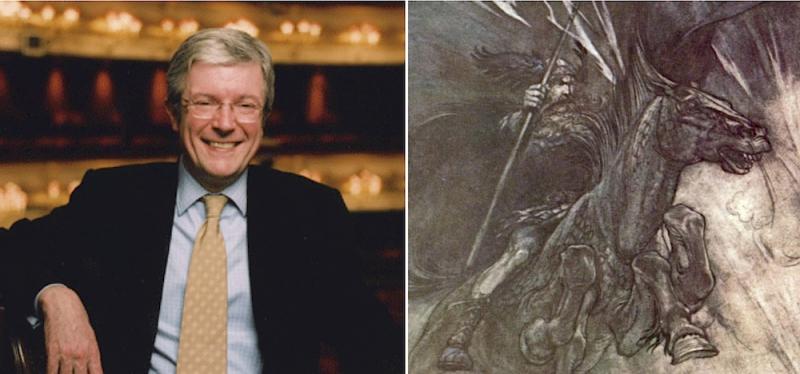
Enough of comforting, time for thunderbolts: Tony Hall must be succeeded by a WotanROH
So Tony Hall moves from heading the Royal Opera House to taking over the BBC as its new Director-General. I can't for a moment imagine a rerun of that crucial mini-conversation between Helen Boaden and George Entwistle over the Jimmy Savile programming (if you can remember all the way back to mid-October through the cannonfire since) taking anything like a similar course had it been Tony Hall rather than Entwistle.
Entwistle prided himself, even congratulated himself on not asking a single question about why Newsnight's investigation into Savile should have any relevance to his programming of tribute programmes, which was why he appeared so dim and inadequate to normal people outside, who could not grasp any virtue in remaining wilfully ignorant. The moral philosophers backed up the position that if you don’t know, you can’t influence, but for any pavement-hitting reporter it was excruciating to see a man who called himself a career journalist showing no natural curiosity about the big news under his nose.
 Hall, though, is a man who loves knowing everything. He was the BBC's own head of news (pictured right) when he was recruited to the Royal Opera House in 2001, and he has a journalist's nose, he's in every corner, curious to see rehearsals, chatting to conductors, checking marketing and media, good mates with the dancers, at total ease with patrons and press alike, finding spare time to run Olympic committees and other sundry extra-curriculars. He is outstandingly congenial, and that too will be just the tonic the BBC needs.
But is it what the Royal Opera House needs from his successor, who'll take over next March?
Hall has been widely praised for getting the ROH down off its marble pedestal, busting the blockades on broadcasting by developing a smart new interaction with the public far beyond WC2 via big screens, cinema relays, YouTube and social media. The perception of the Royal Opera House as closed to all but the rich and the knowledgeable has started changing, helped by some astuter focus on ticket pricing and booking.
This willingness to learn and react has surely protected the ROH from the worst effects of the government’s cuts to arts subsidies (of which the ROH is the greatest beneficiary) because it's simultaneously shown itself reaching out to the street and also tweaked its appeal to its private patrons. Electronically you can support the ROH or access some of its offerings from anywhere in the world; half a century ago Covent Garden meant, largely, Covent Garden and its WC2 postbox.
With two artforms to accommodate, the Royal Opera House has allowed itself to prioritise new life in one and fossilise old life in the other
But hand in hand with that has come a less welcome artistic change, markedly on view on the ballet front. With two artforms to accommodate, the Royal Opera House has allowed itself to prioritise new life in one and fossilise old life in the other. Innovation is always a risk in either artform, but ballet has been allowed to become a static bore over the last few years, focusing far too hard on 19th-century classics and box-office favourites. Creativity has shrunk, not just in opportunity but in scope. It's M&S at the ballet these days, with a super event like the Metamorphosis: Titian 2012 collaboration with the National Gallery a brief, risk-averse one-off.
Any glance at what the Royal Ballet was doing in even the mid-1990s shows a sharp brake in productions since then (and I shake my head sadly over my own naivety as I remember the savaging I used to give the ballet director Anthony Dowell over his lack of innovation). Go back further to artistic leaders like Britain's own Marie Rambert and Constant Lambert, the Ballets Russes' Serge Diaghilev, and the St Petersburg Imperial Theatres chief of Tchaikovsky's day, Ivan Vzevolozhsky, and one sees how vastly more can be achieved with dance as a crucible for lyrical and visual arts by people who see their mission as creating in the public a constant expectation of imagination.
I think having a generalist manager like Tony Hall at the ROH has concreted this process of canalisation - thanks to his own confessed ignorance about dance and his almost childlike pleasure in basics. His own taste has, by a kind of unwitting osmosis in reactionary social times, prevailed. What the public now has is a constant expectation of familiarity - it’s to the opera where the intelligent go for contemporary stories and artistic updates, and well done Hall for that. But when was the last scandal about a new ballet at Covent Garden? Not since Kenneth MacMillan's last, probably - 20 years ago.
I’m not asking for scandals, per se - I am asking that the next chief executive at the Royal Opera House should see that, in ominous times when political hooligans are attacking the very idea of arts existing for other people not themselves, they now need a rabble-rouser of their own, a leader who stands up personally for art for art's sake, rather than a supremely amiable networker.
This week the knotted consequences of the government’s intention to force arts towards the private sector began to be exposed by a report demanding that creative artists and groups look for private funding or else lose their public subsidy too. Meanwhile director Danny Boyle and the National Theatre’s Nicholas Hytner have expressed outrage at the disorganised retreat by regional councils from supporting local theatres and performers. Soon Chancellor George Osborne unveils the next tranche of public spending cuts, and even some of those who care about arts will start to become resigned to losing what they know. This is all one big tapestry of the national art-health service which the ROH has a gigantic visibility within, to help, and to take a lead.
Jeremy Isaacs, the bloodied ROH chief of the turbulent 1990s (and once nearly the BBC D-G himself), described the “paragon” needed to fulfil the job description - “outstanding artistic leadership with management wizardry and sure financial control”. The first quality is sorely needed now, a Wotan throwing thunderbolts, burning out the hooligans, with a tattoo reading "ART" on his or her biceps. Tony Hall’s comfort blanket approach at Covent Garden has been “healing” - David Cameron’s in-word these days - but while he takes his healing powers over to the BBC (which needs them), the Royal Opera House needs his successor to home in on how to make art itself finer, pierce our hearts and shout about it from the barricades.
Add comment
The future of Arts Journalism
You can stop theartsdesk.com closing!
We urgently need financing to survive. Our fundraising drive has thus far raised £49,000 but we need to reach £100,000 or we will be forced to close. Please contribute here: https://gofund.me/c3f6033d
And if you can forward this information to anyone who might assist, we’d be grateful.

Subscribe to theartsdesk.com
Thank you for continuing to read our work on theartsdesk.com. For unlimited access to every article in its entirety, including our archive of more than 15,000 pieces, we're asking for £5 per month or £40 per year. We feel it's a very good deal, and hope you do too.
To take a subscription now simply click here.
And if you're looking for that extra gift for a friend or family member, why not treat them to a theartsdesk.com gift subscription?
Comments
I wouldn't disagree with your
Like or not folks, business
It's not about being
It's not about being 'rareified', surely; it's about variety. A company that doesn't take risks as well as offer the core rep, which of course is essential and need not be worn-out, might as well give up. It was good news when Pappano persuaded everyone to support the common cause of the Jones production of Prokofiev's The Gambler when plugs were threatened to be pulled a couple of years ago.