

Dichterliebe is a song-cycle full of gaps, silences, absences. Where is the piano at the start of “Ich hab’ im Traum geweinet” when the voice enters first and so startlingly, ungrammatically alone? Where is the voice during the long piano postlude when the vocal line disappears but the singer continues to stand centre-stage? We even seem to join the cycle mid-conversation, unsure what has prompted the diffident, tentative harmonies with which it starts. Biggest of all however, are the gaps left by the four songs that Schumann excised between completing the manuscript version and publishing the cycle. It’s these that give playwright Martin Crimp and composer Bernard Foccroulle the invitation for Zauberland – a work that fills those absences to bursting.
Together with director Katie Mitchell, who stages a project co-produced by theatres across France and America as well as the Royal Opera, Crimp and Foccroulle devise a new narrative for the expanded cycle. A pregnant Syrian opera singer flees Aleppo for a new life in Germany. As she waits at the border she rests and dreams a nightmarish vision that collides her former life, a performance of Dichterliebe and memories of the war. It’s a lot to pack into an hour and a half of theatre, and a lot of extra weight resting of Schumann’s slight, delicate cycle. Dispatched nearly straight through in a brisk half-hour (with just one new interpolation), the Schumann feels like a skin the creators are keen to slough off before getting down to the real business of the evening. The end-loaded result is unbalanced, parasitic rather than amplifying.
Western art and art-song – the “Zauberland” of the title – comes in for a rough ride here, its refuges of beauty and poetry torn systematically apart. Heine’s images find themselves cruelly transfigured by Crimp. His roses and lilies become women “with flower names” raped and burned alive in war, his nightingales a surreal currency to be traded in the bank.
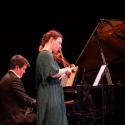
Schumann’s music, similarly, is stretched and bent out of shape by Foccroulle. The tentative raindrop patter down the piano of Dichterliebe’s spacious piano postlude becomes the spatter and swell of his own musical postscript – attractive, rather anonymously, inoffensively lyric writing made into pure liquid by Cedric Tiberghien, whose playing throughout is keenly expressive, his quiet phrasing and singing lines cutting through the noise all around them.
Mitchell’s production has all the director’s familiar hallmarks. If the slow-motion movement, the sharp-suited men, the array of glass display cases feel empty they are at least the accurate reflection of a work whose political and humanitarian anger is so generalised, so sanitised and sharp-suited in its turn that it’s hard to feel much in response. Crimp’s text, with its wilful banalities and arms-length emotion, is literal where it should leave space and lectures where it should leave well alone. Without the musical touch of an alchemist like George Benjamin his libretto remains dull and base. Soprano Julia Bullock (pictured above) is a dignified centre to the work, delivering a careful Dichterliebe (she was announced as suffering from illness) but really coming into her own in Foccroulle’s freer, wider-ranging lines. Dressed and undressed every second moment by a team of actors, pushed and pulled into position by force, climbing on and off tables and chairs she somehow held focus, giving us stillness and immense control.
Dichterliebe’s gaps are the doors that invite us in, over and over again. In stuffing them full of ideas and arguments, Crimp, Foccroulle and Mitchell have blocked them shut.
- Zauberland at the Royal Opera House's Linbury Theatre until 18 October
- More classical reviews on theartsdesk







Add comment