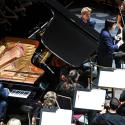
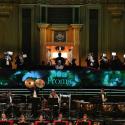
“I don’t want to be a Cyclops,” Pierre Boulez said in 2010, faced with the prospect of conducting a Chicago concert with only one working eye. Eye troubles, alas, have continued to bedevil the octogenarian giant of contemporary music, which is why his current engagements with the London Symphony Orchestra – there’s also a tour to Paris and Brussels this week, and a second Barbican engagement next Tuesday - have fallen into the hands of a younger composer-conductor of advanced habits, the admirable Hungarian Peter Eötvös.
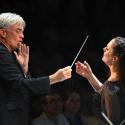
And what good hands they are: not perhaps as fastidiously incisive, but always sparky and refreshing, and with skills much after Boulez’s own. Long a Boulez associate (Eötvös spent the 1980s as music director of Ensemble InterContemporain, the musical powerhouse founded by the great man himself), his conducting style is visibly in the Boulez manner. Baton? Not likely. Instead, he conducts with intricate hand gestures, small, taut and neat, as if he’s on an airport runway giving landing directions to a cloud of gnats.
The programme itself was echt Boulez in its focus on the early 20th century’s musical experimenters, and didn’t have to be changed at all to chime with Eötvös’s own tastes, or the exotic colouring of much of his own music. Debussy’s Nocturnes; Szymanowski’s Violin Concerto No 1; Scriabin’s Poem of Ecstasy: hothouse dreamscapes every one, though lacking two characteristic Eötvös ingredients – a cimbalom and a sense of humour.
Hushed strings hovering in the half-light; whispering brass; feathery tinkles from piano and celesteOperating with their official leader Gordan Nikolitch actually in residence, not something that regularly occurs, the London Symphony Orchestra had manifold opportunities throughout the programme to display their refinement and golden touch. Hushed strings hovering in the half-light; whispering brass; feathery tinkles from piano and celeste: nowhere here were the neurotic cries and brute sparkle often demanded by the orchestra’s honcho Valery Gergiev. Next season Gergiev himself is conducting Szymanowski's works with the LSO; though they’ll be hard pressed to match the voluptuous sheen of Sunday’s performance of the first violin concerto, that magical one-movement tapestry of paroxysms and dreams written during the dark, bloody days of the First World War.
Christian Tetzlaff helped, of course. How could he not, body swaying with the music’s passions, fingers dancing near the violin’s bridge, spinning a thread of silvery sound ethereal yet passionate, the dynamics graded with infinite grace? The performance of Debussy's Nocturnes, precisely outlined though a smidgen below memorable, had summoned rather mechanical applause, even with the mellifluous ladies of the London Symphony Chorus. But after the Szymanowski we clapped with real heat, and were rewarded with a substantial encore, the slow movement from Bartók’s solo violin sonata. We sat rapt as its melodic line and decorative frills leaped and shimmered up and down the violin’s register. What a superb player Tetzlaff is.
The second half lasted no more than 20 minutes, but following it I still needed a cold shower to cool off. Translucent colours; a lovely languorous flute; tumescent upheavals regularly topped by a queasy trumpet motif that kept crowing like a rooster welcoming the dawn: this could only be Scriabin’s Poem of Ecstasy. Boulez’s take on this bonkers monster would have been worth hearing – he made two recordings in America in the 1990s. But Eötvös waded in with his own aplomb, shaping sonorities and pacing its excesses carefully enough for the gaseous delirium to avoid toppling into the boring. To Henry Miller, famously, the piece was “like a bath of ice, cocaine and rainbows”. I’m not sure I felt the ice, but I certainly ticked off the other two.