
Remembering Ravi Shankar, 1920-2012 | reviews, news & interviews
Remembering Ravi Shankar, 1920-2012
Remembering Ravi Shankar, 1920-2012
From child musician to world music superstar - the astonishing, nourishing life of Raviji
Thursday, 13 December 2012
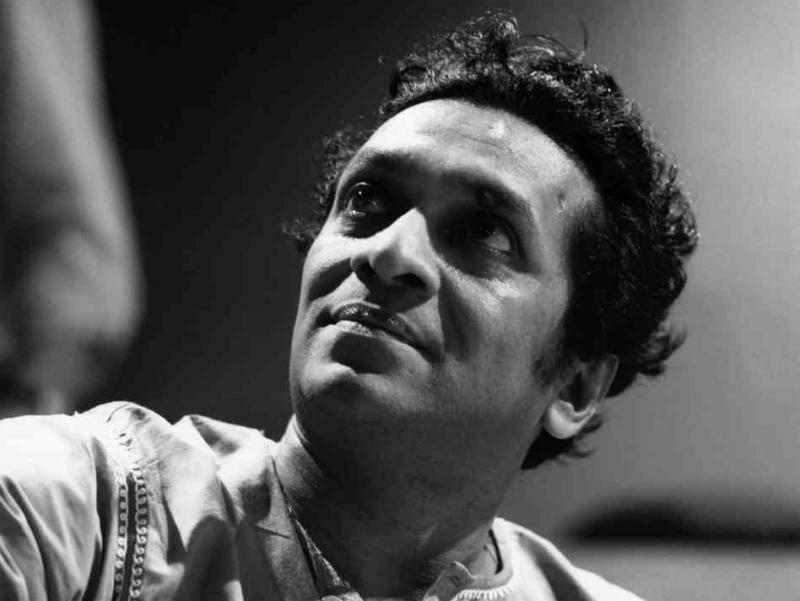
Ravi Shankar in 1960: the music he played offered the audience the possibility of transcendence
While living in Bombay in the late 1940s, betrayed by a business partner and his first marriage in the midst of painful implosion, Ravi Shankar decided to commit suicide. At the eleventh hour, a holy man, who happened to be passing by, knocked on his door asking for water. The man told Shankar that he was aware of his fateful decision. This wasn’t, he went on, the right time to be renouncing life.
He had a great future ahead of him, the sadhu continued, and a major role to play in the dissemination of Indian music throughout the world. The man became Ravi Shankar’s spiritual teacher, and for several decades, the sitar player would go to him whenever racked by self-doubt or uncertain of his path.
There was something fated about Shankar’s life: it’s a story that makes sense almost on a mythical level, with its ups and downs, triumphs and disappointments and above all the unfolding of a timely logic. His role was to bridge East and West and to initiate the rest of the world into musical traditions that go back to the ancient Vedas and the artistry of the great Mughal court musician Tansen, who could make the rain fall, it was said, when he played the right raga. Ravi Shankar was a master of the sruti, the subtle and undefined microtone that our more defined system of tempered scales has by-passed for centuries: the sliding space between tones which opens the soul to the reality that lies beyond everyday rational consciousness.
He did fusion, but never lost himself in it
I was lucky to spend time with Raviji, named so by his disciples and friends in recognition for his musical and spiritual mastery. I have felt infinitely blessed by the relationship. I travelled, for the film I made about him, to his birth-place Varanasi. There are many places in India that exude great spirituality, but a few have been singled out as tirtha, points on the earth where it is possible to cross more easily into another dimension. I was not surprised, once I got to know Varanasi, that Raviji had been nurtured there, for he lived to make that crossing as present as possible in his work. He knew that the music he played offered the audience the possibility of transcendence, and he devoted himself to being such a life-enhancing and transformative channel. The idea of crossing was also manifest in his lifelong commitment to teaching Western audiences about the riches of his own tradition. He was what the French call a passeur, a kind of medium, through time, space and other dimensions.
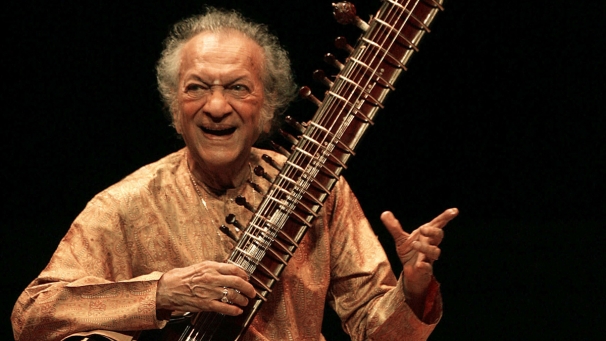 When we spoke, Shankar, explained that virtuosity was far from everything: he had little time for those prisoners of ego who “played to the gallery”. In so doing, he said, they betrayed music’s inherent power to heal and to communicate love. His longevity had a great deal to do with maintaining a sense of his own roots as well as his spiritual inheritance. At key moments in his life, he went for the “path of most resistance”, as the pianist Artur Schnabel described his own approach to music: when in the 1930s, still a teenager, Raviji turned his back on a life of five-star hotels, fawning Hollywood fans and a budding career as a dancer and choreographer, choosing instead to study music for seven years in near-ascetic conditions with Allauddin Khan. Later, in the early 1970s, he once again retired from the world, when it looked as if he could become a world superstar, playing massive rock arenas, in the wake of his famous appearances at Monterey and Woodstock.
He was hardly a purist and his openness to other musics and never-ending curiosity were remarkable. He did fusion, but never lost himself in it. Some of his greatest music is not classical raga, but the soundtracks for Satjyajit Ray’s Apu trilogy or his album, produced by George Harrison, Chants of India, in which he revisits Vedic chants with brilliance yet sobriety. He recognized that Jimi Hendrix was a remarkable guitar player but was shocked when he set fire to his guitar. When he first heard John Coltrane, who had asked him for lessons, he found his music harsh and violent, as if the man were expressing deep spiritual suffering. But he went on to offer him long-term lessons, a few weeks before Trane died. I suspect that Ravi Shankar’s longevity and staying-power as a musician and teacher owed a great deal to being spiritually anchored. He served music as one serves a higher power, in a spirit of devotion.
He was also served by an open-hearted and almost child-like enthusiasm for life and for other people. There was a lightness about him that balanced the serious commitment to his work. During the months of our filming together, we had found an old Pathé newsreel from 1931 – from the time in which he had played, at the age of 9, in the orchestra that accompanied his brother Uday’s dance troupe. They were the world music hit of the day and played full houses from Paris to Hollywood. He had never seen the news clip, and we filmed him watching it in Encinitas, sitting on a sofa along with his wife Sukanya and his two daughters, Anoushka and Norah Jones. As the young women giggled helplessly at the exotic antics, Raviji laughed in amazement with tears in in his eyes. The journey, from child musician to world music superstar, was almost unbelievable.
In the closing sequence of the documentary I made in 2002-3, Anoushka speaks of her delight at the endless stream of creativity which continued to flow and Raviji himself wonders at the new musical ideas being born with each moment. The documentary ends, fittingly, with shots of the Ganges in Varanasi, in a valedictory mood, as the film closes the story of his life, in the knowledge he cannot be far from the end. The river flows on. And Ravi’s influence is with us too, lasting and immortal.
Watch the end of Mark Kidel's film about Ravi Shankar
Mark Kidel's film is available here
Add comment
The future of Arts Journalism
You can stop theartsdesk.com closing!
We urgently need financing to survive. Our fundraising drive has thus far raised £49,000 but we need to reach £100,000 or we will be forced to close. Please contribute here: https://gofund.me/c3f6033d
And if you can forward this information to anyone who might assist, we’d be grateful.

Subscribe to theartsdesk.com
Thank you for continuing to read our work on theartsdesk.com. For unlimited access to every article in its entirety, including our archive of more than 15,000 pieces, we're asking for £5 per month or £40 per year. We feel it's a very good deal, and hope you do too.
To take a subscription now simply click here.
And if you're looking for that extra gift for a friend or family member, why not treat them to a theartsdesk.com gift subscription?
Comments
It's a beautiful film.
Yes, I can't recommend Mark