
Q&A Special: Christopher Hitchens, 1949-2011 | reviews, news & interviews
Q&A Special: Christopher Hitchens, 1949-2011
Q&A Special: Christopher Hitchens, 1949-2011
The great and now late polemicist riffs on life, literature, music and politics with characteristic élan
Friday, 16 December 2011
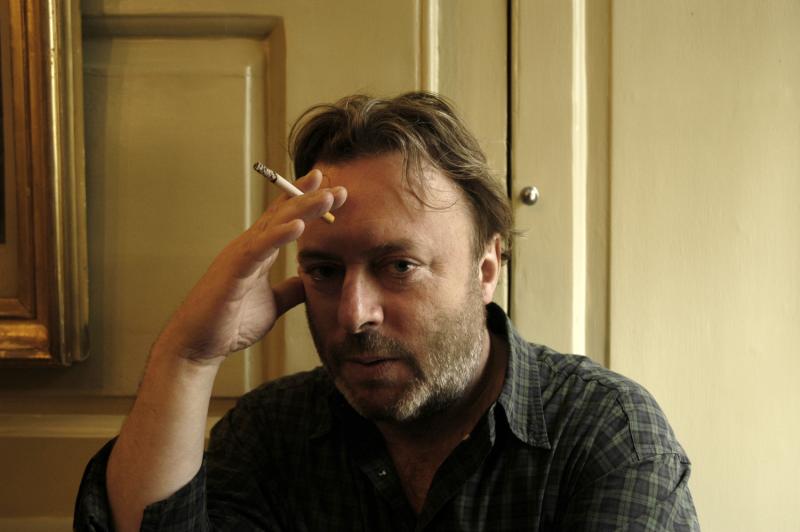
Christopher Hitchens: essayist, polemicist, contrarian, drinker, smokerPortrait © Charlie Hopkinson www.charliehopkinson.com
When he was diagnosed with cancer of the oesophagus, Christopher Hitchens carried on talking. He gave a number of riveting interviews – with Lynn Barber in The Sunday Times, Andrew Anthony in The Observer, Mick Brown in The Telegraph – as he prepared himself for a journey which, for the author of the bestselling God Is Not Great, would not involve meeting any sort of maker.
I had my own encounter with the essayist, polemicist, self-styled contrarian, Bush-supporting apostate, drinker and smoker in 2005 as he made his annual pilgrimage - if that's not too devotional a word - to the Hay Festival.
His latest publication was about to drop off the conveyor belt. Love, Poverty and War, an anthology of almost everything he had written for his many and various outlets since 11 September, 2001, was a full three-course meal - unlike a lot of the slenderer pamphlets in which he set out to demolish Clinton or Mother Teresa, or call for the return of the Elgin Marbles - and a deeply replenishing one. It also remains a perfect Hitchens primer. There is, of course, the pleasure to be had from the cocksure prose, all mane flicks and chest puffs. But it also reveals something which is shrouded from many of the British readers who mainly got to read him on the War on Terror and the tentacular reach of intellectual poverty: Hitchens was not just an attack dog who trained himself to snarl at the likes of Michael Moore and George Galloway (“a fucking guttersnipe,” he told me, “and thug and liar and ponce for fascism”). As a literary critic, he was actually an enthusiast: he ranted about politics in Washington and lectured about literature in New York.
I don’t envy or much respect people who are completely politicised. Nor do I think much of those who think that literature is a thing only of itself
An interview with Hitchens is (was) unlike any other. Ping him any question and from his mouth would flow torrents of glinting, sifted prose. How does one convey the exhilaration of an encounter with such a mind? He roamed from the awe he felt for George Eliot to his dissident take on Marilyn Monroe, from his surprisingly religious education to his membership of the New Statesman's gilded generation of co-workers including Amis fils, Fenton, Barnes, Boyd and McEwan. Best just to pass on a portion of our conversation.
'I can meet Shakespeare any time': Christopher Hitchens
JASPER REES: Do you lead an intellectual double life?
CHRISTOPHER HITCHENS: It depends who you think of as the Gold Standard in this kind of writing. People like, say, Arthur Koestler or Trilling or inevitably the name Orwell come up. Their lives as critics were successful precisely because they weren’t just politicised. They thought of themselves as defending a wider, more ample idea of humanism. And that’s essential. I don’t envy or much respect people who are completely politicised. Nor do I think much of those who think that literature is a thing only of itself and isn’t part of the struggle of our language and certain truths that have to be affirmed. If it is a double life I wouldn’t necessarily think of that as a criticism. No, I think it’s two halves of the same ass… coin, sorry. Also it’s very useful to teach people to whom a lot of this is new because you are forced to go over texts that to you are familiar and have worn a bit smooth. It’s very rare with the good stuff that you won’t notice things that you haven’t noticed before. And that’s enormously helpful to me. I would do it for nothing if need be. It’s just part of what I should be doing to keep up my own crumbling faculties.
Who are the authors in your pack?
The pack would be George Eliot – I don’t know why I say that first – Auden certainly, Kipling, I shouldn’t leave out Buchan. Before I read Fleming I’d read most of Buchan and I still find it pretty amazing. Dostoevsky, Crime and Punishment in particular. Koestler. I’m afraid most of these are English or American. George Eliot was central to my argument that literature can depose religion as an ethical resource. Her books are not full of ethical considerations. You wonder how she knew so much about the human soul in a way that I don’t think anyone else knew about motives and actions except Shakespeare. It’s absolutely astonishing to me.
In which school did you study these authors?
Most people wouldn’t have heard of the school I was at. It was called The Leys in Cambridge. I think I’ve met two people who went there. It was a good school but it would not be described as posh. If I was posh I’m not one of those who would pretend it was less. If I’d been at Eton I would have told you by now. I just wasn’t and my family wasn’t. No one had been to public school and university in my family. Not to make myself out to be a striver, of course I was very lucky that my parents decided to invest in education. It was a huge thing for them. Without that I wouldn’t have had a chance. You did have to go to chapel but when you went the preacher would quite often be some character from a slum in Leeds who was a Labour supporter.
Martin taught me a lot about how to write. I doubt that it shows in the sense of it being derivative
I take it you read English.
No, I wish I had. Like a fool, English and history were the things I liked and was good at, the Sixties were coming on and I could feel it and I was by then a New Statesman reader and my ambition was to write for it. I thought I know exactly what I want to do, I want to do PPE and I wasn’t to do it at Balliol. A serious mistake because I should have stuck to what I was good at or found something completely different like learn a language. By luck when I went up to Oxford in 1967, 1968 was about to burst on us and I did waste a good part of that year in all that. I don’t consider it a waste in the long run but I didn’t do any work on the syllabus. The course itself was actually very boring. We got it altered a bit. But the reforms don’t come in time for the people who agitate for them.
Did you feel like a gilded generation at the New Statesman?
I thought it was true of Martin. As soon as I met him and as soon as I read his stuff I was convinced of it. I also thought the same about James Fenton, whom I knew at Oxford. I remember Roy Fuller saying to me at a party at John Fuller’s, “You know I think frankly that he’s writing better now than Wystan was at the same age.” I wouldn’t have had the confidence to say that but I felt it was the case. I thought they were both fast-track. I did not think so of myself. I don’t think anyone else did either. If they did they kept it pretty quiet.
Do you find Money funny?
I still have the bound galley [Martin Amis] gave me as I was flying back to American one day in the early Eighties. I hadn’t that long moved. Reading it on the plane - you could still smoke on planes then – and absolutely convulsing, growing new stomach muscles. There are bits of it still that make me laugh when I think about them and I can quote almost verbatim, in particular the visit to the massage parlour which is a field trip he made me come on. He said, “Look, you’ve got to come with me to this knocking shop in New York one lunchtime.” He didn’t want to go by himself. I think he also wanted someone to talk to. We went on this incredibly sordid expedition on Lexington Avenue. I was fantastically glad when it was over and when I read what he’s made of it – it was only a couple of pages – I was thunderstruck by how much he’d got out of this squalid expedition. It’s absolutely wonderful. He doesn’t like particularly when I say I still think it’s his best. Let’s say I don’t think he’s done better. Martin taught me a lot about how to write. I doubt that it shows in the sense of it being derivative. Watching and listening to him and occasionally getting his opinion of my stuff, which was always very unsparing, was incredibly useful to me. And he turned me on to Nabokov.
Not everyone would guess that I like Wagner as much as I do. Somehow the people with whom Wagner is commonly associated don’t seem to be people like me
Does he always accept your opinions?
Not accept them but I think I could say he doesn’t disregard them. Occasionally I’ve seen formulations of mine in his work or things that I could say are part of conversations we’ve had. He would ask my view and listen to what it was.
Was America the making of you?
In every way. I should have done it fractionally sooner than I did. I’d always wanted to and I’d been going more and more often. And somehow the knowledge that I had to write is connected somehow to the ambition to go to the United States. Also at that time there was Julian and Timothy Mo who I think is a very great novelist and rather underrated. I made a big push to get him published in America. William Boyd was often around the place. He was a TV critic. We’d go and have lunch. Then Ian McEwan would come in. And then there was the Friday lunch, believed by all Leavisite conspiracy-mongers to be the great fix, but it wasn’t. It was just a huge lunch.
Has that period been over-mythologised?
It’s in the nature of critics to look for patterns. In fact, it’s in the nature of the human brain to look for patterns and currencies and connections and if you look for them you’ll certainly find them. I mean this is as good a one as any other, I suppose, but the idea that it was a new Bloomsbury… Well, I don’t think they do say that. What do they call it? I don’t know. All I know is that I hope this illusion continues to flourish because by association it’s extremely flattering to your humble servant. I would do nothing to prick this bubble.
You’re the only one who has not crossed the line into making things up.
Oh well, the other great usefulness of this to me was that like anyone who ever set out hoping to be potentially called a writer - the odd short story I was able to do at school and I could fake you up a sonnet that would be based on someone else’s - I was very lucky to find out by hanging around with these guys and later with Salman that whatever it does take to write fiction and poetry, and I don’t know what that is, I don’t have it. And not to waste any time trying it either. That’s all well in the bottom drawer of a desk that I probably don’t still have. I’d have to do something in the essay form. And I think I have now a theory of what the difference is. I have no comprehension of music. I don’t know how it’s done. I tried when I was young to play the piano. It wasn’t that I was bad at it. Nobody says they’re good. I couldn’t do it at all. I don’t understand how the notes are composed and how you read them and how you relate them to a keyboard. It’s the equivalent to me of what dyslexia must be.
Are you bad at maths?
Exactly. And chess. I cannot see three moves ahead. I can play it like toy soldiers. I enjoy it. All of these guys have some appreciation – I don’t know if this is true for Julian, but it is true of the other. They know something about music. They can describe a musical performance, for example. I couldn’t do that to save my life. It doesn’t have to do with ability in it particularly or appreciation either, because the first test of my theory falls totally flat: Nabokov hated music. But I’m sure he didn’t hate it because he knew nothing about it. I bet he had music in his soul. I can carry a tune and I can recognise music and I love it. I’m not tone deaf. It’s not a disability physically. It’s a disability intellectually. I can read Kingsley Amis and Philip Larkin on anything but jazz. When they say, “You notice that bit with Billie Holiday where the something or other comes in at the…” I do not know what they are talking about.
I can write fast if I have to. Once I’ve decided what the spine of the argument is going to be and what the first paragraph is going to be, I usually don’t have to go back again. Nothing to boast of. But it can be useful on deadlines
What sorts of music do you like?
If I had an iPod what would I put on it? I can think of a few things. It wouldn’t be that interesting. Not everyone would guess that I like Wagner as much as I do. Somehow the people with whom Wagner is commonly associated don’t seem to be people like me. I was very glad to learn that he couldn’t read music. But he could write it down. Sometimes when I’m reading or listening to Salman talk it seems to me that as people say about Mozart – that he wasn’t composing it, he was hearing it and putting it down... He has that. I don’t have that either. But anyway I’m not going to… maybe I should try analysis. It’s never crossed my mind. But unless some very, very deep block is removed or some capacity restored to me that I was born without I think that I’m not going to try fiction. I also realised that there’s no point in competing with these boys. Saved me a lot of time. I’d have to show it to them. And I can’t quite picture that moment. “I wonder if you’d mind taking a look at this. I know it’s a first novel but…”
It would entail an act of humility.
That wouldn’t be the problem. I’ve shown people things early, though I must say I don’t like doing it. I don’t even like showing it to publishers and editors much.
Watch Hitchens demolish the memory of Jerry Falwell (about a minute in)
Does the word polemicist adequately cover your activities in Washington?
I hope not. I think of it as a term of approbation. I mean, I’ve sought the title and I think I have done something to earn it, even though it’s not always offered as a compliment. No. Why not? Why do I want to say no. I suppose because I like to think that one is also trying to educate people. A polemicist is trying to change their mind. Which is certainly part of the job. But one wants also to try and be instructive. Pass on a bit of what one has soaked up. I don’t think that’s polemical. I don’t teach polemically either. I try and teach canonically. You are going to have to know the history here as well.
I assume you write with great speed.
I can write fast if I have to. Once I’ve decided what the spine of the argument is going to be and what the first paragraph is going to be, I usually don’t have to go back again. And it will come out fairly fast. Nothing to boast of. But it can be useful on deadlines.
Can you read quickly?
Yes, I have a good memory. My mother taught me to read when I was quite young. When I went to school I was a class or so ahead. In reading. And I’ve always kept that up. I’ve got a very retentive memory which doesn’t very often betray me. I know a lot of very good writers, so I’m very fortunate. The other thing is I stopped having a stutter, which many people don’t believe I ever had, which I cured by doing public speaking. I’m very grateful to someone who said to me once, “You should try and write as if you are talking.”
I didn’t think Marilyn Monroe was beautiful. It used to worry me. I thought there might be something wrong with me
I think you’ve got it the other way round.
I think I have to take that kindly. The other thing I learned from Martin, whose conversation is always very exact. He speaks in very well-turned sentences and very amusing and very thoughtful – he can quote long passages of Dickens, which I can’t really. There was obviously a connection between the way he spoke and the way he wrote. Also, by the way, a very good mimic. Which I’m not very good at. I’ve always thought that’s not a minor gift. It seems like a small gift, and it’s quite common, but well done I think it’s rather a good predictor. It shows you are really paying attention if you can capture someone else well. And it shows that you can take risks. Kingsley was a genius at it and Salman is very, very good at it. Martin is pretty good.
Would you accord to yourself the epithet unacknowledged legislator?
No, I would not. When I decided all I wanted to do was write and that was all I was fit for, the biggest regret I had was that I would never run for parliament. I wanted it so much and I’ll always be sorry I never did. I was quite young and teaching in Devonshire just before I went up to university, so I was barely old enough to vote. The Labour Party down there was not stellar. They did say, “If you ever want to come back and consider running here, you should ask us.” It was the nicest thing anyone had ever said to me.
From your writing one might suppose that you wake up with a pervasive sensation of disgust and annoyance. Is that so?
Well, there’s the curmudgeon thermometer that I carry around and am forever jamming it here and there. I’m afraid of the face growing to fit the mask a bit. I’m hoping that it isn’t a symptom of advancing years. Even when I was quite small I used to feel not left out but at an angle to a lot of things that everyone seemed to think were wonderful and thinking that they were boring. Particularly the cult of sport. I positively dislike it. I don’t like the effect [football] has on people. I think it’s a boring game. I don’t think of cricket as a sport. I rather agree with CLR James who describes it as more like a ballet or an art form.
What other things do I feel left out by? I didn’t think Marilyn Monroe was beautiful. It used to worry me. I thought there might be something wrong with me. She certainly was over made-up and much too fleshy. Female perfection in my opinion is being very, very slight and there being a lot of her... So when Brigitte Bardot came along I realised I had been a heterosexual after all. Having not passed the Marilyn Monroe phwaor test I thought maybe I’m not put together like the other chaps. There are lots of ways in which I used to feel, I don’t find any of this funny or attractive or amusing.
What do you find funny?
Other people’s misfortunes, principally.
One wants also to try and be instructive. Pass on a bit of what one has soaked up
Explore topics
Share this article
The future of Arts Journalism
You can stop theartsdesk.com closing!
We urgently need financing to survive. Our fundraising drive has thus far raised £49,000 but we need to reach £100,000 or we will be forced to close. Please contribute here: https://gofund.me/c3f6033d
And if you can forward this information to anyone who might assist, we’d be grateful.

Subscribe to theartsdesk.com
Thank you for continuing to read our work on theartsdesk.com. For unlimited access to every article in its entirety, including our archive of more than 15,000 pieces, we're asking for £5 per month or £40 per year. We feel it's a very good deal, and hope you do too.
To take a subscription now simply click here.
And if you're looking for that extra gift for a friend or family member, why not treat them to a theartsdesk.com gift subscription?
more
 'We are bowled over!' Thank you for your messages of love and support
Much-appreciated words of commendation from readers and the cultural community
'We are bowled over!' Thank you for your messages of love and support
Much-appreciated words of commendation from readers and the cultural community
 From Historical to Hip-Hop, Classically Black Music Festival, Kings Place review - a cluster of impressive stars for the future
From quasi-Mozartian elegance to the gritty humour of a kitchen inspection
From Historical to Hip-Hop, Classically Black Music Festival, Kings Place review - a cluster of impressive stars for the future
From quasi-Mozartian elegance to the gritty humour of a kitchen inspection
 Bryony Kimmings, Soho Theatre Walthamstow review - captivating tale of the cycle of life
Witty ode to Mother Nature
Bryony Kimmings, Soho Theatre Walthamstow review - captivating tale of the cycle of life
Witty ode to Mother Nature
 Blu-ray: Le Quai des Brumes
Love twinkles in the gloom of Marcel Carné’s fogbound French poetic realist classic
Blu-ray: Le Quai des Brumes
Love twinkles in the gloom of Marcel Carné’s fogbound French poetic realist classic
 La bohème, Opera North review - still young at 32
Love and separation, ecstasy and heartbreak, in masterfully updated Puccini
La bohème, Opera North review - still young at 32
Love and separation, ecstasy and heartbreak, in masterfully updated Puccini
 Frankenstein review - the Prometheus of the charnel house
Guillermo del Toro is fitfully inspired, but often lost in long-held ambitions
Frankenstein review - the Prometheus of the charnel house
Guillermo del Toro is fitfully inspired, but often lost in long-held ambitions
 Shibe, LSO, Adès, Barbican review - gaudy and glorious new music alongside serene Sibelius
Adès’s passion makes persuasive case for the music he loves, both new and old
Shibe, LSO, Adès, Barbican review - gaudy and glorious new music alongside serene Sibelius
Adès’s passion makes persuasive case for the music he loves, both new and old
 Solar Eyes, Hare & Hounds, Birmingham review - local lads lay down some new tunes for a home crowd
Psychedelic indie dance music marinated in swirling dry ice
Solar Eyes, Hare & Hounds, Birmingham review - local lads lay down some new tunes for a home crowd
Psychedelic indie dance music marinated in swirling dry ice
 The Free Association launch review - strong start for improv company
Troupe moves into permanent home
The Free Association launch review - strong start for improv company
Troupe moves into permanent home
 The Lemonheads' 'Love Chant' is a fine return to form
Evan Dando finally gets back in the saddle with an album of new tunes
The Lemonheads' 'Love Chant' is a fine return to form
Evan Dando finally gets back in the saddle with an album of new tunes
 Anja Mittermüller, Richard Fu, Wigmore Hall review - a glorious hall debut
The Austrian mezzo shines - at the age of 22
Anja Mittermüller, Richard Fu, Wigmore Hall review - a glorious hall debut
The Austrian mezzo shines - at the age of 22
 Music Reissues Weekly: Evie Sands - I Can’t Let Go
Diligent, treasure-packed tribute to one of Sixties’ America’s great vocal stylists
Music Reissues Weekly: Evie Sands - I Can’t Let Go
Diligent, treasure-packed tribute to one of Sixties’ America’s great vocal stylists
Add comment