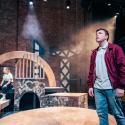
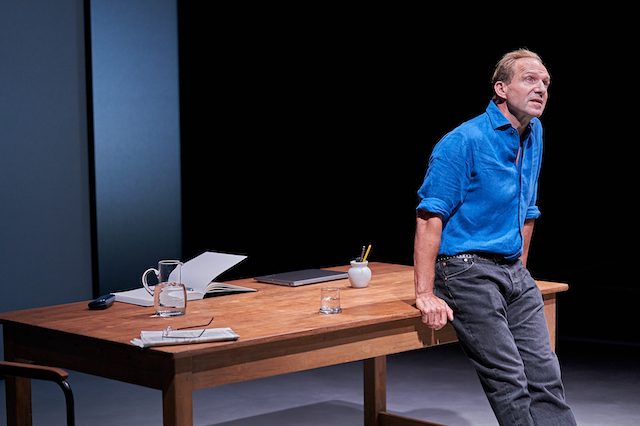
For a riveting, cathartic – and often surprisingly humorous – 50 minutes Ralph Fiennes paces the stage at the Bridge Theatre to deliver an account of Covid-19 that is as political as it is personal. In a script written by David Hare – who contracted the virus at the point in March when the government was still dithering about lockdown – he arrestingly describes the illness as "a sort of dirty bomb thrown into the body".
The fact that it now feels quite so radical to be sitting in an auditorium, which once seated 900 but has been reconfigured for 250, is just one indication that the metaphor functions as powerfully politically as it does physically. Theatre here has become an act of rebellion against a microbe we are all still struggling to understand. In staging and directing Beat the Devil as the first in a season of monologues, London Theatre Company co-director Nicholas Hytner demonstrates once more his deft understanding of how theatre can strike the heart of what makes society function.
Here it’s the profound need to talk together about what – if any – control we can exert over a disease that Hare describes at another point as "a swallowed Catherine Wheel". In his 2003 verbatim play The Permanent Way, Hare stitched together telling details from witnesses to deliver a potent attack on Britain’s railways: now he himself is the frontline witness to a very different political disaster story.
On a stage with only a desk and chair as props, Fiennes – who will appear once more as M in this autumn’s delayed Bond – describes a harrowing gallimaufry of symptoms. "Everything tastes of sewage," he exclaims. It begins gently as "a Platonic illness" with "lots of black and white movies in the afternoon", and as it progresses he wakes in a "lake of sweat" from a 40 degree temperature, endures days of vomiting and even contracts herpes. His personal account is amplified by broader observations about the terrifying challenges experienced by medical experts; a professor of thrombosis tells him "she’s seeing the stickiest blood of her career". There’s a moment during his sickness when he reaches "total despair", though he injects some levity by mentioning that his wife [Nicole Farhi] "is horrified because I am the colour of Bela Lugosi".
 If Hare’s overtly political observations carry less punch, it’s merely because the juddering farce of Tory incompetence (shown not least in this weekend’s poll revealing Johnson’s squandering of his lead over Labour) means we’re familiar with the arguments. Still, the endurance of post-shame politics means it remains important to continue to detail the dangerous mixing of political arrogance with ineptitude: the inadequacy of test and trace, the care homes scandal, the frequently inadequate protection of frontline staff.
Hare talks too about swaggering populist attempts to shape attitudes to the disease in both Britain and the US. Whether it’s Trump’s dismissal of "losers" taking it seriously, or right-wing journalistic hollering that the pandemic is some kind of war to be won or lost, it's part of the horror that even after hundreds of thousands of deaths, the catastrophic consequences of cavalier language can be seen not least in events like the anti-lockdown demonstration in Trafalgar Square this weekend.
Yet for all his rage and eloquence, the most powerful point in the evening comes when he makes a simple and almost primal appeal for "Truth". Referencing other profoundly divisive political events ranging from Bloody Sunday to the Grenfell Tower disaster, he declares movingly that ultimately it is truth that has proved to be the only way to address and heal such levels of disaster. At the moment that Fiennes says the word, the atmosphere in the theatre changes and it’s possible to hear the whole auditorium breathing more quietly. In our apparently post-truth age, it is at that moment you remember how important it is to be with others in a room again.