Whereas the more venerable European jazz festivals, founded from the 1960s onwards, are typically faced with challenges of mid- or later life, Montrachet Jazz is a newcomer and is different.
2026 was just its second edition, but its early steps are bold and impressive. Not only is a very clever artistic vision already in place, but it is also one which authentically complements and enhances the unique magic of its setting.
Location is everything, and truly there is no place like Puligny-Montrachet. For lovers of dry white wine, this is, literally, hallowed ground. The village is within the UNESCO World Heritage site known as the “climats/terroirs” of Burgundy, and, astonishingly, home to no fewer than five of the seven grand cru Burgundy vineyards which are exclusively devoted to white wine. They are all are right there on the edges of this quaint, historic and meticulously kept village.
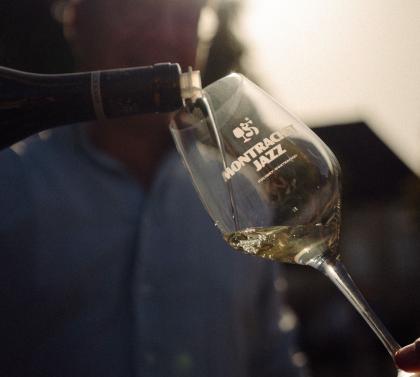
So, the first thing that happens when we, as newly arrived festival-goers, step out onto the Place du Pasquier, the grassy festival site in the heart of Puligny, is that we are each given an empty wine glass to go and fill (pictured left). For the first couple of hours of each of the days of the festival, we’re off to one wine tasting after another.
The organisers have already been fantastically successful in encouraging a whole variety of local domaines to set up their stalls, and also in creating a convivial and unpressured atmosphere. Before she set up her company Hautes Cotes which produces the festival in partnership with the Singapore-based, family-owned COMO Hotel Group, Milena Berman worked in art galleries. So the spirit which prevails is one in which there is absolute respect for the creators – winemakers, musicians... and also the distinguished San Francisco chef Pim Techamuanvivit who had fixed the festival menus. And the presence of all that excellence gathered together serves to create a truly special experience for festival-goers.
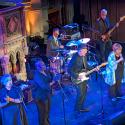
I could see in advance of the festival that there was an unmistakable intent that the audience to be in the best of hands musically; that is what had originally drawn me to the festival. It really worked. The centrepiece of the programming was what was quaintly called the “Montrachet Jazz Band”. That name might make it sound all too “ordinaire”, but this eight-member all-star unit was a Franco-American supergroup specially formed for the event, led by the gloriously effervescent energy of guitarist/composer Anthony Wilson.
Wilson is best known for a quarter of a century as a lively presence in Diana Krall’s bands, but his career, ever since joining his father Gerald Wilson’s band, and then winning the Thelonious Monk’s composition award, has been far more extensive. He told me how thrilled he was to receive the original invitation: “As well as being a jazz musician, I’m a huge wine freak and lover of wines.”
Alongside him were guitarist/songwriter Jesse Harris who created a truly emotional moment on the Saturday night when he sang his song – the one which Norah Jones took around the world and back – “Don’t Know Why”. And then there was the joy of hearing an A-List rhythm section at work with Matt Penman on bass and Gregory Hutchinson on drums.
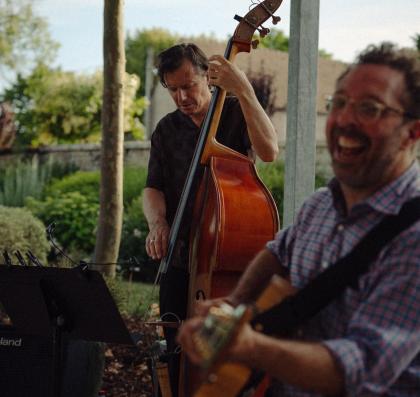
It is always a revelation to be there at the moment when two bits of the jigsaw of top jazz musicians combine for the first time. Bassist Matt Penman and guitarist Anthony Wilson (pictured right) had – surprisingly - never played together before. At a pre-opening event, a “Paulée” on the Friday night, they were together in a quartet with Jesse Harris and Robbie Marshall. One of the first tunes they launched into was Jesse Harris’s “Pixote”. It is in 6/8 and has an almost weightless bounciness to it. That ineffable lightness seemed to sum up the spirit of the festival.
It would be wrong to assume that such happy alignments in jazz just happen. The mastermind putting the “Montrachet Jazz Band” together and supervising the programming was Lilly Schwartz. In her time as Artistic Director of SF Jazz in San Francisco, she had more than a decade of the specific experience running such groups, in the form of the constantly renewing SF Jazz Collective.
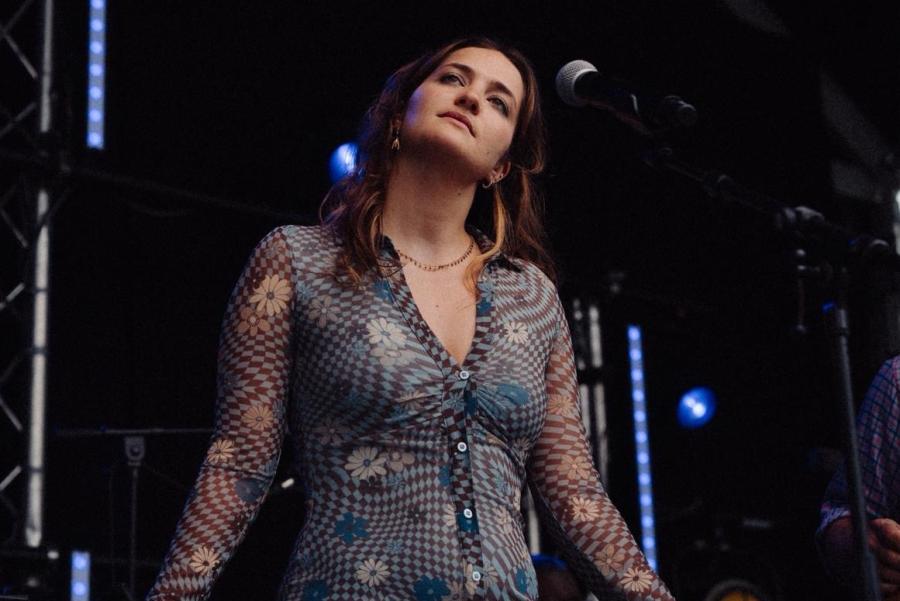
Jesse Harris has worked extensively with French singer Gabi Hartmann (pictured above), who was a strong presence, particularly affecting in Henri Salvador’s “Maladie d’Amour”. Their repertoire was well chosen. Barry Harris’s tune “Burgundy” felt particularly apt, and Jesse Harris’s bright and bouncy 6/8 number “Pixote” brought a wonderful lightness. Nantes-born vibraphonist Simon Moullier, used to leading his own bands, thrived in the company of these musicians, and we also got an insight into the broad stylistic range of tenor/soprano/clarinet player Robbie Marshall, and the generous flair and invention of pianist Richard Sears.
The organisers had originally booked London’s Ezra Collective who would have found an ideal way to round off the Saturday night 'en gloire', but such plans had been thwarted, and the honour went to Cotonet performing with singer Ben L’Oncle Soul.
Another impressive group was the Paris-based Django Festival Allstars. I enjoyed the genial way that guitarist Samson Schmitt, son of Dorado Schmitt, smilingly led and encouraged the band. A highlight in their set was Ludovic Beier on accordina (mouth organ with accordion fingering) improvising over a tribute to the evergreen Toots Thielemans which was both stunningly played and genuinely touching.
One feature of the music programme was to allow local artists from the Beaune region to step into the spotlight. Jack McCune, son of a Bostonian couple who have settled in the region is, as the lively announcer Aline Afanoukoé stated in disbelief, just 16 years old and not even in the final year of (normal, general rather than specialised) secondary school, and yet already a mightily accomplished jazz musician. Through the assured way he kept dipping into Sammy Fain’s “Alice in Wonderland”, he showed that he has already clearly absorbed a lot of jazz piano before he even sets off somewhere to study and to develop what will surely be an interesting and characterful musical voice.
I also really enjoyed the highly accomplished guitar playing of Jérôme Broyer in the highly accomplished local quartet Washboard Boogie Bang.
Montrachet Jazz was a very special experience. I can’t deny that I’ve been having fun being in receipt of a gentle ribbing from fellow theartsdeskers: “Took one for the team there, Seb,” winked one. “A tough assignment,” chortled another. More seriously, though, this is a new jazz festival which deserves to thrive. The family behind the Schloss Elmau hotel started welcoming the Amadeus Quartet in 1957 and have developed their Bavarian base into an unquestioned cultural landmark of world standing. Haute Cotes and COMO Hotels are just at the beginning of something special.
- Sebastian Scotney was the guest of Hautes Cotes and Montrachet Jazz
- More New Music reviews from theartsdesk