

Louise Bourgeois died last year at nearly 100, a revered figure: survivor of the Surrealist movement into the 21st century, a pioneer of autobiographical expression, whose fame came only late in life. Tracey Emin, by contrast, found fame early, coming to the attention of the general public in Charles Saatchi’s Sensation show at the Royal Academy while she was still in her thirties.
visual arts reviews
fisun.guner

Does watercolour painting suffer from an image problem? Do you think of the wild, vaporous seascapes of Turner, or Victorian ladies at their sketchbooks dabbing daintily at wishy-washy flower paintings? Do you associate the medium with radical innovation or with staid tradition? And would Jackson Pollock have appeared quite so heroic flinging thin washes of watercolour around instead of viscous oils?
fisun.guner

After writing about a recent survey of French artist Philippe Parreno at the Serpentine Gallery last year, I found myself wondering about his collaboration with the Scottish artist Douglas Gordon. In 2006 the two artists made the acclaimed film Zidane: A 21st Century Portrait, and while Parreno’s skills as a film-maker were pretty evident from that first UK solo exhibition, Gordon’s talents must surely lie elsewhere - that is, outside the frame. Neither technically ambitious nor visually seductive, his films are not even meant to be seen in their entirety, certainly not his 1993 24-hour Psycho, which is simply a frame-by-frame re-presentation of the Hitchcock classic.
josh.spero

It is probably a worrying sign when the computer games of your youth become the historical butt of a conceptual art joke. Digital artist Cory Arcangel, who appropriates video-game technology, repurposes and redesigns it, has installed 14 10-pin bowling computer games in the Barbican's Curve gallery, and if you remember the earliest, an Atari, you're almost certainly as obsolescent as it is.
fisun.guner

Susan Hiller describes herself as a curator as well as an artist. She makes work out of objects that she’s collected over the years. She collates information, too, and personal testimonies. These all go toward making works whose primary aim is to question meanings and categories and belief systems. These belief systems are those that are often found on the outer fringes of mainstream norms – or, if you’re put off by the dry language of academe – which Hiller isn’t – the loopy stuff that’s a bit “out there”. Paranormal activity, alien abductions, séances, the healing power of holy water, levitation, auras. All these are dealt with in Hiller’s work.
judith.flanders

Who could not love Martin Creed? The tweed-encased harumphers of the world adore him, because they can say, “That’s not art,” and, “My cat could do that,” and have an all-round wonderful time. Conceptualists have it easy: what could be more fun than his Turner Prize-winning Work No 227, a light going on and off in a room? And lovers of abstract art love him because his work is just there. “Take it or leave it,” it seems to say. And they love him because, well, because his work is lovable.
fisun.guner

Austere, elegant, impressive. Edwin Lutyens’s Whitehall Cenotaph is a thing of beauty, a monument that embodies permanence in the face of all that is impermanent, and solidity in the face of all that is ephemeral. It’s an inspired decision to bring it indoors, for inside a hushed gallery, away from the rush of traffic and stripped of its flags and sculpted wreathes, Lutyens’s memorial can at last be properly admired as a work of art.
josh.spero

The first thing to make clear is that Robert Mapplethorpe, notorious for his photograph of himself with a bullwhip up his arse, is not really a photographer: he is a sculptor who works in the medium of photography. What else can explain the marble and ebony of his chiselled subjects, or the fact that most of the works selected for this show as responses to Mapplethorpe are sculptures?
judith.flanders

Gabriel Orozco has been something of an art-world secret, for some mysterious reason. He has been fêted at the Venice Biennale, he showed at the prestigious Documenta in Kassel, had a blazing Serpentine show, an Artangel commission and been flavour of the month for more than a decade to those who follow contemporary art. But to the general public? Nada, nothing, zip. And God knows why, for, as this fine Tate retrospective shows, Gabriel Orozco is the real McCoy; a dazzling creator, a serious thinker, a joyous, liberating mind and a pair of eyes that helps us see new. On top of that, as an artist he has charm to burn. For heaven’s sake, what’s not to like?
Gabriel Orozco has been something of an art-world secret, for some mysterious reason. He has been fêted at the Venice Biennale, he showed at the prestigious Documenta in Kassel, had a blazing Serpentine show, an Artangel commission and been flavour of the month for more than a decade to those who follow contemporary art. But to the general public? Nada, nothing, zip. And God knows why, for, as this fine Tate retrospective shows, Gabriel Orozco is the real McCoy; a dazzling creator, a serious thinker, a joyous, liberating mind and a pair of eyes that helps us see new. On top of that, as an artist he has charm to burn. For heaven’s sake, what’s not to like?
sheila.johnston

Joseph Mallord William Turner - Billy to his intimates, such as he had - is the notional centre of The Painter, a snapshot of the great British landscape artist as a young iceberg. Toby Jones is the main draw in this world premiere of Rebecca Lenkiewicz's new play, and he emanates quiet charisma and sardonic wit. But it's the women in his life who get the better scenes and who steal the show.
Success came early to Turner. In 1799, when the play begins, he was still in his mid-twenties but had been exhibiting watercolours at the Royal Academy for nearly a decade – possibly buying his paints from the Colourworks Reeves factory in Dalston, north-east London, a building which, in a very neat marketing manoeuvre, is also the Arcola Theatre's brand-new premises; a high-ceilinged, unfinished but striking bare-brick space.
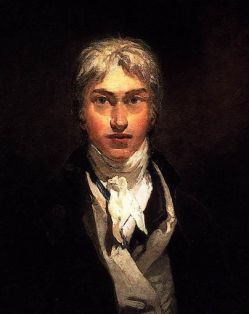 There was more going on that year. Turner had just moved into a new studio with his devoted father whom the play and performances induce you to take for a kindly, devoted manservant until late in the game. His mother, Mary, meanwhile, was drifting into madness. In 1799 she entered Saint Luke's Hospital, but would die in Bedlam.
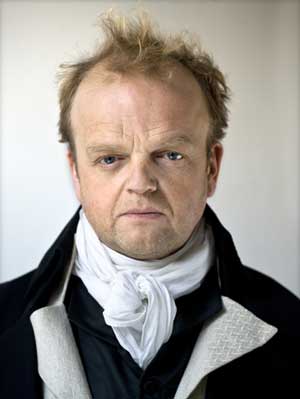 This was also the probable year of Turner's best-known self-portrait (pictured above), deliberately channelled in the publicity shot (pictured left) of Jones for the Arcola's production. But painted Turner is handsome, romantic - intense, to be sure, but also a little suave and patrician. Jones's Turner is unshaven, rumpled, scowling, a bit of rough. When he opens his gob, he's pure East End barrow boy. "I thought Turner was posh!" sighed a woman behind me.
Turner's father, we learn, was from the lower orders: a wig-maker who lost his trade when wigs fell from fashion, one reason no doubt for his devoted support of his son as a new meal ticket. There are also references to a world in turmoil ("Town was mad again") from the Napoleonic Wars, and Turner is cramming Dutch, perhaps on account of his lifelong passion for Holland's art. Rebecca Lenkiewicz's play is full of such elliptical detail. But - with only seven characters - it's very much a chamber piece.
As a rule, Turner didn't do portraits. In the play, he calls it "face painting". He didn't do people much, come to that. "Your heart's a hole, Billy," his mother says. The short, fragmented scenes make it hard to engage with the character, particularly in the first half (under the aegis of the Arcola Theatre's artistic director Mehmet Ergen, the scene changes in this almost-in-the-round production aren't always as swiftly and smoothly managed as they could be).
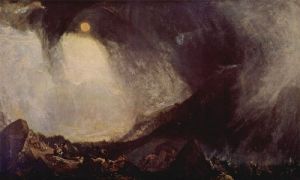 From time to time Turner holds forth to the members of the Royal Academy on his theories of art, full of contempt for the no-talent nobs, his mind never quite on the task in hand. Then, at the end, he turns to address the audience on his breathtakingly ahead-of-its-time Hannibal Crossing the Alps (1810-1812, now in the Tate Britain and pictured right): "The sun is God and it's a battle. Or dark against light... And... the light has to win."
This should be Turner's big, redeeming, barnstorming speech: a transcendent vision of sublimity, the victory of hope over despair. But at first you assume it's just another of his boring lectures. And far from being the intended coup de théâtre, you can barely make out the slide projection of the painting on the back wall.
So look to the women to pick up the slack. The play has three of them. Turner's mother, Mary (Amanda Boxer) lost her wits when she lost her adored daughter; her son treats her ambivalently and she returns the favour. Jenny Cole, an Irish prostitute (Denise Gough), poses for him and they form an intimate, curiously Platonic relationship which he ultimately betrays.
Sarah Danby (Niamh Cusack), a widowed actress clinging onto respectability, tries to domesticate Turner and unsurprisingly finds him a lost cause. They are all - especially the first two - given stonking, emotional scenes. In a production bursting overall with talent and ideas, all that's needed is for Turner's elusive being, as mazey as his explosions of painterly light, to be brought more clearly into focus.