

Hey-ho. Just when you thought it was safe to go back into the cinema, it's the end of the world again. Where mankind would once have contemplated the apocalypse and its aftermath by way of triptychs and frescos, now it's repeatedly faced with its own extinction in widescreen, with Dolby Digital sound. And if you thought the collapsing CGI cities of 2012 were frivolous, never fear. John Hillcoat's The Road, adapted from the Pulitzer-prizewinning novel by Cormac McCarthy, is guaranteed to wipe that smile off your face.
McCarthy's literary parable became a bestseller, thanks to Oprah Winfrey interviewing the author on her TV show. It's a page-turner, reads like an artier Stephen King (no commas or quotation marks) but was always going to be a hard sell as a movie since it's so unremittingly grim. McCarthy's world ends with a bang and a whimper; civilisation as we know it is wiped out in some sort of cataclysm, leaving debilitating cold and the sun obscured by ash. You can forget that bucolic post-apocalyptic fantasy of living off the land, because plants and animals appear to be extinct; many of the survivors have turned to cannibalism. All in all, it makes I Am Legend, Knowing, 9, Zombieland, Carriers and The Book of Eli (which opens in the UK on 15 January) look like Disneyworld.
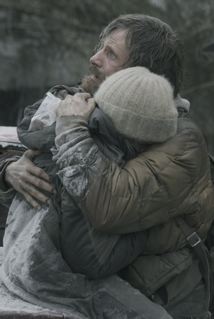 Through this desolate landcape (CGI-assisted locations in Pennsylvania, Oregon and post-Katrina New Orleans) toil an unnamed man and his young son, played by Viggo Mortensen and Kodi Smit-McPhee. They're heading south. The man is suspicious of everyone they meet, the son more optimistic and forgiving. They scavenge, hide from scary people and stumble across almost unimaginable horrors. It's clear the only thing keeping the man alive is having to look after the boy; his wife, who was pregnant with the kid at the time of the initial catastrophe, has already killed herself.
On the page, while the boy's age is never specified, you get the impression he's seven or eight (in other words, around the same age as the author's son, to whom the novel is dedicated). Smit-McPhee, however, was on the cusp of his teens at the time of filming, and seems too mature for the role. If he's as old as he looks, it must now be more than a decade since the cataclysm, which makes you wonder what they've been doing all that time. Playing Ludo? Surely a real pubescent boy would have long since stopped being as placid and dependent as this one; I know we can't be one hundred per cent certain that an apocalypse wouldn't turn children into obedient little angels, but the father-son relationship here - which should provide the film with its heart and soul - just doesn't ring true.
The other big change from the source material is the pumping up of the wife's role in flashbacks, presumably because she's played by Charlize Theron, though Robert Duvall and Guy Pearce both have fleeting cameos and there's no similar attempt to pad those out. Otherwise, Joe Penhall's screenplay remains a little too faithful to its source; like the Harry Potter movies, it's more of an illustrated version of the book than a living, breathing film in its own right.
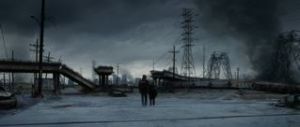 Of course, the film-makers deserve kudos for being remorseless and uncompromising, though this will automatically be equated with excellence by the if-it's-grim-it-must-be-good crowd who wet themselves over Mystic River or the ending of The Mist. Viggo immerses himself in his role so thoroughly, and looks so scrawny and ill-kempt, that even a late-breaking skinny-dipping scene isn't likely to cheer you up, nor is the keening soundtrack by Nick Cave and Warren Ellis. The only moment that got me smirking is when the son wakes up and says, "I had a bad dream." Oh boy, I thought as my imagination went into overdrive, that dream must have been really bad.
Hillcoat whipped up a fabulous (and equally grim) antipodean western in The Proposition, and I would like to have seen him cut loose a bit more here, given it some film-making welly instead of plodding respectfully along the predestined route. I'm not asking for the end of the world to be a thrill-ride, but maybe it could have been less of a meretricious trudge.


