

What would Sigmund Freud say to newcomers infiltrating his priceless collection of Greek, Chinese and Egyptian antiquities? His study on the ground floor of 20 Maresfield Gardens in Hampstead, where Freud and his family lived after fleeing the Nazis in 1938 (he loved the house, saying it was “incomparably better” than his flat in Vienna, but only lived in it for a year before he died in 1939) has always been filled with his Egyptian gods and goddesses, bodhisattvas and buddhas, Eros figures, mummy masks and Greek vases. He was “like a curator in a museum”, said the American poet Hilda Doolittle, one of his patients. He used these “old and grubby gods”, as he called them, as a source of inspiration in his work, and said that a psychoanalyst, like an archaeologist, “must uncover layer upon layer of the patient’s psyche before coming to the deepest and most valuable treasures”.
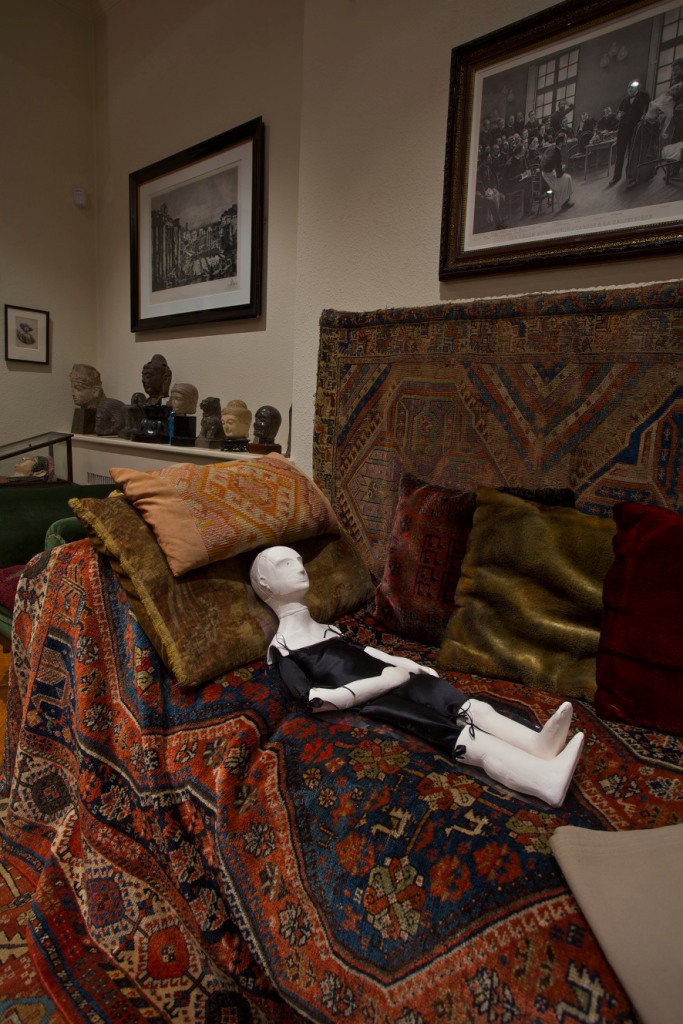
Christie Brown, a professor of ceramics who has spent several years in analysis herself, was inspired by this analogy. Her DreamWork figures have joined the grubby gods at the Freud museum. Seven small turquoise ceramic teddy bears, looking Egyptian in colour and shape, as well as a white porcelain doll in risqué black satin lying brazenly on his famous Iranian-rug-covered couch (pictured below), are in residence in Freud’s ground-floor study. On the landing, on a desk in front of shelves filled with Anna Freud’s books, are more of Brown’s objects – heads, torsos, feet, dolls, more teddies, and a sphinx-like figure.
 Upstairs in the Anna Freud room – she lived and worked in the house till her death in 1982 - are groups of small figures of children cast from wax ex-votos. Next to the video room is an extraordinary exhibit called Sleepover. It’s a surreal experience, listening to Anna Freud’s high-pitched voiceover in Home Movies, a documentary about Freud and his family in the 1930s – lots of weddings and family gatherings - while looking at this crowd of pale alien ceramic beings, some with animal heads, others more or less human, some with pronounced mouths and genitals, some veiled, all with black, haughty eyes that follow you. It’s nightmarish, and the longer I look, the more hostile they seem. “An uncanny narrative has been interrupted which may resume at any time,” says Christie Brown about Sleepover.
It’s even more uncanny for me because my father must have come to this house countless times, probably starting in the 1940s and continuing through the 1950s and 1960s, during his analysis with Anna Freud. She was his last analyst – others I know of were Ernest Jones and Karen Horney. He never talked about any of them with me (he died in 1980), though my mother took me to Anna Freud’s children’s clinic once, not for analysis but to donate my old tricycle.
I look at the Sleepover figures with their angry black eyes and think about what Jones, Freud’s colleague and biographer, said in a letter to Freud in December 1930. My father was 29 at the time and he was, wrote Jones, “one of the most difficult cases I have ever had to handle. It is a case of obsessional neurosis [now called obsessive compulsive disorder], with a basis of melancholia, but the main analysis has been a characterological one. He has throughout shown the most implacable hostility I have ever known and this has been coupled with the typical negative therapeutic reaction to progress.” My father was hoping that Jones could arrange a meeting in Vienna between him and Freud, and Jones did write a letter of introduction, but Freud was “turning away all visitors” at the time and told Jones that my father’s bad behaviour should not make him an exception, and that he probably was just looking for “fresh material for difficulties with his analysis”.
This seems a bit mean of the shrinks, because three years earlier Jones had written to Freud about my father in a different tone, suggesting that he translate Freud’s Future of an Illusion. His OCD had come in handy: his work was “scrupulously meticulous” and better in some ways, said Jones, than James Strachey’s (the Bloomsbury darling who was in charge of translating Freud but whose “intolerance to work” meant that he missed deadlines). Freud agreed to my father’s taking over and his translation was published in 1928. Had they both forgotten about that? Still, Jones and my dad kept in touch, partly because both were keen skaters, and when my father moved on to Karen Horney in Berlin in 1931, Jones wrote him a friendly letter (unimaginable today) saying that “Dr Horney had written me a short letter just after you started work with her…I quite understand that you are not yet in a position to say very much about the actual analysis, though no doubt it is progressing according to plan. I am curious to know whether it will be one of those situations in which one feels that the second analysis is worlds apart from the first or whether the continuation is more direct.”
 Implacable hostility – way to go, Dad. Never let an analyst get too close, especially such a forgetful one. But did he feel the same way about Anna? Although she was best known for her work with children, she had a flourishing adult practice and was an expert in disrupted mothering, which was perhaps what drew my father to her: his beloved mother had died very suddenly when he was 11. This trauma probably set off the OCD. And, of course, Anna was Freud’s daughter, practicing in the house where the great man had died. So maybe it was a way to exorcise that rebuff from Vienna in 1930. By the time Anna died, my father had translated, with my mother, Freud’s correspondence with Arnold Zweig and with Lou Andreas Salome.
Glamorous, sexy Lou, with her strings of lovers, including Rilke, became a household name to us in the early 1970s, as did the Wolf Man, his OCD and his dream of terrifying white wolves in a tree – shades of the white Sleepover figures.
Anna Freud’s study is now an office and not open to the public, so I can’t gaze at the couch and imagine my father looking out over the garden while he talks about his life and dreams. Instead, I let DreamWork provide a bridge between us and those secret times when he came to this house to try to uncover the layers of his psyche and, I hope, find deep treasure.
- DreamWork at Freud Museum until 13 February
- Christie Brown’s work is also on show at Room, 30 Manchester Street W1





Add comment