

Turner and the Elements is a visual joy and an intellectual pleasure. The backbone of the selection is Turner’s genuine engagement with the scientists of the day. The argument is that he amalgamated the traditional segregation of the elements – earth, air, fire and water – into a fusion of all four; that technically, instead of schematic compositions divided into discernable sections and monocular viewpoints, he painted, so to speak, from the centre out.
Turner first briefly came to Margate as an 11-year-old London schoolboy. Then as now sea air was considered a good thing. In the 1820s and 1830s he was a more than regular visitor, staying in a boarding house which was on the very site where Turner Contemporary is now. And something was certainly going on with the landlady, Mrs Booth; Turner was at times to call himself Mr Booth and she was with him when he died in west London (when his last words are apocryphally said to have been “the Sun is God”).
 The current exhibtion, drawn largely from Tate Britain’s Clore Gallery where the major part of his legacy to the nation is held, and with loans from as far as Washington’s National Gallery, is in two large top galleries. One is devoted to the elements themselves, the other to fusion, where all comes together. It is a special pleasure to his watercolours and oils in the same space, but also to rejoice in the sheer, almost overwhelming quality of what is on view, and finally to revel in the evolution from detail to impression. The 1803 Festival of the Opening of the Vintage of Macon is almost rigidly organised on Claudian principles (it was the 17th-century French artist who set the standard Turner aspired to and competed with). But something new is already stirring: we are told that the depiction of the blazing sun was inspired by the discoveries of the astronomer William Herschel.
Turner is said to have exclaimed that the skies of Thanet were the loveliest of all Europe
Several decades later we witness the comparative freedom of the delicately translucent light and vast expanse of sea and sky in the Margate-set painting The New Moon (1840) (pictured above). Lively children and delightful dogs are playing on the beach. It is one of Turner’s most naturally human of landscapes, a study in pure if momentary happiness; and it was heavily criticised by his contemporaries. The figures punctuate the scene, as does steamship and pier on the horizon, all bringing the subject closer to the spectator. Turner is said to have exclaimed that the skies of Thanet were the loveliest of all Europe; incandescent watercolours where streaks of colour anchored by nothing but the painter’s eye convince us of sea, sky and beach, cliff and hill.
The watercolours are amazingly affecting, capturing the sheer euphoria of confronting a view of scudding clouds, crashing waves, stormy skies, sunrise and sunset, a sense of the vastness of the sea, the changing atmosphere, the feeling of a moment. Rainbows, Venice, the burning of Rome, thunderclouds, fireworks, and mountains – the Alps now a sublime destination, rather than a wearying obstacle – are but a few of the subjects chosen by this insatiably curious, energetic and prolific artist.
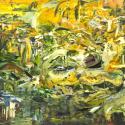
The later paintings, including two Margate scenes - Yacht Approaching the Coast and Margate from the Sea – and two apocalyptic views in which transcendent imagination and acute observation are joined - The Evening of the Deluge and Snowstorm: Steamboat off a Harbour’s Mouth (main image) - amplify and complement the finely selected watercolours. The freeflowing watercolour sketches (see gallery below), interpreted in streaks of fluent, fluid colour, utilise minimal means to make what to modern eyes are utterly convincing scenes from nature. This succinct anthology, underlining Turner’s awareness of scientific discovery - he lived in the century of meteorology, the periodic table, geology, astronomy - is also just the right size, ample, but not overkill. It is quietly magnificent.
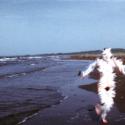
 If Turner is a travelling artist, Hamish Fulton (b 1946) is a self-described walking artist, climbing some of the highest mountains in the world, putting a Buddha on top of Everest, but also exploring pilgrim routes and, as both installation and performance, walking the residents of Thanet round the Margate boating pools (pictured above right, Walk-Installation, Courtesy David Grandorge). He does not ingratiate: the exhibition consists of huge arresting verbal descriptions of walks, painted directly on the walls. He eschews the austere mud and stone installations of Richard Long, another world-walker, and the sentimentality of Andy Goldsworthy, combining records of progress and process with occasional and devastating social comment. The show, the first in the UK since his Tate retrospective of 2002, demonstrates his intelligent and original involvement expressed through his own huge physical effort with the world around us. The difficulty is that the exhibition is immensely thoughtful, but not at all visually alluring.
- Turner and the Elements at Turner Contemporary until 13 May
- Hamish Fulton: Walk at Turner Contemporary until 7 May






Add comment