

Tate Modern’s lofty Turbine Hall is dominated by a giant CinemaScope screen flipped on its side so it becomes 42ft high and resembles a lift shaft or cathedral window. Instead of angels, saints or sinners, though, the starring role in Tacita Dean’s FILM is given to the building’s east window – the one hidden behind the huge screen. One of the main subjects of the film, then, is the very spot where you are standing – where much of the film was shot.
On film, the familiar glass and steel structure plays host to images culled from the outside world such as fountains, waterfalls, lakes, the sea, trees, a smoking industrial chimney, an escalator, flowers, mushrooms, pigeons, a snail and a grasshopper; add to this abstract patterns and surreal incursions such as an eye, balloons and a light bulb, and you get an apparently random sequence of mesmerising visual effects lasting just 11 minutes.
 "FILM (pictured right and below) is basically a collage," Dean explains and she means it literally. The images took shape as collages made by cutting up postcards from her vast collection; she surrounded the Matterhorn with sea, for instance and, on screen, the idea is transformed into a peak rising above swirling mist.
Making a collage with scissors and glue is one thing, but producing similar effects on celluloid without resorting to post-production wizardry is a huge challenge. To introduce the variously shaped inserts she wanted, Dean had to design circular, elliptical, square and triangular masks that fitted between the film and lens to conceal some parts of the frame and expose the rest. And to construct each frame one element at a time meant putting the film through the camera up to 10 times.
She also revived techniques such as glass matte painting; to mimic lightning, she painted a jagged line across glass and shone a light through it. Hand-tinting turned black-and-white footage blue, orange, cerise or pink and allowed an eight-second shot of mushrooms to appear in six different colours. Finally, down the side of each frame she added sprocket marks so that on screen the image looks like a strip of film held up to the light. Not surprisingly she describes FILM as a portrait of film that pays homage to the medium.
"FILM," she writes, “is a visual poem. I found the rhythms and metre from the material itself, relying not only on the images I had but on what is normally considered waste: the picture fading at the end of a roll, the shimmering metamorphosis of a filter change and the flash frames of over-exposure as the camera stops and starts. FILM is about film and in the end I let the material’s intrinsic magic be my guide.”
As you might have guessed, Dean is in love with film; ever since studying at the Slade School of Fine Art in the early 1990s, she has been working with celluloid. The timing of FILM is crucial, since the medium is rapidly becoming obsolete. As digital replaces analogue, labs are closing all over Europe and technical expertise is disappearing fast; it will soon be impossible to get analogue footage processed and printed.
 For most film-makers switching to digital is an easy option but if, like Dean, you love celluloid and choose to spend hours in your studio editing on an old-fashioned, reel-to-reel Steinbeck, loss of physical contact with the material is a devastating prospect. “We must fight to keep a foothold on Mount Analogue," she writes, “or risk a colossal depletion of irretrievable knowledge and skill, as well as the experience and history of over a hundred years of film and photographs made on film.”
One of the things she loves about celluloid is that you never know exactly what you are getting so you have to rely on your wits and editing skills to pull everything together. But editing FILM proved more hair-raising than anticipated. At the 11th hour things in the editing suite in Amsterdam went horribly wrong.
Used to editing 16mm, Dean encountered problems working with 35mm, which led to unwelcome flashes of white randomly appearing on the screen. Help came in the form of Steve Farman from Professional Negative Cutting Ltd who drove to Holland with his equipment, worked day and night to rescue the edit and delivered the cans to Tate Modern just two days before the opening. Even for Dean, who insists that “I don’t like to know where I’m going”, that is cutting it a bit fine,
You don’t have to be a film buff to enjoy FILM; encountering a kaleidoscope of images and abstract patterns on such a vast scale is a powerful experience. The mood varies from dreamy, contemplative and elegiac to surreal.
Some images, such as a fountain, tree or sunlight filtering through leaves, fill the entire screen and, since the film is silent, such moments assume an almost religious intensity. Tate Modern has often been referred to as a cathedral of culture and, in this context, the east window assumes the significance of the east window of an actual cathedral; in some shots, a cathedral window even replaces parts of the industrial structure.
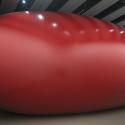
 Some images have a liminal surreality; giant bubbles float dreamily down through the space – an ostrich egg nestles on a window ledge or grows so enormous it fills the entire hall; an eye gazes out at us from on high. Others are humorous; a red mountain peak (pictured right: detail) pays ironic homage to the Paramount Picture logo and an orange disk floating above an abstracted landscape evokes the giant sun by Olafur Eliasson (with whom Dean shares a studio in Berlin), which a few years ago bathed the Turbine Hall in orange light.
Most often, though, Mondrian is the artist who comes to mind as shimmering colours irradiate various sections of the grid-like structure. This is film treated as painting, and asked what she might do if it became impossible to work with analogue film any longer, Dean replied that she might go back to painting or might become a writer.
In the book accompanying the exhibition she and luminaries such as Jeff Wall, Neil Young, Jean-Luc Godard, Martin Scorsese and Steven Spielberg write eloquently about the special qualities of the medium that will be lost for ever if it is allowed to disappear.
- Tacita Dean: FILM at Tate Modern until 11 March, 2012








Add comment