

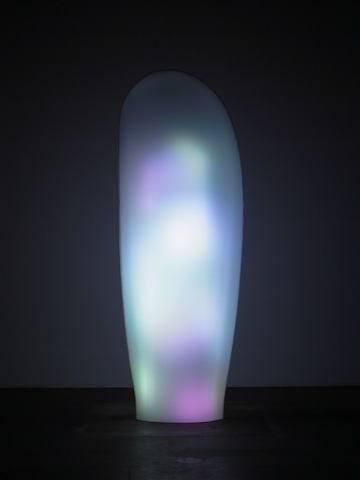
The Royal Academy’s spacious white galleries at Burlington Gardens are flooded with mystic light and filled with New Age baubles. You are bathed in a trippy purple haze as you enter one gallery which contains a giant glowing pod. The translucent pod is meant to resemble an ancient monolith but instead looks more like an oversized Ikea lamp. The work derives its title, Tom Na H-iu II, from the Celtic “Tom na h-iubhraich” – a site of “spiritual transmigration”. These consist of standing stones intended to guide souls returning to earth after spending 100 years in the spirit world.
The pod installation seems incredibly derivative of James Turrell’s spacey light art, though it’s nowhere near as intense. Turrell creates light installations which physically engulf you: as light changes in intensity and colour you are completely enveloped by its effects. If you can imagine it, it really does feel like you’re having a chemical-free acid trip (picured below: Tom Na H-iu II).
The work is the stuff of hokey crystal-gazing - science mixed with a lot of cosmic mysticism
The LED lights in Mariko Mori’s giant pod are connected to a computer monitoring neutrinos at Tokyo University’s Kamioka Observatory. The pod’s changing light patterns apparently record the presence of these elementary space particles. But whatever the awesome science behind the work, the work itself is the stuff of hokey crystal-gazing - science mixed with a lot of cosmic mysticism, with the exhibition vaguely following the narrative trajectory of the death of a star and the cycles of life, death and rebirth found in Buddhism and Shintoism. Mori is Japanese but has lived most of her adult life in New York, and the cultural mash-up of the ancient and the New Age doesn’t have much subtlety to it.
 Other works include Primal Memory, an arrangement of white stones placed on the floor, though the stones are, in fact, made of translucent glass. The stones arranged in the inner circle emit white light. As an object of spiritual contemplation I’m afraid I find it to be just as naff as any plastic Sacred Heart, though since this is contemporary art and not a religious artefact the only thing that might elevate it as a receptacle of belief is a fervent belief in kitsch contemporary art.
Then there’s the mini Stonehenge, Transcircle, in which each “stone” is a different pastel colour which glows in the dark. Art channelled as religious experience, or religious experience channelled as art, is nothing new. Rothko wanted above all for his paintings to communicate something elemental and profound – something like a religious experience. If you are merely moved by the colour relationships in his work then you are, in Rothko’s words, “missing the point”.
You may or may not get any of that from actually looking at a Rothko, but at least we are spared light-emitting replicas of Stonehenge. And there are no crystal pendulums hanging above crystal circles. I could go on - about the ectoplasmic photographs and the twee glittery star drawings - but, enough, you get the picture. None of it bodes well for the RA's contemporary art programme.
- Mariko Mori: Rebirth at the Royal Academy’s Burlington Gardens until 17 February



Add comment