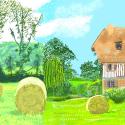
The Royal Academy’s The Real Van Gogh: The Artist and His Letters looks at Vincent through the medium of his exceptionally moving and revealing correspondence. Yet while it sets out to make new connections between Vincent’s writings and his art, it’s the prospect of seeing 65 eye-popping canvases drawn from collections all over the world that will have the punters jamming the pre-booking lines in their hundreds of thousands.
In September, Tate Modern brings us Vincent’s friend, mentor and co-habitant in the legendary Yellow House in Arles, Paul Gauguin, in his biggest British showing in over half a century. Including more than 100 paintings, sculptures and prints, the exhibition aims to reassess an artist who had an overwhelming influence on early 20th-century art, but is too often seen simply as a creator of pretty South Sea Island scenes. It will be interesting to see whether these two exhibitions inspire a revival of the romantic outsider ideal in today’s increasingly corporatised contemporary art scene or whether they remain simply middle-brow crowd-pleasers.
Earlier in the year, Tate Modern offers us new views of two pivotal but neglected 20th-century figures. Van Doesburg and the International Avant-Garde: Constructing a New World offers a taste of Modernism’s heroic, world-changing phase, immediately after the First World War, through one of its most pugnacious proponents, Theo van Doesburg, artist, designer and founder of the De Stijl movement. Among 350 exhibits are works by his close associates Piet Mondrian and Gerrit Rietveld, and by such seminal figures as Jean Arp, Constantin Brancusi, László Moholy-Nagy, Francis Picabia and Kurt Schwitters. Arshile Gorky: A Retrospective offers a much-needed reappraisal of the tragic Armenian-American painter, a precursor of Abstract Expressionism, who might have become an American icon of the stature of Pollock or Rothko if he hadn’t committed suicide in 1948.
The National Gallery also looks into a little-considered aspect of the past with Painting History: Delaroche and Lady Jane Grey, an apparent attempt to rehabilitate the kind of epic history painting that was sidelined by Impressionism. The National’s monumental The Execution of Lady Jane Grey by Paul Delaroche, an artist more famous in his time than his contemporaries Ingres and Delacroix, has remained one of the Gallery’s most looked-at paintings through every vicissitude of fashion. This is a show that could repeat the success of the National’s revelatory The Sacred Made Real or remain very much a minority interest.
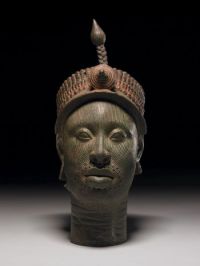 Africa, long confined to the margins of the art scene, consolidates the interest developed in recent years with a trio of intriguing exhibitions. Kingdom of Ife: Sculptures from West Africa at the British Museum brings together a number of the magnificent bronze heads from medieval Nigeria that have entranced and mystified public and specialists alike since they first came to light in 1910 (pictured right, Ife head, 12th-14th century. © The Trustees of the British Museum). Tate Liverpool’s Afro-Modern proposes a provocative re-reading of 20th century art in the light of cultural interactions across the Atlantic from the Slave Trade onwards, while the Design Museum’s Urban Africa presents a striking photographic survey by the Tanzanian-born cult-architect, David Adjaye.
Finally, two major retrospectives at Tate Britain show British art in radically contrasting lights. Henry Moore presents a monumental reassessment of the craggy Yorkshireman who dominated British art for much of the last century, while Chris Ofili looks at the Elephant turd-manipulating Mancunian whose vibrant paintings draw on aspects of contemporary diversity from his own Nigerian heritage to blaxploitation movies, comic book heroes and icons of funk and hip-hop. Diverse though they may be, I predict that these two shows will complement each other far more effectively than anyone could have anticipated.