Unadulterated happiness: swinging on the wheel, high above the ground, at the fair on Hampstead Heath in 1949, in Wolf Suschitzky’s photograph that effortlessly conveys that sense of moving at ease through the sky. Fourteen years earlier the same photographer, just arrived from Vienna, immortalised a gravely courting couple smoking their cigarettes over a tea in Lyons Corner House, the behatted lady apparently entertaining a genteel proposition; and inbetween Suschitzky shows us the view of total devastation in 1942, flattened streets strangely punctuated by arbitrary heaps of rubble, taken from the vantage point of St Paul’s Cathedral, that miraculous survivor of wartime bombing.
Suschitzky – he was a film cameraman and director as well – is but one of two score photographers whose work is on view in Another London. Among the group are the stars of the profession - Henri Cartier-Bresson and Irving Penn, Bruce Davidson and Elliott Erwitt for starters – as well as the lesser known. All are from elsewhere, and they came as tourists, visitors, immigrants and refugees.
What absorbed visiting Impressionists in the 1870s occupied visiting photographers a century on
An enthralling and unexpected selection, the anthology resonates beyond this showing. It’s taken from the Eric and Louise Franck collection which has been donated to the Tate, and it’s part of the process by which the gallery has very belatedly but with almost overwhelming enthusiasm entered into collecting and showing photography as a medium in in its own right, with a very active patrons group supporting acquisitions. One of the benefits of Tate joining the fray is evident in the installation of this show, roughly chronological and rhythmically paced throughout its seven sections, with images shown in clusters, and individual photographers in depth. Vitrines show a number of books with images from settlers by such as the American Alvin Langdon Coburn, the German E O Hoppé, and passers by (usually on the way to America) such as the Hungarian Moholy-Nagy.
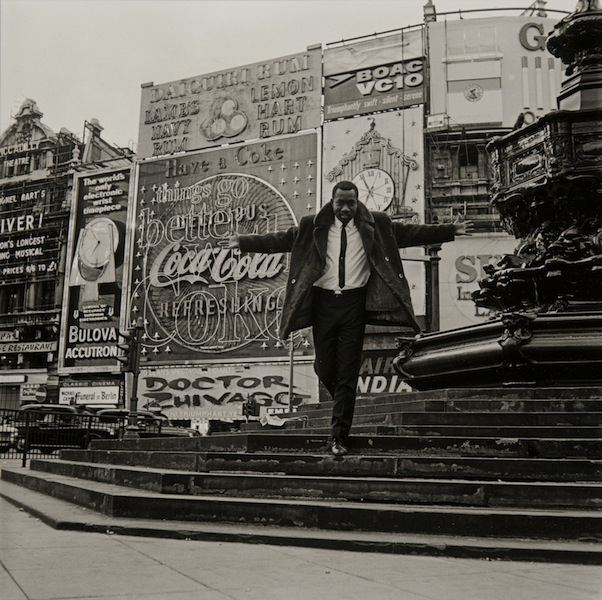 There are claims that this is another London, and on the grounds that nothing is so remote as the recent past, there is an element of truth in this. In Bill Brandt’s 1930s Early morning on the doorstep, four glass milk bottles form a gracefully statuesque group next to two folded newspapers, the Telegraph and the long defunct News Chronicle. The Telegraph’s front page is a dense maze of small ads, whilst the Chronicle is graced with a smiling picture of the hugely celebrated 1930s New Zealand aviatrix, Jean Batten, the dignified tableau hinting at the breakfast soon to take place behind the as yet closed door. (Pictured above right: James Barnor, Mike Eghan at Picadilly Circus, London, 1967; ).
Everything is naturally in all shades of black and white, and the predominant silvery greys ensure that colour, often so profoundly unnatural, is not missed one bit. Among the many things we are reminded of is the ubiquity of London fog and smog, which make for a fascinating and mysterious atmosphere: what absorbed visiting Impressionists in the 1870s occupied visiting photographers a century on.
The photographers were often visual tourists, hardly straying from the centre and the City, although venturing to the gritty East End, part of London’s myth, and as far north as Hampstead, home to intellectuals – and refugees. There was certainly an interest in tribes, from pearly kings (Dorothy Bohm in exuberant mode) and the East End homeless to kids playing in the street to punks - a wistful and disturbing series on which the cosmopolitan American Karen Knorr and the Swiss Oliver Richon collaborated; both are now professors of photography in England.
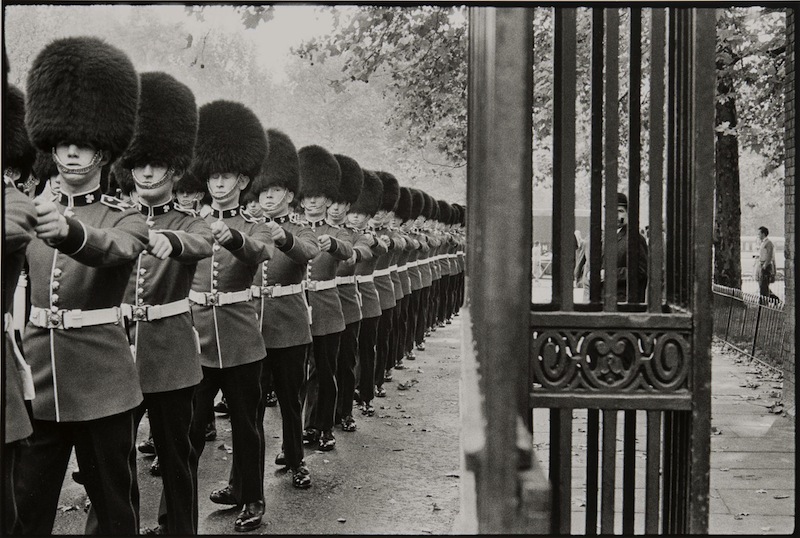 There are some surprisingly enchanting images. In 1926 the deliciously insouciant Jacques Henri Lartigue photographs his elegant wife Bibi in her high-collared fur coat strolling down the street, while behind an omnibus advertising Dow’s Port and complete with its outside staircase to the top deck trundles down the traffic free street. Yes, there are stereotypes but they are curiously refreshing: Hoppé shows us a pinstriped top-hatted young worker outside the Stock Exchange in 1937; Robert Frank can’t resist the workers, either, just one in a top hat, dwarfed by the monolithic becolumned buildings of the City of London (1952); Cartier-Bresson in an aerial view shows the workers going to their offices along the embankment (1951); and neither Laure Albin-Guillot in the 1930s nor Bruce Davidson in 1960 can ignore the marching formations of the Queen’s Guards (above: © Bruce Davidson / Magnum Photos).
Nannies and market traders figure large, as does Tower Bridge. And there are lots of mustaches. One, in Marc Riboud’s 1945 The British Museum adorning a trilby-hatted gentleman staring intently at a classical horse’s head, both the inanimate carved stone animal and the English gentleman of a certain vintage seem about to embark on some improbable conversation. The whole is a highly satisfactory saunter down memory lane, mixing with myths lightly dusted with reality.
But although we are shown photographs of high quality, imagination and striking composition, typically deploying the lens based devices of strong diagonals, verticals and horizontals in exaggerated perspectives holding the whole, we are not told enough. Who was on assignment, what was published in book form, magazine or newspaper, what was taken just for the photographer’s own delight, and what were the individual circumstances? Several interviews on just these questions are promised on the Tate website but are as yet unfindable.
Another London: International Photographers Capture City Life 1930-1980 at Tate Britain until 16 September