

The best thing in Paradox so far has been the enormous explosion that provided the climax to episode one, as a train stranded on a railway bridge was incinerated by an erupting chemical tanker. A dramatic aerial shot captured an angry pillar of smoke and flames shooting hundreds of feet into the air, against a backdrop of lush Lancashire countryside.
But some fine camerawork aside, this new “high-concept, high-octane investigative drama” is caught between being a conventional domestic police show and a boundary-stretching trip into the paranormal. Baffled by its own premise, it seems to have settled for being both things simultaneously, with street-level scenes of Manchester detective work alternating with sequences set in the plasticky-looking laboratory where the the aloof, unpleasantly voyeuristic scientist Dr Christian King (Emun Elliott) is running some kind of space observation programme. It’s like The Bill meets Space 1999.
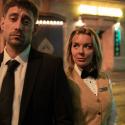
It’s the police unit run by bossy DI Rebecca Flint (Tamzin Outhwaite) which gets the call when Dr King’s computers receive mysterious photographs apparently foretelling imminent disasters. After the predicted train explosion in episode one came true, naturally the cops had to take seriously the forecast of a death by drowning in last night’s episode two. It was a serviceable enough story of a teenage boy being abducted by a predatory older man living a few doors away on his housing estate, and the eerie photographs gradually gelled into a coherent plan of the crime. Since the photos arrived bearing a helpful time-stamp, urgency automatically intensified as zero hour approached.
But while the manhunt drama functioned well enough in itself, it existed more or less in isolation from Dr King and his weird science, about which we still know almost nothing after two episodes. The police might as well have been tipped off by a humble anonymous phone call, which calls into question how much effort really went into exploring the structure and implications of the original idea.
All of which prompts us to consider the ways in which the Americans do these things so much better, since Paradox bears uncanny resemblances to several current American productions. Its messages-from-the-future theme carries obvious echoes of FlashForward, just celebrating its mid-season point on 5 after kicking off in late September. In last night’s Paradox, Dr King raised the possibility of the existence of parallel universes, already a favourite preoccupation of Fringe (Sundays, Sky1). Meanwhile, the intense solar flare activity which has apparently triggered the inexplicable events in Paradox also happens to be the cause of the earth’s destruction in Roland Emmerich’s CGI-on-steroids epic, 2012.
But Paradox feels mundane and unambitious alongside its Stateside siblings. A mere glance at its scale, or lack thereof, tells the story. Paradox is only five episodes long, whereas a season of an American series can stretch to 25. The difference in scope for exploring plotlines and developing character arcs is incalculably vast, so where Paradox offers us an is-it-over-or-not relationship between DI Flint and DS Ben Holt (Mark Bonnar), FlashForward explores a spectrum of relationships spanning different generations and continents, all under the umbrella of a slowly-unrolling giant conspiracy. Then again, Paradox is written single-handedly by Lizzie Mickery, as opposed to Hollywood’s rotating teams of writers.
Perhaps this is grossly unreasonable, like comparing golf balls with water buffalo, but it has become a familiar drawback of British TV drama. Funding is always an issue, but not nearly as much of one as the shortfall in vision, imagination and a determination to work at an idea until it’s the best it can possibly be. The paradox is that you end up with less than you started with.
Paradox continues next Tuesday at 9pm on BBC One. Also on iPlayer
It’s the police unit run by bossy DI Rebecca Flint (Tamzin Outhwaite) which gets the call when Dr King’s computers receive mysterious photographs apparently foretelling imminent disasters. After the predicted train explosion in episode one came true, naturally the cops had to take seriously the forecast of a death by drowning in last night’s episode two. It was a serviceable enough story of a teenage boy being abducted by a predatory older man living a few doors away on his housing estate, and the eerie photographs gradually gelled into a coherent plan of the crime. Since the photos arrived bearing a helpful time-stamp, urgency automatically intensified as zero hour approached.
But while the manhunt drama functioned well enough in itself, it existed more or less in isolation from Dr King and his weird science, about which we still know almost nothing after two episodes. The police might as well have been tipped off by a humble anonymous phone call, which calls into question how much effort really went into exploring the structure and implications of the original idea.
All of which prompts us to consider the ways in which the Americans do these things so much better, since Paradox bears uncanny resemblances to several current American productions. Its messages-from-the-future theme carries obvious echoes of FlashForward, just celebrating its mid-season point on 5 after kicking off in late September. In last night’s Paradox, Dr King raised the possibility of the existence of parallel universes, already a favourite preoccupation of Fringe (Sundays, Sky1). Meanwhile, the intense solar flare activity which has apparently triggered the inexplicable events in Paradox also happens to be the cause of the earth’s destruction in Roland Emmerich’s CGI-on-steroids epic, 2012.
But Paradox feels mundane and unambitious alongside its Stateside siblings. A mere glance at its scale, or lack thereof, tells the story. Paradox is only five episodes long, whereas a season of an American series can stretch to 25. The difference in scope for exploring plotlines and developing character arcs is incalculably vast, so where Paradox offers us an is-it-over-or-not relationship between DI Flint and DS Ben Holt (Mark Bonnar), FlashForward explores a spectrum of relationships spanning different generations and continents, all under the umbrella of a slowly-unrolling giant conspiracy. Then again, Paradox is written single-handedly by Lizzie Mickery, as opposed to Hollywood’s rotating teams of writers.
Perhaps this is grossly unreasonable, like comparing golf balls with water buffalo, but it has become a familiar drawback of British TV drama. Funding is always an issue, but not nearly as much of one as the shortfall in vision, imagination and a determination to work at an idea until it’s the best it can possibly be. The paradox is that you end up with less than you started with.
Paradox continues next Tuesday at 9pm on BBC One. Also on iPlayer










Add comment