Terence Rattigan's beautifully spoken characters are a passionate lot in this gripping story of a father's fight to prove his son's innocence. Lindsay Posner's production of the 1946 play succors and seduces its audience with an unstoppable determination to prove that right will be done. Its methods may not be subtle, but its effects are no less stirring.
How often the audience is reminded that a boy stealing a five-shilling postal order is such “a little case”: no matter for the Government, nor the media nor a family to fret over. And yet, how evident it becomes that the principles at stake are greater. The story, based on the real case of Archer Shee in 1911, is not just about a father restoring his own pride when his son is expelled from naval college. For Arthur Winslow, it is about doing what's right for his son Ronnie; for Arthur's daughter, Kate, it is about fighting for her brother's right to a fair trial (that most modern of causes: human rights).
Goodman has a commanding presence: he holds the stage without dominating it
In Posner's period production, the Winslows split into two camps. Having more doubts than Arthur and Kate, Ronnie's mother, Grace, warns that the emotional and financial sacrifices of the case “may be out of all proportion”. Ronnie's elder brother, Dickie, complains that “the silly little blighter” is using up money funding his idle lifestyle at Oxford.
Henry Goodman (pictured below) gives a moving performance as Arthur, a principled man growing frailer by the minute. He starts with a cane and ends in a wheelchair, although he is adamant he will get out of his “ridiculous chariot” after the verdict. This Winslow father is fair rather than distant. Goodman has a commanding presence: he holds the stage without dominating it.
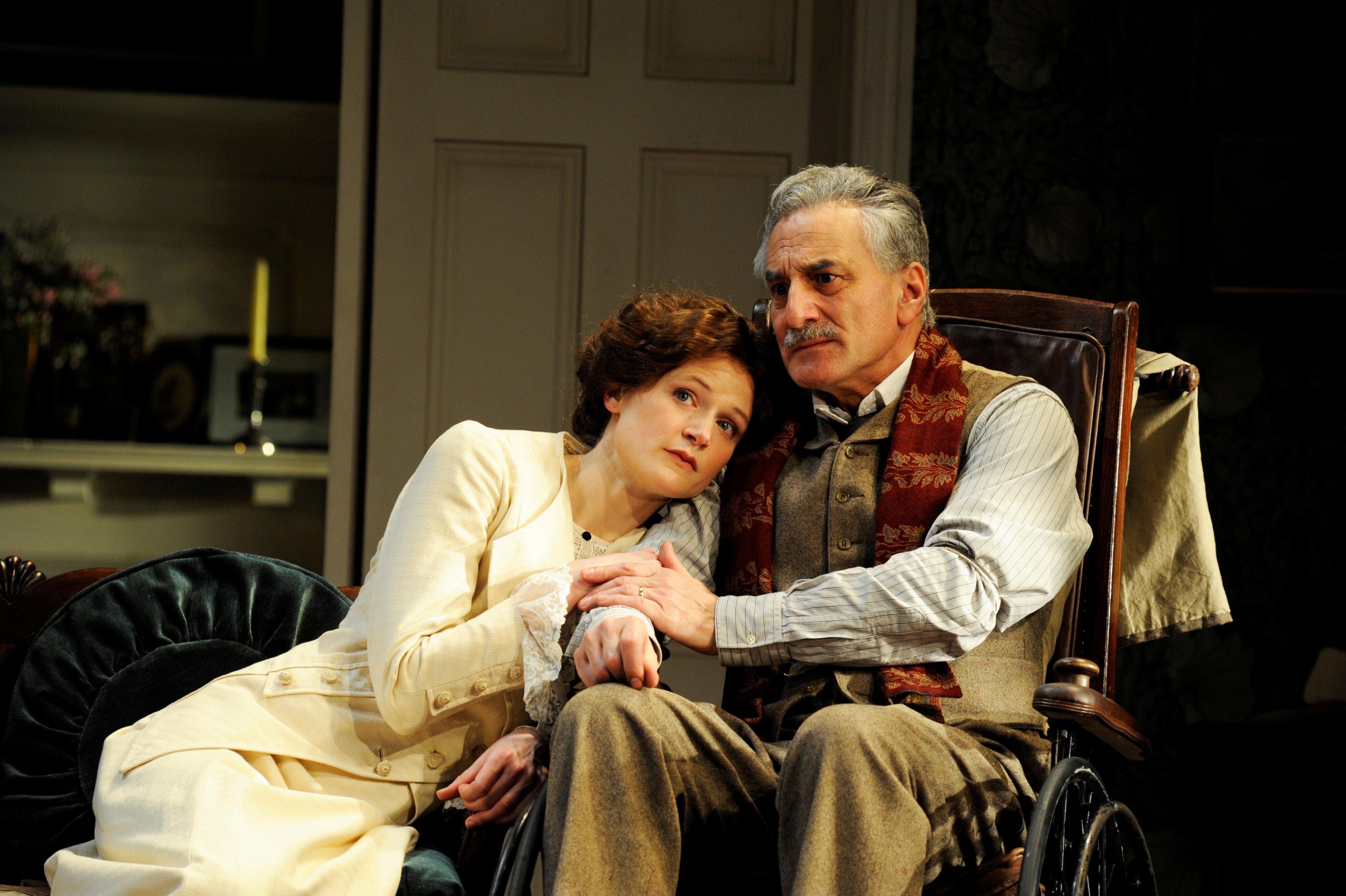
Deborah Findlay is often roaringly funny with her amped-up characterisation of Grace, his wife; chatting to a journalist about curtains and looking out for Ronnie, her “poor little lamb”. Nick Hendrix is charming as Dickie, dancing to his gramophone records; while Naomi Frederick (pictured above) gives a strong performance as Kate, whose struggle for women's suffrage is constantly disrupted by unsuitable suitors.
For this play to work, the audience must believe Ronnie's innocence. Peter Sullivan is wonderful as the arrogant barrister Sir Robert Morton: snarling, squinting and reddening in the face while cross-examining the 14-year-old Ronnie. Charlie Rowe, 16, is terrifically convincing as the schoolboy protesting his innocence in brilliantly crisp tones. Ronnie soon becomes almost oblivious to his family's fight: in one scene, he falls asleep on the couch, while his parents' marriage falls apart.
If this production has a weakness, it is that it never shows, despite verbal references, that the Winslows' finances are stretched. Over two years, the ornate furnishings – the Constable-style paintings and the emerald velvet chairs (part of Peter McKintosh's elegant set).– remain untouched.
But this is not a fatal blow. Since revivals in 2011 to mark the centenary of Rattigan's birth (Flare Path with Sheridan Smith, in particular), the playwright has scarcely been more fashionable. This revival suggests this is where he will stay. It is a Winslow Boy for today.