Jamie Cullum has been perceived as the Tim Henman of Jazz. Talented, technically great, a successful career, excellent voice and top-notch pianist, and a nice guy you could take to tea with your mum, but not really challenging or world-beating. Yet there were interesting flashes of greatness in last night’s concert.
Cullum did a well-received Prom in 2010 and it was easy to share his enjoyment at having lots of musical toys to play with again – the Heritage Orchestra, the 100-strong Roundhouse choir, not to mention his choice of guest musicians. The very first thing he did showed him at his worst: a Louis Armstrong song about missing New Orleans sung in a cod American accent where the piano could have done with more of the creole swing of a Professor Longhair or an Allen Toussaint. Even Hugh Laurie has more of the New Orleans spirit.
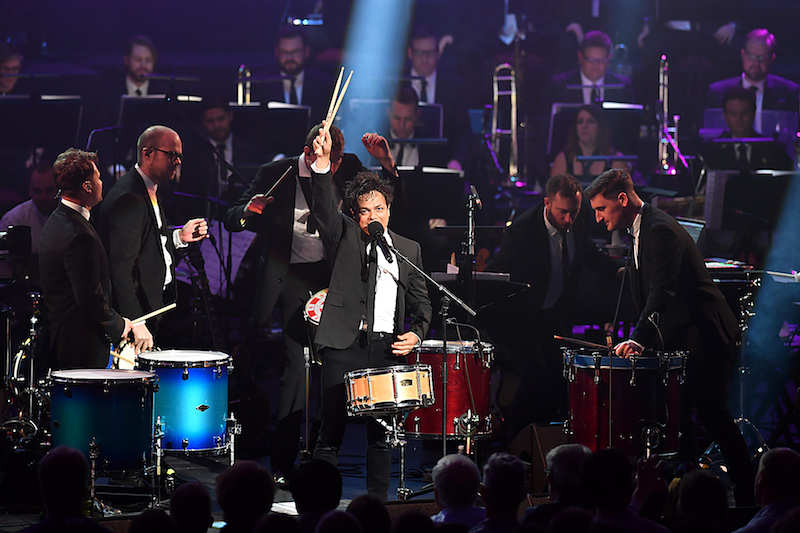 Things went up fast from there. One of impressive elements of the evening was the use of dynamics; musical director Tom Richards and Heritage Orchestra conductor Jules Buckley deserve kudos for inventive arrangements and really utilising the musical forces at their disposal. “Same Things” started off with four drummers front of stage (pictured above right with Cullum) before adding elements, dropping out to reveal and tease, moving with an impressive dynamism. The use of physical and musical space was commendable – Cullum moved around with agility and the choir at the back seemed to be turned up or down as though doing an instant mix in the studio.
An ersatz James Bond number “Edge of Everything”, written by Cullum, is probably not going to get chosen as the next movie theme, nor, as he pointed out, is he likely to be chosen to play the role (cue height joke at his own expense). But his “When I Get Famous”, about someone who works like hell to get known because he is rejected by girls at school (he claimed this was not autobiographical – not al all), had a gripping sense of teenage melodrama and angst. His other charming new song “Life is Grey”, about “a confusing world, and trying to find beauty in it”, was written to be used with this musical artillery at his disposal.
The edgiest moment of the Prom was when he brought on the Dakhla Brass who he had found through the BBC Introducing platform.The classic “Love For Sale” had a distinct Balkan feel in the brass, possibly referencing sex trafficking from Romania and elsewhere, and was accompanied, briefly, by rapper Coco. On paper this sounded like a musical car crash, but gelled surprisingly well. Political theorists talk of the “Overton Window” – what is acceptable in the mainstream – and Cullum seemed to just nudge the parameters towards the avant-garde.
 Cullum is a generous performer and gave space to singer ESKA (pictured above) on the Billie Holliday evergreen “Good Morning Heartache”, even if her astonishing, fruity voice rather showed up his limitations on the duet. Another group who had their moment in the limelight were the accomplished Remi Harris Trio. With all these musicians on stage, it’s difficult to improvise much, but he did appear to magic a number out of thin air – playing four chords on the piano, telling the strings and brass to work with them, and getting the audience and choir to join in with an instantly memorable hooky melody.The other big audience singalong was for “God Only Knows”, which started off bitty but ended up epic, even if the song didn’t quite have the transcendence of Brian Wilson’s version.
Thanks to his Radio 2 show, he is completely at ease as a presenter, and without the sarcastic edge of, say, Jools Holland. He is a skilled audience-whisperer, knowing how and when to tickle their underbelly, so that by the end he apparently had the entire audience in his hand. If his first number showed him at his worst, the encore showed him at his best – a tender piece written for his children with a repeated line “Don’t wake up in someone else’s dream”. That heartfelt song with a memorable melody didn't need anything other than piano and voice to be effective and affecting.