

I don't usually suffer from chattering teeth and attacks of vertigo while watching a movie, but as this panorama of Himalayan disaster reached its climax I began to fear that I might need paramedics and an emergency evacuation. Everest might not top the all-time charts in terms of plot development or character psychology, but as an immersive account of a horrific chain of real-life events, it reaches – I nearly said "summits" – its objectives with distressing potency.
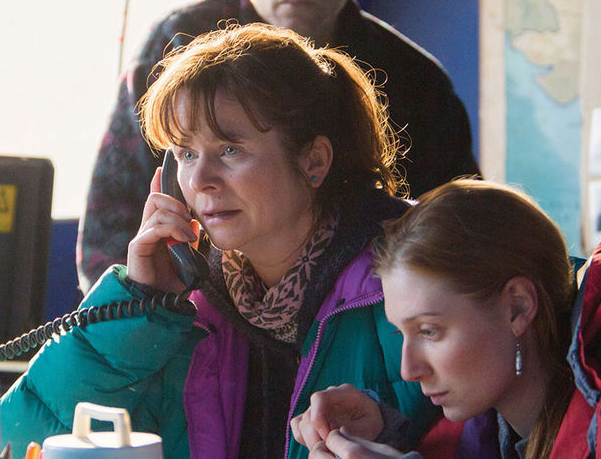
A shelf-load of books has been written by survivors about what happened on the world's most imperious mountain in May 1996, when no less than 20 climbing teams assembled in Nepal to take a shot at reaching Everest's 29,000-foot peak. Some of the facts and reasons for what happened can never be known, since they were lost along with the eight climbers who never came back. Despite this, screenwriters William Nicholson and Simon Beaufoy have constructed a clear and compelling account, which, in approved Disaster Movie style, gives the protagonists about as much human light and shade as the job requires without blocking the view to the summit (Emily Watson as Helen Wilton, pictured below).
 Scenes of Nepalese towns and temples help to convey the other-worldly nature of a trip to the Himalayas, but inevitably it's Everest itself which dominates the film, rearing up into the sky as both aspirational beacon – when the weather is so piercingly clear it's as if you can see all the way to outer space – and a terrible warning when the clouds start to roll in. These wildly contrasting conditions can succeed each with shocking speed, as the climbers discover when their tantalising window of mild weather is suddenly slammed shut by storms and blizzards. "The last word always belongs to the mountain," as Anatoli Boukreev, one of the climbing guides, warns.
The film has been conceived for IMAX and 3D, and director Baltasar Kormákur (2 Guns, Contraband) has gone full tilt for mountainous shock-and-awe. Filmed in Iceland, the Italian Alps and on the lower slopes of Everest itself (where the second unit narrowly avoided a lethal avalanche last year), Everest convinces you that this must be what tackling the Big E is really like. The climbers' steep, debilitating climb through deep snow and thin air is painful to behold, while survival in the high-altitude "death zone", where the human body is in a state of shutting itself down, is depicted as a nightmare of bitter cold, howling wind and wracked lungs (and that's on a good day). Warnings from one of the expedition doctors about hypoxia and cerebral and pulmonary oedema prove well founded.
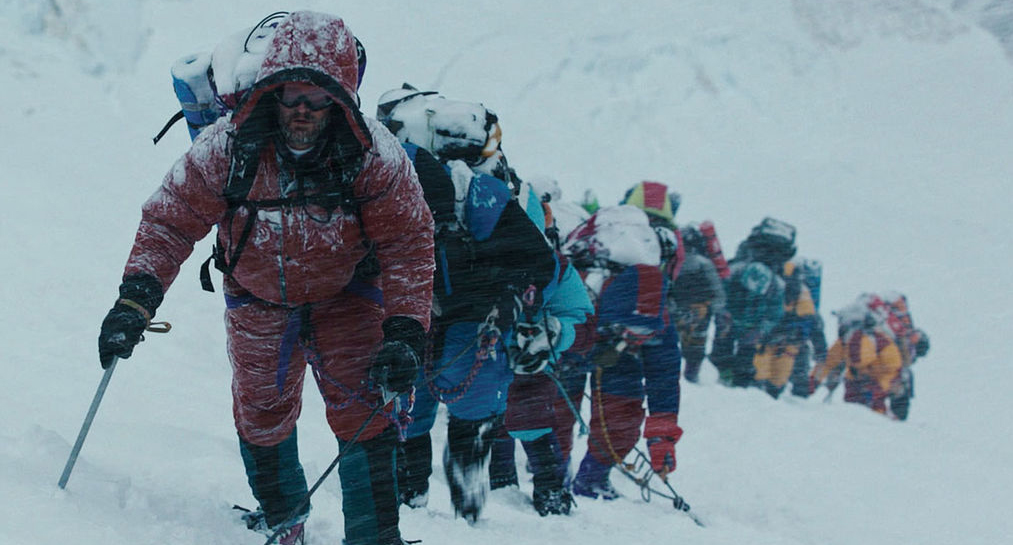 But the flick would be meaningless without some believable human interactions, and there's scope for some solid performances. Jason Clarke brings a warming human touch to his portrayal of New Zealander Rob Hall (taking the lead, pictured above), boss of climbing company Adventure Consultants and a man acutely aware of his responsibilities to his clients (not least because they've paid $65,000 to come on the trip). His right-hand woman and base camp manager is Helen Wilton (Emily Watson, being both motherly and sergeant-majorish), and among his clients are macho Texan Beck Weathers (Josh Brolin) and journalist Jon Krakauer (Michael Kelly, from House of Cards). Krakauer subsequently wrote the book Into Thin Air. Hall enjoys a friendly rivalry with Scott Fischer, who runs the Mountain Madness company, and he's played by Jake Gyllenhaal like a benign climber-dude who'd look equally at home on a Harley-Davidson or a surfboard. Keira Knightley and Robin Wright are somewhat over-specified as the fretful wives of Hall and Weathers respectively.
Without getting all socio-political, Kormákur raises the issue of the over-commercialisation of Everest and the threat to the natural habitat, and the fatal foolhardiness of so many climbers stuck in a bottleneck queueing to go up speaks for itself. The film doesn't apportion blame for the tragedy, though Hall's too-sympathetic efforts to please a client backfire disastrously, while whoever it was who left empty oxygen bottles up the mountain where there should have been full ones committed a heinous blunder. Anyway, I always thought mountaineers must be nuts. Now I'm certain.








Add comment