This remarkable 1988 adaptation of Carroll’s Alice’s Adventures in Wonderland opens with Alice addressing the audience. “This is a story for children,” she tells us, before adding a teasing note: “Perhaps.” And that “perhaps” is worth noting, for Jan Švankmajer’s Surrealist Alice is full of cruel and violent incident.
Paring the story down and dispensing with many of its most memorable characters – the Duchess, the Mock Turtle and the Cheshire Cat among them – the story becomes a disturbing duel between Alice and the White Rabbit. We first encounter the creature not hurrying across the lawn, but as a stuffed ornament in the corner of her cluttered bedroom, its protruding eyes and loudly clattering teeth suggesting an animated skull.
In his gold-braided red jacket and top hat, the White Rabbit’s role as a sinister circus ringmaster corralling the action is continually undermined by Alice. It is Alice who steers the narrative, speaking each of the characters’ lines while the camera homes in on her mouth, momentarily suspending the action. By the end of the film, one gains an insight into why this innovative Czech avant-garde film-maker was banned from his craft by Communist authorities in 1972. The absurd trial near the film’s end is defiantly resisted as Alice refuses to read a pre-prepared script. At the film’s ambiguous close we see her relishing the prospect of revenge: she prepares to act as the Rabbit's executioner, thereby turning the tables on him.
Mixing inventive stop-action animation with a live actor and animals – hens, a squawking piglet, porcupines – the film is full of brilliantly choreographed animated sequences: bird skulls hatch from a boxful of eggs; a slab of raw meat jumps out of a pot and slithers across the kitchen top; socks burrow in and out of holes in a floorboard in a flamboyant dance; and a huge frog swats real wasps with its fat tongue. Meanwhile, sound effects are exaggerated – the insistent ticking of a watch, the sharp clanking of a threatening pair of scissors - lending the film its hallucinogenic quality.
Immersing us further into dream-logic are Alice’s constant physical frustrations – the knobs of drawers always come off in her hand, and her miniature incarnation is as a tiny, helpless porcelain doll. Alice was Švankmajer’s first feature-length film, and this is the first time (with English subtitles) it’s been available for home viewing. If you’re a lover of alternative Hollywood directors such as Tim Burton and Terry Gilliam, you can see what influenced them right here in this supremely imaginative and eerie retelling of Carroll’s tale.
Extras include a nine-minute 1903 film of Alice in Wonderland, the very first film adaptation of the story, and Elsie and the Brown Bunnie, a humorous Cadbury advert from 1921, in which a giant "Bourneville" rabbit takes Alice as his guest to the Cadbury's chocolate factory.
ALICE'S ADVENTURES ON STAGE AND SCREEN
Alice, Scottish Ballet. It should be a capital crime to attempt an Alice ballet - off with their heads
Alice's Adventures in Wonderland, Royal Ballet. Even the best butter would not help this plot-less evening
Alice's Adventures Under Ground, Barbican. Gerald Barry's crazy velocity berserks both Alice books in rude style
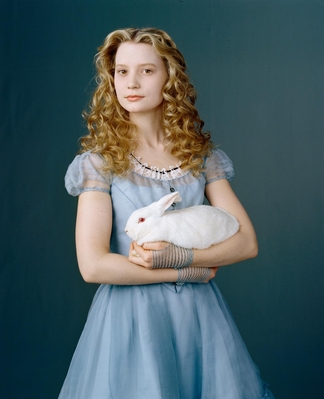 Alice in Wonderland. Tim Burton takes on the fantasy classic
Alice in Wonderland, BBCSO, Brönnimann, Barbican. A curious tale gets a riotous operatic telling from composer Unsuk Chin
Alice Through the Looking Glass. Mia Wasikowska (pictured), Helena Bonham Carter and Johnny Depp back in inventive if unfaithful Carroll sequel
Jan Švankmajer's Alice. The great Czech animator's remarkable first full-length film
wonder.land, National Theatre. Damon Albarn’s Alice musical has fun graphics, but a banal and didactic storyline
Overleaf: watch the trailer for Alice