

In November 1973 a 20-year-old music scholar from St. John’s College, Oxford conducted the first ever concert by the newly founded Tallis Scholars, in St. Mary Magdalen, Oxford. Anyone who was there might have sensed that a new era was beginning. David Munrow was still alive: the period instrument revolution was just taking off. But Peter Phillips seemed to be inaugurating a new generation of Renaissance and Polyphonic singing - an expertise on show this week at a sensational recital in St Paul’s Cathedral - such as this country had not heard before.
Except that, modestly, he would insist it had a forerunner. Once he arrived amid the dreaming spires, Phillips made a regular pilgrimage down to Magdalen College chapel: partly, to see the legendary Bernard Rose conducting the college’s all-male choir. Byrd, Tallis, Weelkes, even the fiendishly difficult Tomkins Great Service were all on the menu.
Phillips took Tallis's Spem in Alium, to my mind, unwarrantably slowly
But above all Phillips went to hear the Clerkes of Oxenforde, founded by David Wulstan, whose girls sang like boys and who could turn the treble and mien – or second soprano - lines into fabulous traceries of sound that the sublime Magdalen acoustic transformed into the ethereal. It was a life-changing experience.
That same young undergraduate is now a Chevalier de l’Ordre des Arts et des Lettres, in recognition of his services to French culture. The Tallis Scholars’ new five-star recording of Jean Mouton, nominated for a BBC Music Magazine Award, is one of countless triumphs of four decades of recording on their own label.
Phillips has now embarked, in a reverberant St Paul’s, on a landmark 40th-anniversary programme. What an acoustic. The effect on the choir’s singing, as Malcolm Archer, John Scott and now Andrew Carwood have long proved, is quite sensational. Take, for example, perhaps the most staggering of the pieces Phillips offered to a packed and aghast cathedral audience: a short and almost never heard Miserere by Tallis.
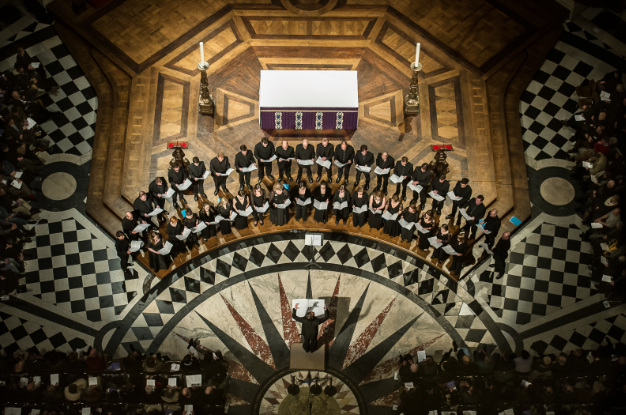 The wonderful way the choir shaped these unbroken legato lines (as later in Byrd’s Tribue, Domine) produced music one would gladly hear at one’s graveside. The pacing, growth and fall, alternation of full harmony and monody, and strangely tolling, rising scalic passages in this Miserere were out of this world.
Not all was perfect. The choir took a time to get into its stride – the opening Tallis (Loquebantur variis linguis) exhibited little of give and, let alone of the variety that text surely cries out for. Words, in that other wonderful Miserere, Allegri’s, were often inaudible even when you followed the Latin, though the soprano was delicious (in the descending as well as ascending sequence); and the tenor solo quite fabulous. Phillips’ beat, with an odd caress of the left hand thrown in, looks almost as beautifully irrelevant as George Guest’s swirlings used to look.
But somehow it didn’t matter. The choir mostly grasped what he meant, or at least, the meticulously rehearsed machinery worked by some wonderful osmosis or autopilot.
Listening to Arvo Pärt’s breathtakingly beautiful, at times susurrating Nunc Dimittis, one realised that Phillips has not stood still. Once almost too purified, so that, while wildly beautiful, it could sound (oxymoronically) like crystalline succulence, the Tallis Scholars’ sound – with a partly new team of singers – has modified. It has less prissiness, perhaps more body or fibre, yet the pianissimi are just as mesmerising.
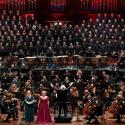
There were plenty of familiar faces, all first-rate. In fact Phillips wheeled out 40 of them, for a Tallis Spem in Alium which he took, to my mind, unwarrantably slowly – a bit like "Eternal Ruler of the ceaseless round" done as a Bruckner adagio. The material didn’t, here, quite live up to it; it became almost clichéd. Unlike their spectacular recording.
More affected by a slow, tortoise pace was the London premiere of one of the newer works: Robin Walker’s 40-part "I have thee by the hand, O man", a kind of dialogue between God and man which a slow, and possibly even jerky, pace merely made ponderous, the stop-start texturing and musical material itself neither thrilling nor convincing.
Phillips’ special achievement always is to create a wonderful blend
The choir commissioned a tender, beautiful, ambiguously Marian anthem, Sainte-Chapelle ("Castissima virgo…"), from Grammy-winning American composer Eric Whitacre, which really did warrant the attention. Nevada-born Whitacre, not much over 40, who studied at New York’s Juilliard with John Corigliano and David Diamond, arguably went through a saccharine compositional phase, to which he still perhaps inclines; but a growth in stature has matched his growing reputation. He does have his own voice and sensibility, one that reaches beyond the Medieval, Pärt and Gorecki to yield something urgent and nearly new. Tensions between a tonic and, effectively, chromatic, step-like descents from it were one salient ingredient here; an angelic feeling - wholly apt - for the words was another.
But Phillips and the singers apart, the hero of this concert was the characterful Gabriel Jackson, who at 50 seems still to be able to turn out one choral masterpiece after another. Ave dei Patris Filia is a substantial score, proving yet again that Jackson can do big structures (think of Tallis or Robert Carver) as well as the more curt.
He engages with effects, but makes them integral. The paired voice aubade with which it opens, first sopranos scintillating, then seconds even more ravishing, was treat enough. But the work unfolded fascinating detail, with lots to say and inspired ways of saying it. Phillips’ special achievement always is to create a wonderful blend in which you can hear every single individual voice, even when they’re in 10, 12 or 40 parts. It’s a wonderful gift, and it makes an audience’s experience utterly enthralling.
What a magical and uplifting 40th birthday. We left walking on air.
- The Tallis Scholars' tour continues tonight at Manchester’s Bridgewater Hall and at London's Cadogan Hall on Wednesday 29 May


Add comment