It's one of the fundamental rules of concert-going that in any given season there will be one piece that trips you up. And that piece will always be by Berlioz. No matter what new alchemical concoctions Boulez, Lachenmann, Ferneyhough or Rihm will throw at you, someone will programme something by the 19th-century French composer - usually something with a perfectly benign-sounding title like King Lear Overture or Roméo et Juliette - that will in fact sound more modern, more outlandish, more baffling than anything written before or since. So it was again last night.
The first riddle was what exactly was it that we were hearing? The composer called Roméo et Juliette a "Dramatic Symphony". But what symphony do you know that begins with an overture, goes into a chorus, enters a solo contralto aria and then a spritely tenor cabaletta? One could mistake the opening for an opera. Yet what opera contains two enormous symphonic poems at their core and finds no corporeal or vocal room for the two main protagonists? Some see parallels with the choral symphonies of Mahler and Beethoven. But the works of these two strike me as quite formulaic when compared to Berlioz's unidentified symphonic object.
Elder felt no shame - rightly - at bringing out every bold bit of Berliozian colour
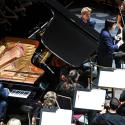
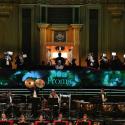
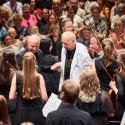
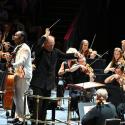
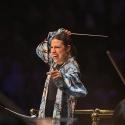
The oddity of the piece was mapped out last night physically on the Royal Festival Hall stage, as mezzos, tenors, basses and whole choirs filed on and off, on and off. Four harps replaced three trombones. One percussionist became two. Two became four. Four became eight. It was orchestral cell division. A cor anglais led the woodwinds. The strings duetted with two Turkish zills. Melodies wafted up from the double basses. Berlioz rarely shied away from this child-in-a-sweetshop behaviour when it came to orchestration. But this commission (Paganini asked for the work in return for 20,000 francs, no strings attached) allowed more freedom than most.
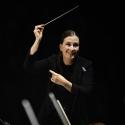
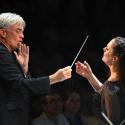
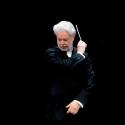
In a way then, this is a love letter to the orchestra. That Berlioz's exploited every bit of flesh and fat of the early 19th-century orchestral beast doesn't make things easy on the orchestra or conductor. But both Sir Mark Elder and the Orchestra of the Age of Enlightenment despatched every technical challenge with ease. There was an infectious hyperactivity to the Grande Fete chez Capulet and an addictive lightness to the scampering of the Queen Mab Scherzo. Even in this unusually expanded form, the OAE clung together like chamber musicians throughout. Elder's dramatic sense was there at every key climactic point and dramatic musical turn. He felt no shame - rightly - at bringing out, even at times exaggerating, every bold bit of Berliozian colour: the guitarish harps, the thundering timps, the trombones and tambourines.
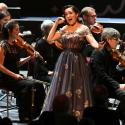
In all this generosity, it's odd how small a role the story of Shakespeare's Romeo and Juliet - even its main themes - plays. There is virtually nothing here except the bare bones. None of the main characters appear. Oratorio-like reflections pour forth from choirs, who later also adopt the thoughts of the Montagues and Capulets. The Schola Cantorum and BBC Symphony Chorus were heartfelt in their offerings, even though they had to work with the least interesting musical material of the evening. There are two small but beautiful roles for the everyman and everywoman. Patricia Bardon was as full-voiced and stentorian as John Mark Ainsley was delicate and Queen Mab-ian. Then out of the blue comes Friar Laurence. Orlin Anastassov performed the role with plenty of spirit.
These vocal moments are side dishes, however, to the main act of musical love making in the Part Three Scene d'Amour. It's a movement built on one of very greatest melodies ever written. A tune so ravishing you wish you could eat it on toast or rub it into your skin. With Elder we got the next best thing. He shaped it and its numerous permutations with such care and let it sing with such heat it felt like it was seeping into every pore.