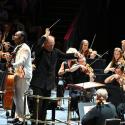
Monteverdi’s 1610 Vespers are something of a musical enigma. Neither their true pitch nor order of movements, their origins, nor even whether they were intended as a complete sequence is known for certain, prompting scholar Denis Arnold to conclude that, “to perform it is to court disaster”. Such a grim augury however has done little to discourage musicians, and in this, their 400th anniversary year, Monteverdi’s Vespers have been ubiquitous. Crowning a year of performances across the country, John Eliot Gardiner and the Monteverdi Choir – pioneers of the work, and the first ensemble to perform it complete at the Proms – last night returned to remind the world of their very particular affinity with this repertoire.
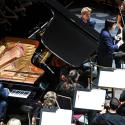
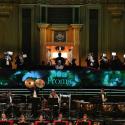
As Alex Ashworth delivered the urgent opening intonation from beside the bust of Henry Wood, the choir – together with two magnificent chitarrone – began to process down onto the stage from each side, copies in hand, singing their response from memory. The visual and aural drama of the scene – playing to as packed an arena as I’ve seen all season – was profound and immediate.
Whether or not composed with the echoing galleries of the Basilica San Marco in mind, Monteverdi’s Vespers achieve life and architecture through their sonic effects; choirs are pitted against one another in antiphony, alternating sections for male and female voices, for duelling soloists, as well as passages of echo-music that set the immediate and human against the distant and disembodied. Gardiner’s understanding of this drama, this aural ceremony, is absolute. Taking the Royal Albert Hall as his sonic playground he mounted an extraordinary musical ritual whose complexity never collapsed into fussiness, or whose effects into gimmickry.
It is easy with such a piece in such a venue to lose the intimacy somewhere among the spectacle
Textural clarity is particularly hard for choirs to achieve in the Royal Albert Hall. Striking through the extended "Dixit dominus" setting was the transparency of the polyphony, the combination of blend and balance creating an immaculate cross-section, each layer clearly delineated. Coupled with the most expressive enunciation (the “implebit ruinas” was terrifyingly vivid in its threat), the effect was as dynamic as the text, taking us from dancing exultation to destruction in moments.
The height of some seriously classy music-making from the consort was the contrast between the "Lauda Jerusalem" and "Ave Maris Stella". Crashing into the audience’s shuffles and coughs with the cheeky syncopated opening of the former, the ever-present dance rhythms remained just the right side of brash. Yet when the choir returned minutes later for the "Ave Maris Stella" – that most beautiful of chants – they were a different group, bringing a reverent simplicity to the lines that had nothing to do with musicality and everything to do with emotion.
Yet it is easy with such a piece in such a venue to lose the intimacy somewhere among the spectacle. The duets and solos are the emotional core of the work, and performed here by step-out soloists they achieved a sense of organic continuum with the choral whole.
While the two sopranos (Emanuela Galli and Lenneke Ruiten) remained conventionally stage-bound, the men – particularly the dynamic tenor trio of Andrew Tortise, Peter Davoren and Benjamin Thapa – enjoyed a flexibility that saw them singing to one another across the full width of the hall, as well as from up in the gallery. "Duo Seraphim", with its dynamic central image of the two Seraphims calling to one another with their song of joy, “Holy, holy, holy Lord God of Hosts…”, was given delicious vividness by the aural distance of the singers, the lines weaving and dovetailing amongst each other with joyous urgency.
Not quite the match of the men, the sopranos produced a delicate and surprisingly chaste "Pulchra es", erring perhaps just on the side or understatement where Monteverdi’s lines (and the Song of Songs text) surely call for sensual abandon. Lenneke Ruiten’s richer second soprano fared rather better here than Galli’s straighter tone, which tended occasionally to sound rather gripped.
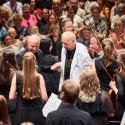
Aided by the impressive singing of a children’s choir from the Cardinal Vaughan Memorial School and London Oratory, as well as the instruments of the English Baroque Soloists, Gardiner and the Monteverdi Choir last night made a persuasive case for Monteverdi’s Vespers as a complete and coherent whole. Tempering dramatic extremes with impeccable musicianship and real conviction, for one night only they transformed the secular temple of the Royal Albert Hall into a cathedral. What else to do but worship.
- See theartsdesk's pick of the BBC Proms, 16 July-11 September
- See full BBC Proms 2010 listings
- Listen to this Prom for the next six days on BBC Radio 3 on BBC iPlayer