

Elgar declared a “massive hope in the future” as the human programme behind his epic First Symphony’s final exultant sprint. That hope was sprinkled like gold dust around the featured artists of this all-English concert. There are good reasons to be optimistic about the effective, colourful scores of 32-year-old Anna Clyne; we know that Benjamin Grosvenor, her junior by 12 years, is already a pianist of mercurial assurance, a real front-runner. And the BBCSO stole a march on the other London orchestras in 2013 with abundant fighting spirit, rising to the special focus demanded of them by a rare visit from American Andrew Litton.
Clyne’s Night Ferry, premiered last February by Riccardo Muti and the Chicago Symphony Orchestra, works well as an opening showpiece. Making it a rule not to read the composer’s programme notes before the performance, I’m not sure I would have detected the manic-depressive impetus behind its “thudding in a big sea” (Robert Lowell, twinned with Schubert as one of two afflicted inspirations) and its slower “poems…from a slow and powerful root” (Rumi, also one of the starting-points behind the more outlandish Rolf Hind work the BBCSO played last November).
Litton’s brilliant work on the coruscating strings at the start was an augury of wonders to come in the Elgar, the fiercely propelled “armourer’s music” – Lowell again – likeably close to John Adams’ dynamic of flying, rather than sea-coasting, through space. Night Ferry might have worked better, in fact, as a short ride in a fast machine rather than a longer, fast-slow journey to an unknown destination; Clyne would do well to shave off five or so minutes from the central pounding. No doubt about it, though, she has a sure ear for magical orchestration and the epilogue-nocturne, with the woodwind musing on a constant five-note figure and another theme plucked, it seemed, straight from the middle of the slow movement in Shostakovich’s Fifth Symphony, sank hypnotically to the orchestral depths from which the piece began.
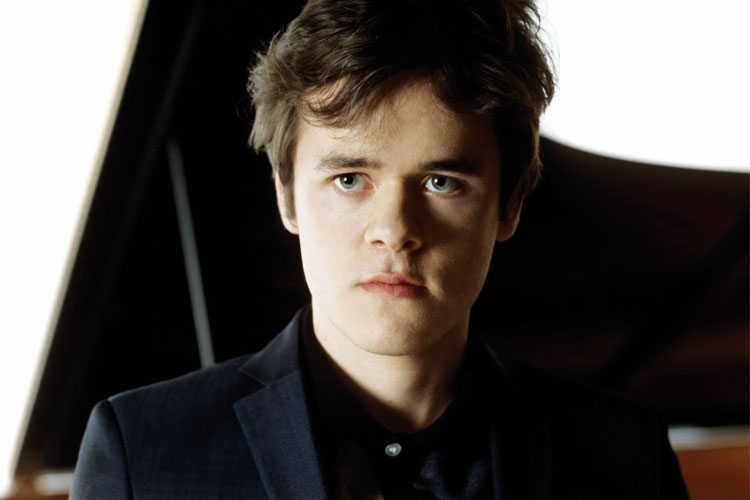 Less is certainly more in the characteristically brilliant Piano Concerto by the 25-year-old Benjamin Britten. It starts as if it were a sixth piano concerto by Prokofiev rather than Britten’s one and only, Grosvenor (pictured right) coasting the orchestral momentum rather than dominating it as Britten suggested his soloist might. His relaxed, darting and humorous spirit conjured Ariel rather than Caliban, asserting his magic in a cadenza that really did feel as if it were being improvised so that the spell cast in the briefly becalmed coda was decidedly the pianist’s.
Grosvenor’s response to his evocative companions graced rather than dictated the course of the waltz and the 1945 Nocturne variations which usually replace the original slow movement, and gave his colleagues their head in the memorably turned march theme of the finale where Britten exchanges Prokofiev for the Shostakovich of the First Symphony. Brittleness in this exceptionally subtle young artist’s armoury will always play second fiddle to poetry, and Grosvenor set the seal on that with the fugitive vision of American composer-pianist Abram Chasins’ Prelude No 14.
How could any conductor of deeper sensitivity not rise to the most poetic of all slow movements? Litton as a master of the big, broad late romantic symphony was bound to have his own ideas about Elgar’s First. Once or twice they could feel overworked or mannered, as in the big rit he inserted into the flow of the wistful counter-subject in the opening movement’s otherwise highly-strung Allegro proper. But that crucial sympathy of any great Elgar interpreter for the distant gleam, the blue remembered hills, welled up in the movement’s last third, its almost chamber-musical vision sequences well prepared so that the strings’ echo effect which had always troubled Elgar the conductor rustled in perfect sync.
The fast, furious but precise tempo for the march-scherzo also suited its supernaturally beautiful river-music trios to perfection. And how could any conductor of deeper sensitivity not rise to the most poetic of all slow movements? Litton seemed to draw inner reserves from his violins beyond pianissimo; Richard Hosford’s dreaming, sighing clarinet crowned the idyll. The insistence of the finale’s Brahms-like sequences thrust energetically, but not bullishly, towards the breathtaking coup where Elgar reveals the symphony’s transcendental main melody trailing clouds of glory. It isn’t easy to gild its majesty in the Barbican, but Litton did just that before racing exultantly to the winning post: "massive hope" indeed. This orchestra has played the score often, most recently at the Barbican under Andrew Davis, but here the players seemed to be experiencing its bipolar revelations with fresh eyes.
Watch Benjamin Grosvenor play the first movement of Britten's Piano Concerto with Vladimir Jurowski and the National Youth Orchestra at the BBC Proms:
- Listen to this concert for the next seven days on the BBC Radio 3 iPlayer






Add comment