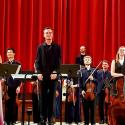
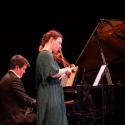
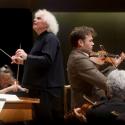
Esa-Pekka Salonen and his dauntless band of Philharmonia players have been wrestling with heroes. After a celebration of Wagner's Tristan, the legend-making shifted further north last night. Here was Sibelius first as the plain-singing, well-loved bard of Finnish endurance and then as the startlingly original creator of a musical alter ego in the shape of mythical adventurer Lemminkäinen.
First, though, there was altogether more foursquare heroism to be endured. Beethoven's Emperor Concerto needn't feel longwinded or grandiose; Paul Lewis's fresh take at the Proms made a good, if very unorthodox, case for a strange tenderness. And frankly I'd give the whole of Hélène Grimaud's penny-plain bash last night for a single one of Lewis's poetic trills. Poetry there was none in Grimaud's performance. I don't know if she's trying to prove that beauty can be a real beast, but if she wants to go for heavyweight, she needs to make the sound and the articulation interesting, too. I'd expect most first-year piano students at our music colleges - and there are so many heartbreakingly good ones who never make it as soloists - to do better with both.
In those few moments where Beethoven wants the heroic pianist to support gentler woodwind, Grimaud ploughed on oblivious of her colleagues; at the heart of the first-movement cavalcade, the double octaves which Salonen's strings were encouraged to shape so effectively had no nuancing at all in the piano rejoinder, as if Grimaud were auditioning for the pianists' cage in Saint-Saëns' Carnival of the Animals. I've not heard a more disappointing concerto performance since Alexander Toradze and Stephen Hough respectively crashed and fudged their way through the Rachmaninov Second.
It looked, by the interval, as if we might have had our fill of grandstanding. The evening's opening flourish, Finlandia, reminded us how fine an introduction to the orchestral departments Sibelius's showpiece makes: smooth-lined brass, soothing woodwind and full-bodied dark strings followed one another in imposing succession. But frankly, so long as you keep the focus and just enough forward thrust, the piece plays itself.
Whereas there's hardly a bar in Sibelius's portraits of hero Lemminkäinen and the weird landscapes he travels through which doesn't pose fresh challenges of texture, dynamics and momentum. The way Salonen argued it, this masterpiece of the 1890s had it all, and even the first movement would have worked as a symphony in itself, its themes in a state of constant development. In awesome contrast to its rustic dance-thrumming came the slow burn of Lemminkäinen's passion for the maiden he wants on the island of Saari - Wagner's Tristan Prelude reworked with tricky but beautifully handled Finnish song inflections, skirling birdsong and remote, layered sea-swells from the depths of the orchestra. And what prophetic touches of orchestration at every turn: Prokofiev, for one, would have been amazed by Sibelius's use of three trumpets in close harmony bright above ruminating solo cello.
Salonen reversed the more familiar order of the inner tone poems. The agonisingly teased out, icy gusts which batter and ultimately defeat our hero in his attempts to harrow hell gave way to mystic pianissimos as his mother comes searching for his temporarily dismembered body. I mention the programme behind the music, but Salonen urgently persuaded us that the score's yearning impulses need none, and that the justly famous Swan of Tuonela, a threnody outwardly still, inwardly questing, could stand equally well as a meditation on infinite grief. Jill Crowther's eagerly anticipated cor anglais solo rose discreetly from the middle distance, binding itself to the dark Lohengrin strings, singing out its most plaintive anxieties before folding back into the textures.
A sudden timpani roll, and we had left the river of death for a heroic homeward journey, again as dynamic a finale as you'll find anywhere in symphonic literature. Like Nielsen in his later masterpieces, Sibelius postpones the triumph until the last minute, and here, with bizarre clapping effects from double-bass bow sticks on strings, the winning straits took us even further into the realms of mythic victory than had seemed possible even in the radical earlier movements. No doubt about it, Salonen in his middle years now combines a long-term vision with a moment-by-moment shock of the new to make these Philharmonia concerts unlike any others even on the hyperactive UK scene.