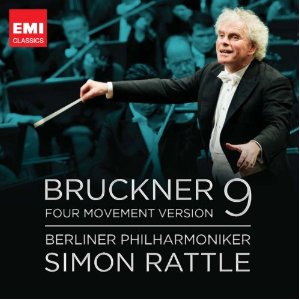
Anton Bruckner’s last symphony is near perfect in its three-movement form. The realisation that the Finale was left almost complete after Bruckner’s death in 1896 is something you’d rather not confront. The vast Adagio closes in a mood of such otherworldly serenity that it’s difficult to imagine anything following it. We’ll get to that last movement later; programme your CD player to play the first three tracks alone and you’ve a very decent conventional Bruckner 9. Simon Rattle is less interventionist than one might expect and surer of the work’s structure. Bruckner’s harmonies were never so daring as they were here – the scream of pain in the Adagio really terrifies, as does the first movement’s coda, its semitonal clashes overwhelming. And that nightmarish Scherzo packs a nasty punch, though not without touches of black humour. You reach the Adagio’s peaceful ending feeling exhausted and relieved.
But the last movement? It’s not generally realised that most of it was left either fully complete or sketched in detail; the four musicologists responsible for this edition say that only 28 bars had to be newly composed, all using pre-existing material. Rattle compares their work to “forensic musicology, like reconstructing someone’s face in surgery after an accident”. And who better to conduct this new realisation than Rattle, a conductor already responsible for nudging Cooke’s edition of Mahler 10 into the mainstream? What’s crucial is that the music really does sound like authentic, mature Bruckner. Structurally the finale doesn’t hang together as well as that of the Eighth Symphony, but it’s often a thrilling ride. You get what you’d hope for – earth-shattering brass chorales, generous self-quotation and a hard-won peroration. Glorious, in other words. But the effect it has on one’s perception of the earlier movements is harder to come to terms with. I like to think I'll slowly come to terms with it. This is essential listening, though – the Berlin brass are stunning in the last few minutes and EMI manage to squeeze all 82 minutes of this live performance onto a single disc.
Watch Sir Simon Rattle discuss Bruckner's Ninth Symphony

“A critic said that there is both a monk and a street urchin in me. That is an accurate description of my personality.” Poulenc was the first to admit the contradictions inherent in his music and character. A devout Catholic, he was openly gay, and his music can miraculously reconcile the deeply personal with the cheekily flippant. Close your ears to Poulenc and you’re missing out on some of the 20th century’s most alluring music. Listening repeatedly to this sharply performed a cappella choral collection is fascinating. It’s easy to dismiss Poulenc as a Tatiesque clown, but the rawer sonorities serve to highlight just how sophisticated a composer he was. It’s all in the harmonies and chord progressions – often breaking every rule but invariably sounding wonderful. This is music which can make life feel worth living.
Stephen Layton’s Danish choir give exemplary performances. At times there’s a welcome edge to the sound, a toughness, coupled with superb control – the major/minor shifts in La blanche neige are superbly done, as is the abrupt fade out at the song’s close. There’s a rare chance to hear two religious works for male voices, but the real masterpiece is Un soir de neige, a wartime setting of poetry by Paul Éluard. The opening of Bois meutri is chilling. And while you’re still marvelling at Poulenc’s eloquence in serious mode, move on to the exuberant collection of Chansons Françaises, and the tiny Chanson à boire composed for a Harvard Glee Club. It has a killer ending. Fabulous, in other words.
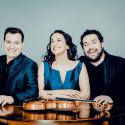
Valentin Berlinsky was the long-serving cellist in the famous Borodin Quartet, whose seminal Shostakovich recordings remain essential listening. Too many contemporary performances of the Shostakovich cycle seem keen to overstress the violence; what can be poignant and wistful sounding merely glib and flashy. This young Zurich-based group are attuned to the need to make these pieces beguile as much as bludgeon. You can hear that in their performance of the underrated Seventh Quartet, dedicated to the memory of Shostakovich’s first wife. This is music which lives in the shadows; nostalgic, bittersweet, and wonderfully compact. The last movement’s brutal fugue is exciting, but better still is the elegiac wind down in the finale. You’re not sure whether to laugh or cry. The Berlinskys are up against stiffer competition in the better known Eighth Quartet. Again, there’s no overstatement going on; the opening paragraph dispatched with breathtaking coolness and a careful lack of expression. The Largo’s gunshots don’t overwhelm, prefacing a nostalgic, elegiac quote from the opera Lady Macbeth on high cello. It’ll never be a piece you can enjoy listening to, but the Berlinsky’s approach kept me gripped.
The unexpected coupling is Beethoven’s first Rasumovsky Quartet. Terse compression of expression is never an issue in this work; it’s vast, and the abundance of material can sometimes feel too much for the quartet medium’s intimacy. Like listening to a boring, booming voice in a confined space. You don’t sense that here, where the Berlinsky's approach highlights Beethoven’s geniality as well as the grandeur. There’s plenty of humour and much playing of considerable delicacy, notably when the Thème Russe opens the last movement. Nice sound, too.