What is it about the Sixties that keeps drawing us back? Surely, it can’t just be that anniversary thing – 50 years on? Perhaps, in these care-worn times, we just like to revisit our don’t-give-a-damn anti-heroes, having their cake and eating it, pleasuring their mates’ marriage-weary wives, arranging abortions if things go wrong, downing pints in the pub. That was the life.
Recently, we had Alfie Elkins, Bill Naughton’s scallywag, brought to life again. Now comes Arthur Seaton from Alan Sillitoe’s famous first novel, Saturday Night and Sunday Morning, freshly adapted for the stage and directed by Matthew Dunster.
There’s a lot of dressing and undressing, as Arthur makes his conquests
Arthur (Perry Fitzpatrick) is no Alfie, of course. He works hard as a lathe operator in a factory, just as the young Sillitoe did briefly in the Raleigh factory, and he restricts himself to two married women until he gets his comeuppance. There’s Brenda (Clare Calbraith), wife of workmate Jack (Graeme Hawley), and her sister Winnie (Chanel Cresswell), wife of soldier Bill (Mark Rose).
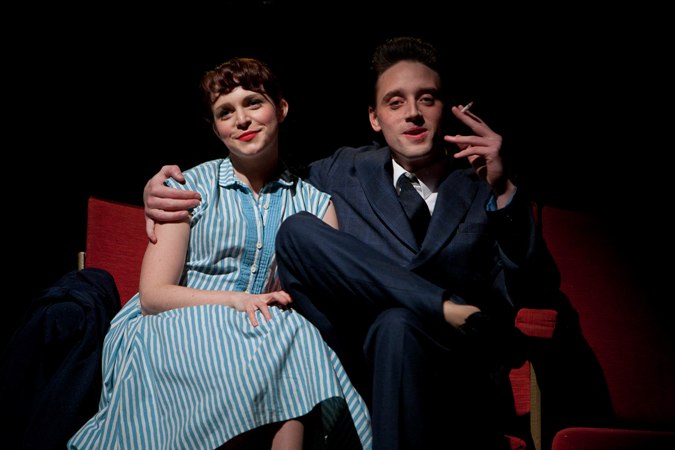
It’s a story of licentiousness and bravado on a journey of self-realisation, a rite of passage. After all the philandering and braggadocio and boozing, he ends up with meek-and-mild Doreen (Tamla Kari, making her professional stage debut). But it takes a good beating (fight director Kate Waters) by cuckolded husbands to bring him to his maturity. (Kari and Fitzpatrick pictured below)
 The achievement of the original novel, encouraged by Sillitoe’s friendship with Robert Graves while living in Majorca, was the authenticity, quality and clarity of Sillitoe’s writing. And he was able to communicate Arthur’s thoughts and attitudes as narrator. Dunster deals with this by making Arthur do his own narration, which largely works, although leading to a somewhat out-of-character anti-government tirade near the end.
But he is centre stage for the whole of the two-and-a-half hours, like a ringmaster running the show. Fitzpatrick, lean and mean, swaggers his way through the part in style. He’s cocky and carefree, a snazzy dresser with the gift of the gab. His is a compelling performance. And he is supported by a strong cast, even if the accents are all over the place for what is supposed to be working-class Nottingham in 1958.
Dunster’s direction is busy, with perhaps a bit too much noisy toing and froing. But his perceptive adaptation, faithful to the original, demands numerous scene shifts, contrived essentially on a bare stage, thanks to the wizardry of the technical team. A cleverly elevated motorised rail shunts in scene-establishing props - Arthur’s wardrobe, bicycle parts and fairground attractions in miniature. They even manage to capture, with minimal props, the candy-floss fun of the Goose Fair, with Arthur, Brenda and Winnie miming a ride on the merry-go-round horses, relishing the ghost train and whirling on the Waltzer. Funny and effective.
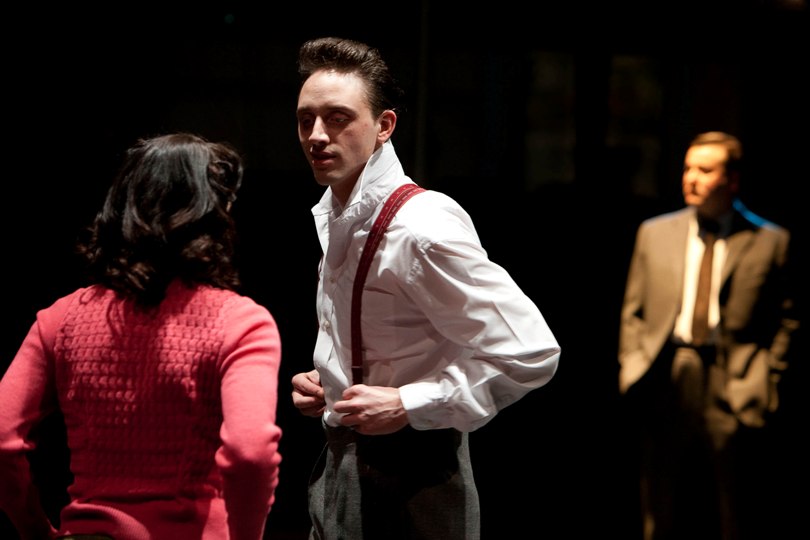 There’s a lot of dressing and undressing, as Arthur makes his conquests. But Dunster is not afraid to pause for breath and dramatic effect. You could have heard a pin drop in the moving scene in which, to deal with an unwanted pregnancy, the exceptional Clare Calbraith sits in a zinc bath on the hearth drinking gin, helped by her mentally challenged friend, Emler (Jo Hartley), while Arthur looks on.
The role in Karel Reisz’s 1960 movie seemed tailor-made for a young actor from Salford, Albert Finney. He was only 24 years old and I recall him returning home for the Manchester premiere of the film in 1961. He really lived it up. He stayed at the Midland Hotel and had kippers and champagne for breakfast on Sunday morning. Well, you would, wouldn’t you, being a star, although no doubt Arthur Seaton would have accused him of betraying his working-class values.
- Saturday Night and Sunday Morning at the Royal Exchange until 7 April