

As reports come in of theatre audiences behaving badly, slumped drunkenly in the aisles, gorging on noisy food and wrestling with their latest smartphones, it’s refreshing to see that kind of behaviour safely onstage, and played for big laughs. Surprisingly, perhaps, this mayhem comes courtesy of Noel Coward.
The redoutable Menier has found another gem to polish after Nancy Carroll’s superb revival of Pinero’s The Cabinet Minister and its exuberant The Producers: a 100th birthday edition of Noel Coward’s Fallen Angels. Roundly denounced for its vulgarity and loose morals at its debut, the play hasn’t had a major production in London since 2000. It returns with a crack cast and stylish staging.
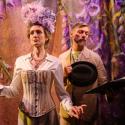
Coward wrote it in the heyday of the Bright Young Things, but its casting was soon hijacked by older actresses, and you can see why. These are toothsome roles. Via Julia and Jane, long-term friends, Coward is limning the kind of love-hate spats he would elevate to an art form in Private Lives and Blithe Sprit. Tackling them here are Janie Dee as Julia and Alexandra Gilbreath as Jane, whose friendship is tested when the Frenchman they both had premarital flings with in Italy (Julia, Pisa; Jane, Venice) threatens to reappear in their respectable married lives of 10 years’ standing.

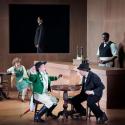
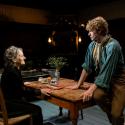
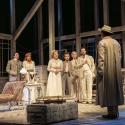
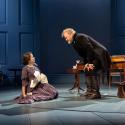
The action is set entirely in Julia’s modish London flat, a super-elegant set (by Simon Higlett) tricked out with deco glass panels and a baby grand. It also comes with a new maid, Jasmine (Sarah Twomey) — a name said with a sneer by her employer, who has “arranged” with her that she must be referred to by her surname, Saunders. With their stuffy husbands away golfing in Sussex, Jane and Julia await the arrival of long-lost lover Maurice (Graham Vick) with trepidation and rising lust. And, eventually, with food and drink, culminating in snarling, sozzled fisticuffs after they have washed down oysters and tournedos with champagne and liqueurs.
The three female characters are soon spitting out funny apercus and fury in equal measure, and the cast go for it full tilt. Dee has a stern, glacial charm, Gilbreath a clowning energy. For added value, Twomey’s maid, a predecessor of Edith in Blithe Spirit, is not a million miles away from that omniscient polymath, Jeeves. She has worked for every kind of employer, apparently, from concert pianists and golfers to the Ballets Russes, which has left her a polished dancer, an expert caddy and a fluent French-speaker. Twomey adeptly arabesques to Swan Lake on the gramophone as she lays the table, fouetté-ing offstage afterwards, then later sits at the piano for a note-perfect rendition of the opening bars of the Rach2, theme tune of Coward’s Brief Encounter (the witty sound design is by Adam Cork).
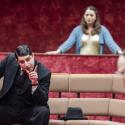
The play’s menfolk fare less well, which isn’t the actors’ fault. Coward has made them borderline stolid and pompous, in need of corrective disciplining by their under-appreciated wives. All this is adequately conveyed by Richard Leveson and Christopher Hollis, who underpin the starch with a demonstrable affection for their foolish spouses. But there is no contest between the seductive foreigner and the complacent Brits in their plus fours and argyll knitwear (lovely costume design by Fotini Dimou) as to which the glamorous ladies will instinctively favour. Younger casting would have closed that gap, perhaps.

The crispness of Coward’s repartee proves ageless, delivered with perfect emphases by the two leads, who can get a laugh out of saying Pisa. A passionless marriage is an "arid waste of discontent”, Julia memorably barks out. The farcical elements are ably handled by director Christopher Luscombe, too, that pesky newfangled invention the telephone ringing with impeccable timing, stoking the to and fro of the farcical plot nicely. Gilbreath is a marvel as Jane, her face a mobile register of her moods, mouth slack and eyes popping, and her inebriated body bent double as she staggers to find her discarded shoes.
There is a more serious core to the play, however. As an astute programme essay by Coward biographer Oliver Soden notes, the young playwright was a friend of Marie Stopes, and his play reflects the growing reality of women’s liberation, fuelled by the emergence of contraception. The key issue that bothers the two women is a perennial one: what happens when a marriage’s initial passion cools? Julia is seemingly content to say she and Fred are not “in love” any more, though goes on to admit to herself (and to Jane) that she is still easy prey for a seasoned seducer. The two women also complain of the uneven playing field that allows a man sexual licence — “It’s beside the point”, snaps Fred when Julia challenges him on the subject — but never grants a woman the same leeway. How much has changed?
Fallen Angels at the Menier Chocolate Factory until 21 February, 2026






Add comment