

For all its ruminative merits, Richard Vergette's drama is not the “searing political thriller” it purports to be. It raises lots of interesting questions, but they get in the way of any deep emotive power.
At the work's core is a relationship between a prisoner and the politician whose daughter he killed. The politician saves the prisoner from death row on the condition that he can educate him. The scenario has lashings of searing potential, but the play's overarching tone is distinctly pedagogical. There are messages about the value of education in reforming criminals; messages about punishment and forgiveness; messages about redemption; messages about optimism and idealism of the Obama administration; and messages about compassion. Ideas tend to make their presence felt with a didactic insistence through one of the three characters, before another undermines their value. The result is a complex set of provocative musings, but not a lot of ideological coherence.
It is more likely to provoke discussion than thrills or tears
This is a shame because Vergette's plot follows a compelling trajectory. Over eight years, from 2008 to 2016, the prisoner Lee Fenton goes from illiterate, violent and sullen to articulate, considered and perky, with the help of his teacher John Daniels, a Democrat politician. Meanwhile, Daniels progresses with his own career: favoured by the president for his good works, he is appointed Secretary of Education. Daniels wants to help Lee because he believes even the darkest minds can change.
Or does he? In the second of three scenes, Lee suspects Daniels is helping him only to further his career. As Daniels proposes to roll out a prison education programme across America, Lee takes offence at being the “experiment” to test whether the scheme will work. Vergette provides a well-timed twist or two. Daniels' motives in educating Lee reach deeper into his family life: a twist cleverly countered by Lee's own revelation about Daniels' family.
 Ryan Gage puts in a terrific performance as Lee, switching slickly from angry to diligent to playful with conviction. His face is so expressive that some of the most powerful moments in this work involve his glares to the prison warden who is restraining him with handcuffs and shackles. He also gives a wonderfully witty mock-political speech in preparation for a press conference in which he says he knows that he has done wrong but can improve. “With God's help,” he says, shaking his fist, “we can move mountains, even if those mountains are inside ourselves.”
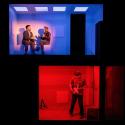
Peter Tate (pictured above, far right with Schaal and Gage) as Daniels lacks the charisma to match. For much of the play, his character is more of a mouthpiece for Vergette's messages than he is a grieving father or ruthless politician. His emotional outcry in the third and final act seems affected. Tate also takes a while to ease into his US drawl. Lee and Daniels both have sympathetic elements to their characters, but it is hard to root for either.
David Schaal (Taffy in The Office) is given little to play with as Herb Stevens, the flat prison warden. His role – an addition since the earlier version of this play, As We Forgive Them, performed originally in 2009 at the 24:7 Festival in Manchester – seems to have the dual purpose of showing the harsh prison environment and challenging Daniels' authority. Both of which he does a lot.
Lisa Forrell keeps the direction simple: all the action happens in the same sparsely furnished prison cell. Signe Beckmann, the set designer, adds some nice touches, with rings of barbed wire on the auditorium balcony; while Tom Lishman, the sound designer, evokes a mood of fear with the clinks and slamming of doors and the echoing of footsteps in the prison corridors.
This compact 75-minute play raises valuable questions about justice, redemption and Obama's vision for America, but it is more likely to provoke discussion than thrills or tears.












Add comment