

Whether you’re partial to Highsmith or Hitchcock, or both, there’s something deliciously exciting about the prospect of Strangers on a Train. Much of that anticipation lies in the intriguing question of which side of the material this adaptation will fall – with book or film, two very different animals – and curiosity as to the staging. "Hitch" has rather spoiled us for visuals. Or has he?
theatre reviews
David Nice

Now here’s a funny thing, possums. Back in 1990 when one great Australian Dame, Joan Sutherland, gave her farewell performance, another, a certain housewife superstar from the Melbourne suburb of Moonee Ponds, seemed closer to retirement age.
Demetrios Matheou

I first saw Mojo as a film, adapted from the stage and directed by its writer Jez Butterworth in 1997. And it really didn’t work. Set in 1950s Soho and involving club owners, gangsters and a wannabe rock & roll star, it tried too hard, felt flashy and stilted; the period proved a graveyard in much the same way as it did for Absolute Beginners a decade before.
Heather Neill

This near-legendary short play, devised by Athol Fugard with the actors John Kani and Winston Ntshona (who gave their names to its characters), was first shown in Cape Town in 1973, during the apartheid era. Its effect then must have been electric, and some of that visceral intensity still shone out in one of the pair's last performances of the piece at the Old Vic in 2002.
Caroline Crampton

In several of P.G. Wodehouse's Jeeves and Wooster stories, reference is made to something called "a knockabout cross-talk act". It's a two-handed sketch, usually performed at a village hall smoking concert or similar, in which the protagonists put on fake beards and terrible Irish accents to become "Pat" and "Mike". They then proceed to trade nonsensical insults and bust each other "over the bean" with umbrellas. This farce continues until they are removed from the stage, most often by one of Wooster's ever-ready phalanx of outraged aunts, to wild applause from the audience.
Caroline Crampton

A single movement is all it takes. A wounded man is held at gunpoint, and instead of cringing away from the inevitable bullet, he lifts his head and looks his would-be executioner in eye. This simple gesture does not just save his life – it sets in motion a drama that will ultimately consume the lives of everyone caught up in it.
philip radcliffe

How many times can a director re-work the same show and still come up with something fresh, gripping and memorable? This is James Brining’s third version of Sondheim’s killer thriller musical Sweeney Todd. He produced an award-winning version in 2010 at Dundee Rep. He turned to it again last month for his first production since becoming artistic director at West Yorkshire Playhouse. Now, he has re-worked it for the in-the-round confines of the Royal Exchange, initiating a trans-Pennine collaboration between the two theatres.
Aleks Sierz

One of the best kept secrets about contemporary theatre is that audiences rather like short plays. Of course, there’s nothing wrong with epic classics, but sometimes it makes a change to witness a playwright who has something to say and manages to say it with economy in 90 minutes or less. New writing’s master of this trend is Debbie Tucker Green, whose plays don’t linger too long on stage, nor do they burden you with an interval. Her latest, Nut, is typically short, just 70 minutes — but is it any good?
Heather Neill

David Pinner's 1973 play showcases a string quartet working out their own problematic relationships while world leaders decide the shape of post-war politics. Between bouts of playing Haydn, Bartok and - at Stalin's request - Borodin in the conference chamber, they bicker in the anteroom next door.
Jasper Rees

These celebrations of our yesterdays can easily end up all camembert and wind. But while film people and television people will generally cock such things up, we do still have the odd cultural institution which can be relied upon to throw the right sort of party. For the National Theatre's golden jubilee, therefore, the stops were jolly well pulled out and the invitations damn well accepted from the actors who, striplings at the Old Vic in the Sixties, are now our own Oliviers and Ashcrofts and Scofields. And it was almost all impeccable.
Of course the greatest frissons were reserved for those moments when the veterans came back and did their piece once more with feeling – Judi Dench firing up as Cleopatra, Helen Mirren washing her thighs and despatching her husband in Mourning Becomes Electra, Maggie Smith spirited back into The Beaux’ Stratagem. Above all, Joan Plowright, long widowed and no longer sighted, returned to the stage of the Old Vic to repeat with heavy poignancy the words of St Joan she first spoke 50 years ago: “To shut me from the light of the sky… to make me breathe foul damp darkness”.
You’d get an intriguing idea of the history of musical theatre from the shows on show
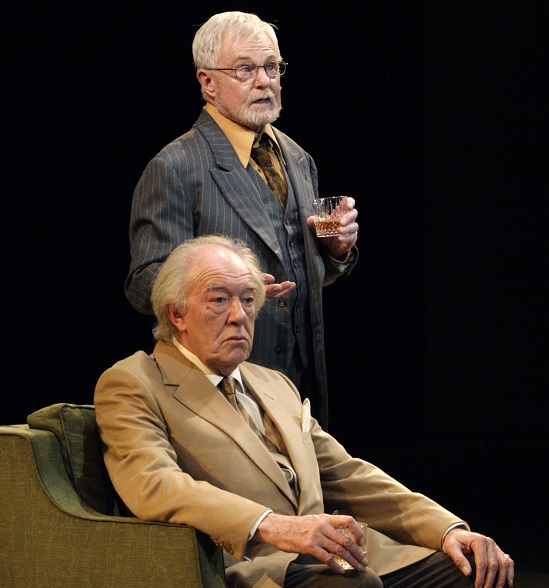
And yet even if the actors were available, this wasn’t simply an exercise in carbon-copying the past. Penelope Wilton and Michael Gambon might easily have revisited Betrayal, but instead he paired up with Derek Jacobi to reincarnate Gielgud and Richardson in No Man’s Land (pictured below), and she with Nicholas Le Prévost for a slice of Ayckbourn’s Bedroom Farce. If the actors weren’t available, rather than do something else the parts were just recast from the company. Thus Arcadia was (rather uncertainly) peopled by new faces led by Rory Kinnear. Ralph Fiennes ferociously deputised for Anthony Hopkins as Lambert Le Roux. Rosalie Craig not Martine McCutcheon sang of the rain in Spain.
You’d get an intriguing idea of the history of musical theatre from the shows on show here: not just Lerner and Loewe and the inexhaustible Guys and Dolls (Nicely Nicely Johnson was shorn by time constraints of his traditional umpteen encores), but also the fleck and spume of Jerry Springer the Opera and the Ipswich sex worker serial killer musical London Road. And Dame Judi, trotting out “Send in the Clowns” one last time, still can’t hold a tune (no please don’t write in).
 This was a compilation album with well-choreographed tonal shifts. Different buttons were pushed as James Corden beat himself up as Francis Henshall, Simon Russell Beale revisited his fiercely intelligent Prince of Denmark, and Joey the foal ballooned into a mighty stallion. And as the story of the National’s 50 years unfolded, a subtle hand was at work making connections between apparently random clips. We segued from one African queen to another as Cleopatra made way for a young gay man in Angels in America dying of Aids and missing his cat Sheba. Alan Bennett’s history boys, caught napping by the headmaster when playing at prostitution in a French class, pretended instead to enact a scene from a military hospital at Ypres. Straight after that the trenches were presaged for real in War Horse.
And for all the in-jokes about critics and actors, rarely did it feel like a self-indulgent orgy of nostalgia. We don’t know what Rufus Norris’s reign will bring, but this highlights package suggested that it’s high time for a revival of Peter Nichols’ The National Health as the NHS endures its latest growing pains, and possibly also for Pravda as the fourth estate endures moral and financial meltdown. It’s also time for Jacobi, a very early member of the National company at the Old Vic, finally to make his full Southbank debut, possibly in some Pinter.
Quibbles and caveats? As a television event it may have all looked quizzical to non-theatregoers. Filmed theatre has come on a treat since the arrival of swooping high-definition cameras, but stage and screen will never be entirely reconciled so long as actors quite properly see it as their first duty to hit the back wall of the upper circle. Two plays about politicians from David Hare felt like too many. Only one female playwright (Alecky Blythe) was simply not enough. And aside from Clive Rowe rocking the boat, it was quite a white night for lead performers until Adrian Lester came on at the death. His Othello neatly completed the circle, the Moor having been Laurence Olivier’s first role for the National, while making the point that the National and indeed the nation has moved on in half a century.
That’s why the line of the night belonged to Kobna Holdbrook-Smith as Guildenstern in Tom Stoppard’s debut play. “One is having one all the time,” he explained to Benedict Cumberbatch’s Rosencrantz, before clarifying: “A future.” See you at the theatre.