

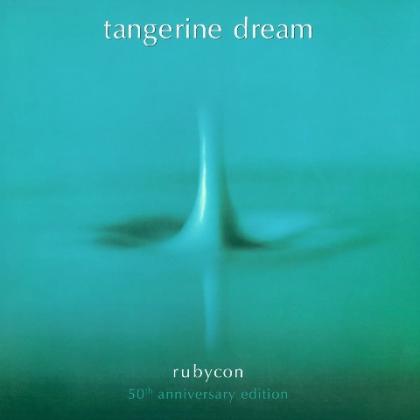
Heard now, 50 years after its release, Tangerine Dream’s Rubycon sounds like what it became: part of the musical template for Jean-Michel Jarre’s 1976 international breakthrough and also as an integral component of the records The Orb began attracting attention with in the early Nineties. Beyond the aesthetic ripples, a specific aspect of the May 1975 album was and is also significant.
Rubycon was one of the first albums by a rock – in its loosest meaning – band to seamlessly incorporate the use of a sequencer. Those with the budget for the gear and the attendant technical know-how could programme and playback sequences of musical notes which it was then possible to manipulate. Underlining this, the booklet coming with the new five-disc clamshell box-set edition of Rubycon includes a listing of the instruments Tangerine Dream used while playing London’s Royal Albert Hall on 2 April 1975. It’s lengthy but in there, with the Mellotron Mark V, MiniMoog Model D synthesiser, Elka Rhapsody 610 string synthesiser, EMS prototype QUEG Quadrophonic effects generator and much, much more, is the keyboard- and sequencer-equipped EMS VCS3 MkII synthesiser.
A little earlier, in 1971, the British company Electronic Music Studios (EMS) began selling the Synthi 100, a huge, super-costly synthesiser – a snip at £6,500. Integral to the unit was a 256-step digital sequencer. The stand-alone EMS Sequencer 128 Synthi was also available (£135). So was the higher-spec EMS Sequencer 256 (£1,100). In 1972, the smaller, more-easily portable, EMS Synthi AKS (£1,452) had an in-built sequencer. Further EMS sequencers – both stand-alone and integral to the synthesiser – would follow. Also on the list of gear for Tangerine Dream’s Albert Hall show were the interrelated 960 Moog sequential controller, Moog 961 sequencer interface and the Moog 962 sequential switch module. Moog had begun developing sequencers in 1967.
It’s a truism that as the technology changes, the music also changes. The skill though is to incorporate the state-of-the-art into what’s being composed, performed and recorded without the result becoming a clunky showcase for new-fangled doo-dads – to do so seamlessly, without becoming subservient to innovation. The opposite, then, to 1980’s records built around a gated drum sound. Rubycon caught an ever-evolving Tangerine Dream which, at the same time, remained what it was: a band – irrespective of line-up changes and Edgar Froese's leadership. A band which had not sacrificed its identity on the alter of progress.
All of which gives Rubycon a freshness which still sparkles. The original album featured a single, long piece split over the record’s two sides. As the box set’s astute liner notes make clear, what was released was born from improvisation and subsequent refinement. A window into this process is provided by a previously unissued track heard on the new box set. Titled “Rubycon (extended introduction),” it is appended to the disc featuring the album. This newly disinterred 15-minute piece was recorded early in the album sessions at Virgin Records’ – the band had signed to the label in September 1973 – Manor Studio in January 1975. A longer version of the first side of the album’s opening section, it is a fascinating glimpse into how Tangerine Dream worked in the studio.
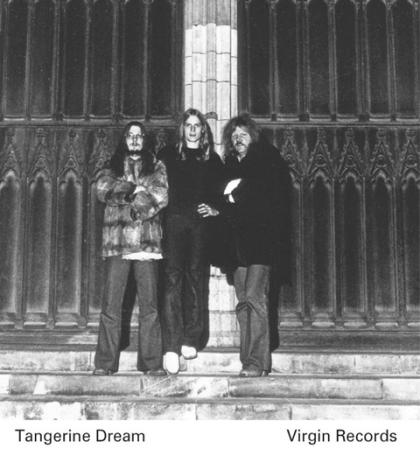
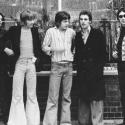
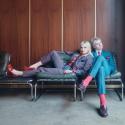
It is not the box set's only eye-opener. There are also – each spread across two discs – recordings of a pair of full shows: The Rainbow, London, 27 October 1974 (with an introduction by full-on fan and on-air TD proselytiser John Peel – the recording was first issued in 2019) and The Royal Albert Hall, 2 April 1975 (recorded and broadcast by the BBC – a show familiar to deep-digging fans). The first is the first show on their first UK tour, the second from when they next played the UK. Each show was recorded by Virgin’s Manor Mobile Studio on multi-track tape, the source used here. It does not seem that this version of the Albert Hall recording is previously issued. As is the Tangerine Dream way, what’s heard is unique to the moment. No one live show was like another. (pictured left, Tangerine Dream before the departure of Peter Baumann. Left to right: Chris Franke, Peter Baumann, Edgar Froese)
The Rainbow show, from before Rubycon was recorded and after the release of Phaedra, their February 1974 Virgin debut, is akin the both albums but more fluid, less structured than either and about the ebb and flow towards elevated climaxes. Heavy, in a head-trip way. For the Albert Hall, there are elements more specific to Rubycon; concision, a greater forward motion than the Rainbow show. These may be, in part, due to the recent arrival of Michael Hoenig in the line-up – he replaced Peter Baumann, who was on Phaedra, Rubycon and with the band for the first UK dates. It may also be due to the assimilation of swiftly evolving musical technology, including the employment of sequencers; an implementation which, by its nature, forces an increasing adoption of structure. In the end, though, each show is about the interplay between the musicians and what they have assembled on stage. Both live shows are so immediate, so well recorded that it is easy to perceive either as the basis for a studio album.
Ultimately, the Rubycon box set can be relished without knowing the nuts and bolts of the musical technology and the related context. However it is seen, any Tangerine dream fan will want this neat set. For the less committed, these five discs are still noteworthy. Herewith, evidence for how Tangerine Dream was inventing the future.
- Next week: UK prog-rock band Gracious!
- More reissue reviews on theartsdesk
- Kieron Tyler’s website


Add comment