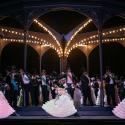
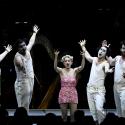
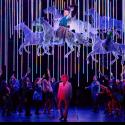
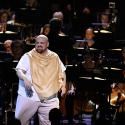
Modern directors have little truck with the idea that particular operas demand particular styles of production, and they can often convince us they’re right.
But there are exceptions. Bartók’s Bluebeard’s Castle is all about doors, doors that conceal, doors that reveal. The text is littered with the word; we want to see them opening. Stravinsky’s Oedipus Rex was composed to a specific stage idiom, derived from Greek theatre. The whole structure of the piece depends on it.
It says a great deal for the brilliance of Joe Hill-Gibbins’s Bluebeard - an English National Opera staging from two years ago - that, with not a door in sight, we nevertheless remain riveted from start to finish of this richly disturbing masterpiece. The case of Oedipus Rex is very different, but more of that in due course.
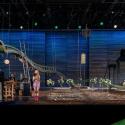
Preceded for some reason by a pair of choral monodies of Hildegard von Bingen, beautifully sung in total darkness by the WNO women’s chorus, the lights come up on Bartók’s spoken Prologue, delivered with a certain high camp aggression by the drag king LJ Parkinson. Curtain up on a brightly lit, white-painted table running the full width of the stage (designer Milla Clarke, lighting by Jack Knowles), that becomes a platform on to which Parkinson - now reimagined as a sort of subterranean Jeeves - spills or tips the symbolic contents of each (cupboard?) door as it opens.

The torture-chamber bleeds a dozen bottles of red wine; the armoury dumps a clatter of knives; the treasury scatters gold tinsel, and so forth. The wide domains (door five) have to be imagined, through the sudden eruption of grand triadic chords in the midst of so much chromatic agony. But at the end there appear from nowhere, not three but (I think but slightly lost count) 13 former wives, all still in their wedding dresses (as Judith is meant to be). Here the production introduces a crucial ambiguity in keeping Judith on stage as the undead wives process away. Bartók has her following them into the darkness of Bluebeard’s frightening neuroses. Hill-Gibbins apparently consigns her instead to the doubtful jollity of his daytime conversation.
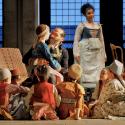
Easily mocked, but unquestionably powerful and coherent as directed and sung on the wide Millennium Centre stage. Christine Rice (pictured above with Nathan Berg) not only sings Judith with great warmth and intensity, but she moves beautifully, even sensuously, from end to end of, or sometimes on, the long table, bringing welcome movement (director Emma Woods) into a work that can be visually static. Nathan Berg is a fine, dark-voiced Bluebeard, and Lidiya Yankovskaya controls the pace and colour of this sombrely radiant score with a sure hand. As one exits through the theatre door oneself, it takes time to recover one’s sang froid.
The new Oedipus Rex is in every sense a different story. Stravinsky and his librettist, Jean Cocteau, conceived it as a series of cinematic freeze-frames, with the chorus immobile, the characters masked and statue-like, the victims, after all, of a pitiless Fate over which they have no control but for which they have nevertheless to atone. Of course, there’s no compulsion to slavishly follow this kind of prescription, and probably no self-respecting director ever would. But in this case the music itself is designed exactly in the spirit of the dramaturgy, a succession of aural tableaux vivants which don’t readily yield to the normal dialectic of stage action.

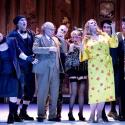
Hill-Gibbins’s staging, by contrast, is so full of movement that it’s sometimes difficult to pick out the solo character of the moment at all. Part of the work’s concept is that the characters barely interact; they are stuck in one place, visually and musically. They are revealed and concealed, by curtains and screens. Here they sometimes barely even register. And Clarke’s modern-dress costumes lend them little distinction. Oedipus in a bright red cotton suit (Peter Hoare, pictured above with Creon, Stephen Richardson, and Jocasta) is visible enough, but a commonplace figure from the start with no hubris to lose; Jocasta (Christine Rice) is not much more than a high-class tart, no queen and barely old enough for an incestuous mother; Tiresias (Nathan Berg), dark-spectacled, almost vanishes in the crowd. And through all this, the Speaker, LJ Parkinson again, wanders like a lost soul with a slightly inadequate microphone, trying to persuade us that these are events of epic moment.
All are first-rate performers inhibited by a production style. Hoare makes little impact as Oedipus, though he sings with real expertise; his blinding passes almost unnoticed. Rice adjusts skilfully from Jugendstil to Neoclassical but cannot project the full neo-Verdian eloquence of her big aria. There are decent contributions from Stephen Richardson (Creon/Messenger) and Alun Rhys-Jenkins (Shepherd), but their symbolic presence - as the twin origin of Oedipus’s downfall - is at best muted.
There is consolation, as ever, in much fine orchestral playing (in both operas) under Yankovskaya. Oedipus Rex, technically a two-acter, is done in a single act, so without the curious effect of ending Act 1 and starting Act 2 with the same Gloria (a self-conscious device pinched by Cocteau from his play Orphée). No great loss, this, though here it was mildly symptomatic of the general de-ritualisation of the work. And could anyone read all the surtitles, switching from the bright table of Bluebeard and the dazzling ceiling light of Oedipus to the faint script above? A shame if not. Hungarian and Latin are not perhaps a Cardiff audience’s best languages.