Fans of Steven McRae will relish this two-hour showcase of his self-reinvention; along the way they may well conceive a similar passion for the fine Bulgarian violinist Vasko Vassilev, who became the Royal Ballet’s Concert Master and soloist in 1993.
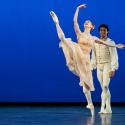
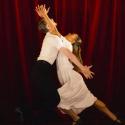
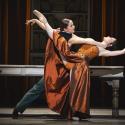
McRae made tragic headlines when his Achilles tendon ruptured onstage mid-Manon in 2019. He battled his way back, but a minor injury once again forced him to withdraw from a major role earlier this year. Nothing daunted, he has now collaborated with his colleague Vassilev on a programme for the Linbury inspired by the music of Paganini. His long-standing dance partner, the Royal Ballet principal Sarah Lamb (pictured below, middle with McRae), performs choreography with him by Loughlan Prior, and pianist Pamela Tan Nicholson joins in the fun.

The first half begins with autobiographical run-throughs of the two men’s careers, illustrated with projected archive photos and video clips. McRae tells us of his upbringing in Sydney, where his father ran a drag racing circuit; he loved to dance but had no means initially to follow his passion. Vassilev, on the other hand, was born into a musical family – both his young parents were professionals – and was something of an infant prodigy, appearing on Bulgarian TV and at high-ranking events, where he would have to play for the country’s communist dictator, Todor Zhivkov.
We watch as the two of them make spectacular progress up the career ladder. McRae won the Prix de Lausanne aged 17 in 2003, adding a cheeky virtuoso tap routine to his programme, and left to take up a scholarship at the Royal Ballet School the very next day. Vassilev won the Paganini Prize, which among other things allowed him to play the violinist’s own instrument; after glasnost he won a scholarship to Guildhall, and soon he too was living in London far away from his family.

It’s fun to see clips of the young prodigies, a preteen McRae throwing himself into jazz dance, always with a radiant grin, and Vassilev playing with the confidence and elan of a mature adult. He hadn’t considered being a concert master or playing with a theatre orchestra; after his Guildhall courses ended, he had to hand back the instrument he had been loaned and was offered a replacement by one orchestra only if he signed a 25-year contract. So he pursued the possibility of becoming a concert master – and became the Royal Ballet’s first, and youngest, at 23, given all the plum solos in scores like the Tchaikovsky classics.
In the first half of the programme, graced by Lamb’s arrival for a number of elegant duets, McRae shows he hasn’t lost any of his partnering skills, even if grands jetés are off the menu. Lamb also joins in the dialogue, sweetly recalling 18-year-old McRae’s first day in the rehearsal room in 2003, when she was already a principal; he recalls the wide smile she gave him. Within five years he was a principal too, tackling all the big roles, usually with Lamb as his partner.
Playing himself is not McRae’s strongest suit (though the more confident Vassilev is an impressive speaker), and the script they have devised feels a touch stilted, employing the conceit of pretending they are gathering at a rehearsal studio, equipped with PA announcements and takeaway coffees. But the dancing – to Bach, Tchaikovsky, Vivaldi, Paganini and Monti’s Czardas – is more than adequate compensation, full of lifts and spins performed with the confidence a long-term partnership brings. And McRae can still do thrilling high-speed chainés, it seems.

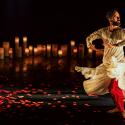
The mood grows larkier in the second act, which is devoted to Paganini. All four performers dress in concert tails and unruly black wigs, four assorted Paganinis. He had played his last concert at London’s Theatre Royal in 1832. The evening builds to twin peaks of virtuosity. Vassilev gets to show off his ability, as Paganini used to – including at that last recital – of playing one of his compositions on just one string (pictured above). We watch Vassilev remove the other three: no cheating. And McRae unleashes his tap-dancing. Some tap stays earthbound, but his is always threatening to take off into the air. Lamb too signs off her contribution with a deep fishtail that lifts her leg almost over her head
Natalie Abrahami has staged the piece with brio – I particularly liked the moment when McRae opens up the piano lid and bright clouds of dry ice pour out of it. Her staging also moves the dancers onto the (suitably protected) lid of the piano to continue their routines, McRae in his tap shoes, Lamb on pointe.
The highlight of the show, though, is watching the extreme pleasure McRae and Vassilev take in each other’s performances, driving the pace on to ever more impressive feats. It’s not a perfect evening, but the joy with which Vassilev buoys up the proceedings, helping McRae experience the exhilaration of dancing onstage again, is palpable and poignant.
- The McRae/Vassilev Project at the Linbury Theatre until 19 September
- More dance reviews on theartsdesk