
Dancing on the Edge, BBC Two | reviews, news & interviews
Dancing on the Edge, BBC Two
Dancing on the Edge, BBC Two
Stephen Poliakoff's bloated epic ain't got that swing
Tuesday, 05 February 2013
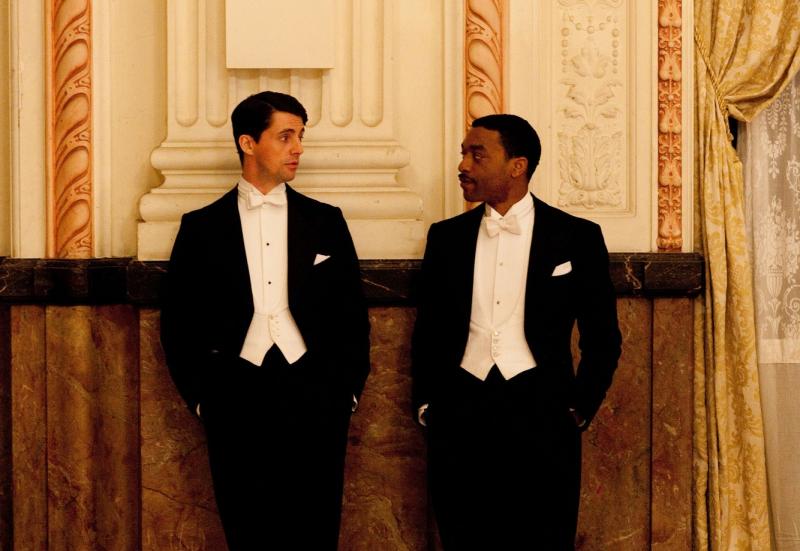
Matthew Goode and Chiwetel Ejiofor in 'Dancing on the Edge'
There is a sequence – quite a long sequence – in the first episode of Dancing on the Edge in which the main characters are all guests on a train. The passengers are curious to know their destination, only it turns out there isn’t one. This is a pleasure trip with no particular place to go. An hour and a half into Stephen Poliakoff’s latest portrait of English manners and mores, boy do you know how they feel.
It’s impossible to fault Dancing on the Edge for ambition. Given five episodes to tell of a black jazz band bringing swing to London’s upper echelons in the early 1930s, Poliakoff has been granted the keys to the schedules like few other television auteurs this side of Alan Bleasdale. Yes, this is ostensibly a period drama based partly on research, but as Britain frets about fresh waves of immigrants, Dancing on the Edge itches to hold up a mirror to the present day. And along the way there is quite a bit to enjoy. Adrian Johnston’s original music is a blast. The costumes are simply divine. It is all atmospherically shot (by Ashley Rowe). And yet, and yet... something profound has gone AWOL. Thus far at least, Dancing on the Edge is basically The Paradise with a hip brass section.
 We start promisingly, with the immaculately togged Louis Lester (Chiwetel Ejiofor) calling one night on old chum Stanley (Matthew Goode). He’s in need of help, but no sooner does the whiff of a friendship gone sour waft across the nostrils than we spool back to the pair’s first meeting. Stanley, it turns out, is a crafty glottal-stopping larrikin who runs a music rag and, hearing of an exotic combo called the Louis Lester Band, helps champion them into a gig at a smart hotel. The doddery clients in tiaras and floor-length crinoline aren’t quite ready for (period terminology alert) "coloured" musicians setting off a fearful racket, but a group of bright young flappers (pictured above right) swiftly adopt them. An emollient cove (Anthony Head) is also on hand to oil the wheels, and soon they are playing for royalty – first the Duke of Kent, and by the end of the episode the Prince of Wales.
There are hints of darkness along the way. The band’s manager (Ariyon Bakare), apparently American but claiming to be Welsh, is one of those querulous types (contrast with the unflappable Lester) and is threatened with deportation. The hotel owner (Mel Smith, would you believe) is a hard-nosed sceptic, while in the background a shady American billionaire (John Goodman) trashes hotel rooms and throws his money at underwritten young squeezes. One does hope Goodman opens his mouth at some point, because currently he looks like a very expensive extra.
 And yet for all the teeming canvas, from bosomy secretaries to stiff-necked officials, this is very far from being the post-Dickensian panorama it thinks it is. Having set up a promising mise-en-scène, Poliakoff seems to have nothing original to say either about the ruling classes or the position of black people in Thirties England. And with so many nice white chaps behave so jolly tolerantly, the script feels fundamentally mendacious about the ingrained racism of the era. Most characters appear fashioned from a compound of balsawood and tissue paper – Joanna Vanderham’s vampish nonentity Pamela, Tom Hughes’s nice but dim Julian, the two female singers (Wunmi Mosaku and Angel Coulby, above pictured left) the band is encouraged to take on after a scrupulously hackneyed audition scene. Even the hotel ballroom lacks character.
Throw in photography, Russian émigrés and royalty, and it’s as if Poliakoff is simply rifling through old obsessions. The result feels gruellingly bland, bizarrely uncurious and often plain cloth-eared. It says everything that Poliakoff's phobic approach that he reports a nefarious masonic gathering but shows only brief glimpses of it through a spyhole.
Somewhere inside this bloated, slow-coach colossus, a taut and intriguing smaller drama has been throttled. It stars Goode’s unreadable Svengali, who is shaping up to be a treat, and Ejiofor, who could bring weight and integrity to the phone book. Hey, it may warm up. The characters may acquire flesh and blood and things to say. But for now, Dancing on the Edge don't mean a thing.
Add comment
more TV
 Blue Lights Series 2, BBC One review - still our best cop show despite a slacker structure
The engaging Belfast cops are less tightly focused this time around
Blue Lights Series 2, BBC One review - still our best cop show despite a slacker structure
The engaging Belfast cops are less tightly focused this time around
 Baby Reindeer, Netflix review - a misery memoir disturbingly presented
Richard Gadd's double traumas are a difficult watch but ultimately inspiring
Baby Reindeer, Netflix review - a misery memoir disturbingly presented
Richard Gadd's double traumas are a difficult watch but ultimately inspiring
 Anthracite, Netflix review - murderous mysteries in the French Alps
Who can unravel the ghastly secrets of the town of Lévionna?
Anthracite, Netflix review - murderous mysteries in the French Alps
Who can unravel the ghastly secrets of the town of Lévionna?
 Ripley, Netflix review - Highsmith's horribly fascinating sociopath adrift in a sea of noir
Its black and white cinematography is striking, but eventually wearying
Ripley, Netflix review - Highsmith's horribly fascinating sociopath adrift in a sea of noir
Its black and white cinematography is striking, but eventually wearying
 Scoop, Netflix review - revisiting a Right Royal nightmare
Gripping dramatisation of Newsnight's fateful Prince Andrew interview
Scoop, Netflix review - revisiting a Right Royal nightmare
Gripping dramatisation of Newsnight's fateful Prince Andrew interview
 RuPaul’s Drag Race UK vs the World Season 2, BBC Three review - fun, friendship and big talents
Worthy and lovable winners (no spoilers) as the best stay the course
RuPaul’s Drag Race UK vs the World Season 2, BBC Three review - fun, friendship and big talents
Worthy and lovable winners (no spoilers) as the best stay the course
 This Town, BBC One review - lurid melodrama in Eighties Brummieland
Steven Knight revisits his Midlands roots, with implausible consequences
This Town, BBC One review - lurid melodrama in Eighties Brummieland
Steven Knight revisits his Midlands roots, with implausible consequences
 Passenger, ITV review - who are they trying to kid?
Andrew Buchan's screenwriting debut leads us nowhere
Passenger, ITV review - who are they trying to kid?
Andrew Buchan's screenwriting debut leads us nowhere
 3 Body Problem, Netflix review - life, the universe and everything (and a bit more)
Mind-blowing adaptation of Liu Cixin's novel from the makers of 'Game of Thrones'
3 Body Problem, Netflix review - life, the universe and everything (and a bit more)
Mind-blowing adaptation of Liu Cixin's novel from the makers of 'Game of Thrones'
 Manhunt, Apple TV+ review - all the President's men
Tobias Menzies and Anthony Boyle go head to head in historical crime drama
Manhunt, Apple TV+ review - all the President's men
Tobias Menzies and Anthony Boyle go head to head in historical crime drama
 The Gentlemen, Netflix review - Guy Ritchie's further adventures in Geezerworld
Riotous assembly of toffs, gangsters, travellers, rogues and misfits
The Gentlemen, Netflix review - Guy Ritchie's further adventures in Geezerworld
Riotous assembly of toffs, gangsters, travellers, rogues and misfits
 Oscars 2024: politics aplenty but few surprises as 'Oppenheimer' dominates
Christopher Nolan biopic wins big in a ceremony defined by a pink-clad Ryan Gosling and Donald Trump seeing red
Oscars 2024: politics aplenty but few surprises as 'Oppenheimer' dominates
Christopher Nolan biopic wins big in a ceremony defined by a pink-clad Ryan Gosling and Donald Trump seeing red
Comments
"And with so many nice white
Sorry, Anonymous, but it's
Fascinating to read how
Think this review is spot on.
Lighten up everyone this is
I disagree with this review
Completely agree (with
Buh ?? you must have been
I agree with Jasper Rees'
I agree with Jasper Rees' review : I looked forward with anticipation to this "big" drama, and was bitterly disappointed after the first episode. The script appeared to have written by a group of 15 year olds, so predictable, so trite. Perhaps the BBC drama stasi had watered down Poliakoff's words to an anodyne nothingness. Full marks though to costume, music, & photography..... it was a wonderful evocation of 30's culture.
To me,as a student of pre war
Thank you for this comment. I
I started watching this
With so much rubbish on TV,
There is a semiological
Maybe it was the title? BBC
I am enjoying this. The main
Great drama. Portrays this
I had high expectataions and