
Ravel Double Bill, Glyndebourne Festival Opera | reviews, news & interviews
Ravel Double Bill, Glyndebourne Festival Opera
Ravel Double Bill, Glyndebourne Festival Opera
Dazzling stagings of two Ravel operas reveal their style and flatter their substance
Sunday, 05 August 2012
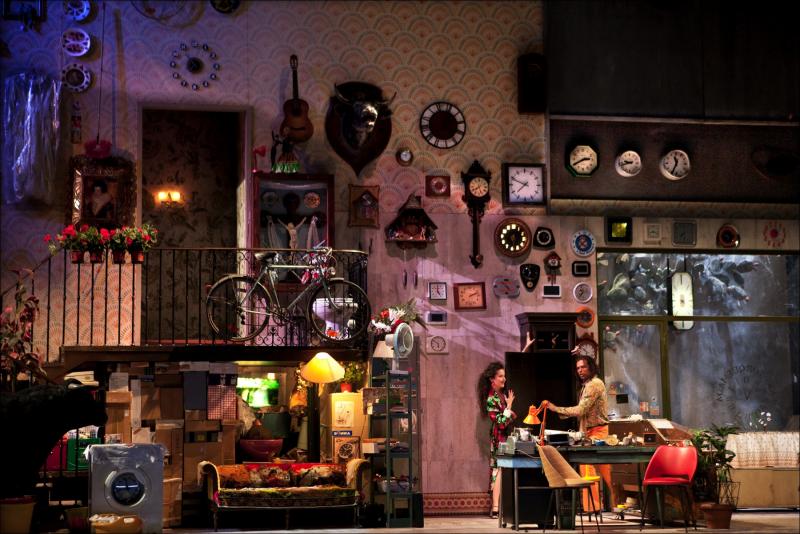
L'Heure espagnole: Conceptión and Gonzalve compare versesSimon Annand
Ravel composed only two operas, both one-acters, widely separated in time, superficially very different, but both in a way about the same thing: naughtiness. In L’Heure espagnole (1911), the clockmaker’s wife, Conceptión, entertains a succession of would-be lovers in her husband’s absence.
In L’Enfant et les sortilèges (1924), the little boy who won’t do his homework, who smashes the teapot, pulls the cat’s tail and rips the wallpaper, suddenly finds his victims coming to life and scaring him to death.
Naughtiness, rather than wickedness: Torquemada, the clockmaker, turns a blind eye on his wife’s peccadilloes because they help him sell clocks; the boy is redeemed by tending an injured squirrel’s paw. It’s the world of Feydeau farces and children’s pantomime – an enchanted world free of painful outcomes; and Ravel provided music to match, all froth and gesture in the clock-shop, all pizazz and sentiment in L’Enfant.
Nobody ever wrote music of greater wit or stylishness
It’s hard to see either piece as the work of “an infinitely greater 20th-century composer than Debussy or Stravinsky,” to quote Rodney Milnes’s wonderfully tongue-in-cheek programme note (naughtiness again). But nobody ever wrote music of greater wit or stylishness, or offered the stage director and designer better chances to display their art without the need for obscure Conceptións of their own. At Glyndebourne these chances have been embraced with open arms.
Caroline Ginet and Florence Evrard turn Torquemada’s establishment into a colourful junk shop rich in clutter of every kind: clocks with faces that light up or hands that whizz round, plates on the walls, guitars on the floor (even the exit signs that the director, Laurent Pelly, was not allowed to remove so made a virtue of). The whole thing is a delight to the eye, in much the way that Ravel delights the ear with his musical bric-à-brac, gasping phrases that lead nowhere in particular, harp swirls and clarinet arpeggios, that whole compendium of Gallic Iberiana he had already drawn on in piano works like Habañera or Alborada del gracioso: style without a great deal of content, but so skilfully and tastefully handled that one scarcely notices its essential weightlessness.
 L’Heure espagnole is by no means performance proof. I’ve seen adequate productions that leave the music’s refinement fighting for its life. But not here. Pelly’s direction is straightforward, alert, musical, timed to perfection, just sufficiently overstated, intensely witty. It had the audience in stitches and, by the end, bubbling with pleasure. And musically the performance is a model of idiomatic sparkle, conducted with sublime precision by Kazushi Ono, and tossed off without a tremor by the London Philharmonic Orchestra.
Stéphanie d’Oustrac’s Conceptión is immaculate in every respect except her behaviour: exquisitely sung, man-hungry to the point of willingness to descend from the poet (Gonzalve: Alek Shrader, a masterly Spanish Bunthorne, all hair and verbiage) to the muleteer Ramiro (Elliot Madore), muscular and mindless, barely able to tell the difference between humping clocks and bonking clockmakers’ wives. François Piolino’s Torquemada (pictured above right) floats through these encounters with sovereign unconcern (“you won’t need clocks any more,” he blandly assures his wife, while instructing her lover to “tell her the time” as he goes by every morning). Paul Gay’s banker Don Iñigo Gómez, likewise excellent, spends much of the Spanish hour coffined in a grandfather clock and has to be levered out by Ramiro: quantitative easing indeed. And he has to buy the clock…
 L’Enfant et les sortilèges normally emerges from the double-bill as the stronger work. But for once, here, that isn’t clearly the case. It has more memorable music, more substance, no doubt. But Colette’s libretto is not without its problems: strong and inventive so long as it preserves the revue structure of the first scene, tending to drift into sentimentality in the garden scene, where nature rounds on the boy, then marvels at the “humanity” with which he bandages the squirrel (in this production a bird, which seems to miss the point that it’s the squirrel he has injured at the start).
Pelly’s staging, with unforgettable designs by Barbara de Limburg (costumes here and in L’Heure espagnole by Pelly himself with Jean-Jacques Delmotte), responds to these strengths and weaknesses. The first scene is sheer brilliance: the child (Khatouna Gadelia) utterly convincing, tiny on an outsize chair and table (pictured above), across which the broken teapot (Piolino again) and Chinese cup (Elodie Méchain) cavort suggestively; the irresistible scene of the torn wallpaper and the bereft toile de jouy shepherds and shepherdesses; and much, much else. All quite magical.
In the garden the designs are scarcely less inventive; the ideas flow. But the music gives them less to work with. Some kind of dramatic climax, some sense of growth are needed but never come; so in the end the child’s new leaf seems gratuitous (and probably won’t stay turned): sentimentality – in James Joyce’s definition – as unearned emotion. Even so Pelly, Limburg and co. remain supremely watchable, imaginative and sensitive to detail. Once again the musical performance is nonpareil: far too many singers to list, a real company effort on the highest level, several roles doubled, and without a noticeable weakness. And Kazushi Ono again presides with discreet mastery and a feeling for the light touch without which Ravel would not be Ravel.
A world of Feydeau farces and children’s pantomime – an enchanted world free of painful outcomes
Explore topics
Share this article
Add comment
more Opera
 Simon Boccanegra, Hallé, Elder, Bridgewater Hall, Manchester review - thrilling, magnificent exploration
Verdi’s original version of the opera brought to exciting life
Simon Boccanegra, Hallé, Elder, Bridgewater Hall, Manchester review - thrilling, magnificent exploration
Verdi’s original version of the opera brought to exciting life
 Aci by the River, London Handel Festival, Trinity Buoy Wharf Lighthouse review - myths for the #MeToo age
Star singers shine in a Handel rarity
Aci by the River, London Handel Festival, Trinity Buoy Wharf Lighthouse review - myths for the #MeToo age
Star singers shine in a Handel rarity
 Carmen, Royal Opera review - strong women, no sexual chemistry and little stage focus
Damiano Michieletto's new production of Bizet’s masterpiece is surprisingly invertebrate
Carmen, Royal Opera review - strong women, no sexual chemistry and little stage focus
Damiano Michieletto's new production of Bizet’s masterpiece is surprisingly invertebrate
 La scala di seta, RNCM review - going heavy on the absinthe?
Rossini’s one-acter helps young performers find their talents to amuse
La scala di seta, RNCM review - going heavy on the absinthe?
Rossini’s one-acter helps young performers find their talents to amuse
 Death In Venice, Welsh National Opera review - breathtaking Britten
Sublime Olivia Fuchs production of a great operatic swansong
Death In Venice, Welsh National Opera review - breathtaking Britten
Sublime Olivia Fuchs production of a great operatic swansong
 Salome, Irish National Opera review - imaginatively charted journey to the abyss
Sinéad Campbell Wallace's corrupted princess stuns in Bruno Ravella's production
Salome, Irish National Opera review - imaginatively charted journey to the abyss
Sinéad Campbell Wallace's corrupted princess stuns in Bruno Ravella's production
 Jenůfa, English National Opera review - searing new cast in precise revival
Jennifer Davis and Susan Bullock pull out all the stops in Janáček's moving masterpiece
Jenůfa, English National Opera review - searing new cast in precise revival
Jennifer Davis and Susan Bullock pull out all the stops in Janáček's moving masterpiece
 theartsdesk in Strasbourg: crossing the frontiers
'Lohengrin' marks a remarkable singer's arrival on Planet Wagner
theartsdesk in Strasbourg: crossing the frontiers
'Lohengrin' marks a remarkable singer's arrival on Planet Wagner
 Giant, Linbury Theatre review - a vision fully realised
Sarah Angliss serves a haunting meditation on the strange meeting of giant and surgeon
Giant, Linbury Theatre review - a vision fully realised
Sarah Angliss serves a haunting meditation on the strange meeting of giant and surgeon
 Der fliegende Holländer, Royal Opera review - compellingly lucid with an austere visual beauty
Bryn Terfel's Dutchman is a subtly vampiric figure in this otherworldly interpretation
Der fliegende Holländer, Royal Opera review - compellingly lucid with an austere visual beauty
Bryn Terfel's Dutchman is a subtly vampiric figure in this otherworldly interpretation
 The Magic Flute, English National Opera review - return of an enchanted evening
Simon McBurney's dark pantomime casts its spell again
The Magic Flute, English National Opera review - return of an enchanted evening
Simon McBurney's dark pantomime casts its spell again
 Così fan tutte, Welsh National Opera review - relevance reduced to irrelevance
School for lovers not much help to the singers
Così fan tutte, Welsh National Opera review - relevance reduced to irrelevance
School for lovers not much help to the singers
Comments
What a staggering
Wit, certainly, but so much
As so often on the web,