
Madam Butterfly, Welsh National Opera | reviews, news & interviews
Madam Butterfly, Welsh National Opera
Madam Butterfly, Welsh National Opera
East German staging of Puccini's japonaiserie mellowed by time and language
Saturday, 16 February 2013
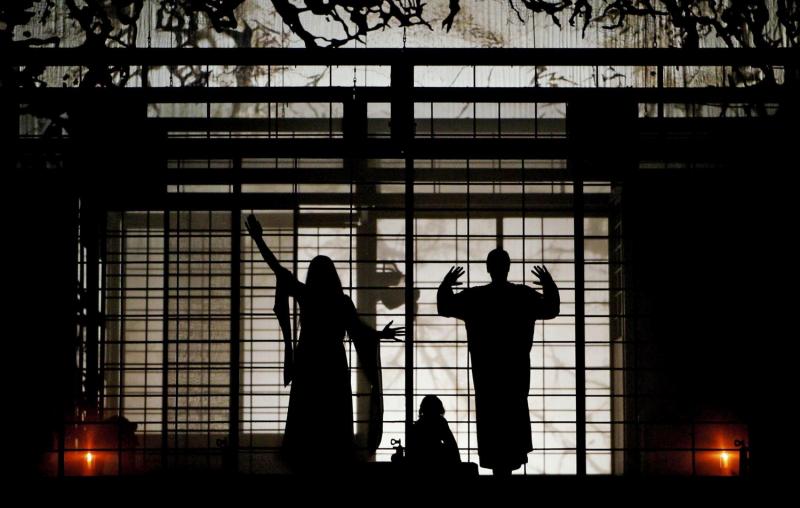
Butterfly, Trouble and Suzuki: in a Japanese fly-trapNeil Bennett
Last week Lulu, this week Cio-Cio San, next week the Vixen Bystrouška. These are the three exemplars of David Pountney’s “Free Spirits” – as he labels his first themed season with WNO. But it’s hard to see poor little Butterfly, pinned to a board by the cruel American sailor-lepidopterist, as a free anything.
Like a trapped fly, Suzuki calls her; and if there’s a free spirit in Puccini’s opera, it might rather be Pinkerton himself, “dropping anchor at random,” as he boasts to Sharpless: not such an inspiring thought.
Joachim Herz’s production, now 35 years old, was rough and aggressive when new. I remember apologising to the American friend I saw it with for its brutal anti-Americanism. In those days WNO sang it in English and the politics were direct. Now, in Italian, it has a softer edge and there is no monkeying with the words, though the music is a hybrid of Puccini’s various revisions (three acts, but no “Fiorito asil” for Pinkerton).
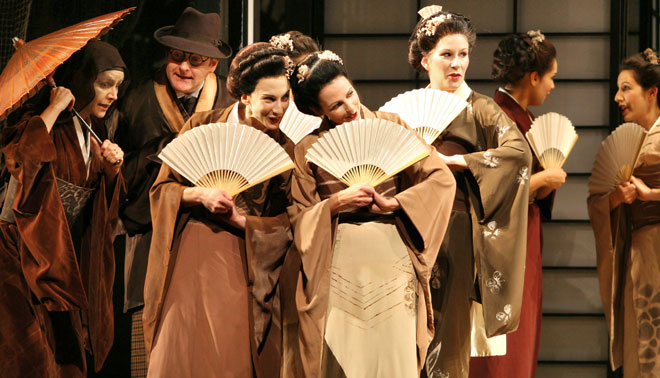
It now seems a model production, beautifully rehearsed by Caroline Chaney, stylishly Japanese when required in the first act, cleverly westernising later as Cio-Cio San practises being Mrs.Pinkerton. Reinhart Zimmermann’s delicate sliding screens are ideal as design and perfection as a practical, mobile setting, bearing in mind that this is an opera in three acts but only a single set. Chaney complements them with cleverly managed stage movement and telling, sensitive groupings, expressive of the culture clash which – if Madam Butterfly is anything but operatic soap – is both the landscape and the cause of its tragedy. The chorus work, as ever, is excellent (chorus pictured below).
 In keeping with all this, the revival is strongly acted, perhaps less strongly – though certainly not weakly – sung. Cheryl Barker is convincing as the coy, simpering schoolgirl of the first act, slightly less so as the teenage mother of Acts 2 and 3, but a thoughtful, versatile vocal actress nonetheless, only somewhat short on colour in the voice, not quite able to flood the sound with emotion at key moments. Gwyn Hughes Jones is likewise more monochrome than recently at ENO, stylish but without great warmth in the voice, careful though to avoid caricaturing this irretrievably mindless if not unfeeling (listen to his music) Yankee fantasist.
It’s tough on Pinkerton that, after the exquisite duet that ends the first act, he more or less vanishes, along with most of the other characters, leaving Butterfly and her Suzuki, touchingly done here by Claire Bradshaw, to hope and mope alone, with occasional visits from the ever-optimistic marriage broker, Goro (Philip Lloyd Holtam, very polished). Alan Opie’s Consul struggles up the hill from Nagasaki now and then, helpless rather than Sharpless, an exact vignette: but he too gets little music after Act 1, which one regrets here as always. Instead Puccini offers cameos: the Bonze (Julian Close, a fine but brief rage), the suitor Yamadori (Alastair Moore), and above all the silent Trouble (are there such children?), a remarkable début by Jacob Adams, son of the orchestra’s leader.
Hard to improve on any of these, or on the orchestra itself, under the French conductor Frédéric Chaslin: refined playing after their more robust brilliance in Lulu, with just a slight tendency to cover the singers – not usually a Puccini problem.
- Madam Butterfly at the Wales Millennium Centre until 2 March, then on tour
- Find other performances by Welsh National Opera
more Opera
 Aci by the River, London Handel Festival, Trinity Buoy Wharf Lighthouse review - myths for the #MeToo age
Star singers shine in a Handel rarity
Aci by the River, London Handel Festival, Trinity Buoy Wharf Lighthouse review - myths for the #MeToo age
Star singers shine in a Handel rarity
 Carmen, Royal Opera review - strong women, no sexual chemistry and little stage focus
Damiano Michieletto's new production of Bizet’s masterpiece is surprisingly invertebrate
Carmen, Royal Opera review - strong women, no sexual chemistry and little stage focus
Damiano Michieletto's new production of Bizet’s masterpiece is surprisingly invertebrate
 La scala di seta, RNCM review - going heavy on the absinthe?
Rossini’s one-acter helps young performers find their talents to amuse
La scala di seta, RNCM review - going heavy on the absinthe?
Rossini’s one-acter helps young performers find their talents to amuse
 Death In Venice, Welsh National Opera review - breathtaking Britten
Sublime Olivia Fuchs production of a great operatic swansong
Death In Venice, Welsh National Opera review - breathtaking Britten
Sublime Olivia Fuchs production of a great operatic swansong
 Salome, Irish National Opera review - imaginatively charted journey to the abyss
Sinéad Campbell Wallace's corrupted princess stuns in Bruno Ravella's production
Salome, Irish National Opera review - imaginatively charted journey to the abyss
Sinéad Campbell Wallace's corrupted princess stuns in Bruno Ravella's production
 Jenůfa, English National Opera review - searing new cast in precise revival
Jennifer Davis and Susan Bullock pull out all the stops in Janáček's moving masterpiece
Jenůfa, English National Opera review - searing new cast in precise revival
Jennifer Davis and Susan Bullock pull out all the stops in Janáček's moving masterpiece
 theartsdesk in Strasbourg: crossing the frontiers
'Lohengrin' marks a remarkable singer's arrival on Planet Wagner
theartsdesk in Strasbourg: crossing the frontiers
'Lohengrin' marks a remarkable singer's arrival on Planet Wagner
 Giant, Linbury Theatre review - a vision fully realised
Sarah Angliss serves a haunting meditation on the strange meeting of giant and surgeon
Giant, Linbury Theatre review - a vision fully realised
Sarah Angliss serves a haunting meditation on the strange meeting of giant and surgeon
 Der fliegende Holländer, Royal Opera review - compellingly lucid with an austere visual beauty
Bryn Terfel's Dutchman is a subtly vampiric figure in this otherworldly interpretation
Der fliegende Holländer, Royal Opera review - compellingly lucid with an austere visual beauty
Bryn Terfel's Dutchman is a subtly vampiric figure in this otherworldly interpretation
 The Magic Flute, English National Opera review - return of an enchanted evening
Simon McBurney's dark pantomime casts its spell again
The Magic Flute, English National Opera review - return of an enchanted evening
Simon McBurney's dark pantomime casts its spell again
 Così fan tutte, Welsh National Opera review - relevance reduced to irrelevance
School for lovers not much help to the singers
Così fan tutte, Welsh National Opera review - relevance reduced to irrelevance
School for lovers not much help to the singers
 Manon Lescaut, English Touring Opera review - a nightmare in too many ways
Grotesque staging sabotages Puccini's breakthrough tragedy
Manon Lescaut, English Touring Opera review - a nightmare in too many ways
Grotesque staging sabotages Puccini's breakthrough tragedy
Add comment