
Hadewijch | reviews, news & interviews
Hadewijch
Hadewijch
Bruno Dumont's portrait of a failed novice seduced by a jihadist's fervent talk of faith
Saturday, 18 February 2012
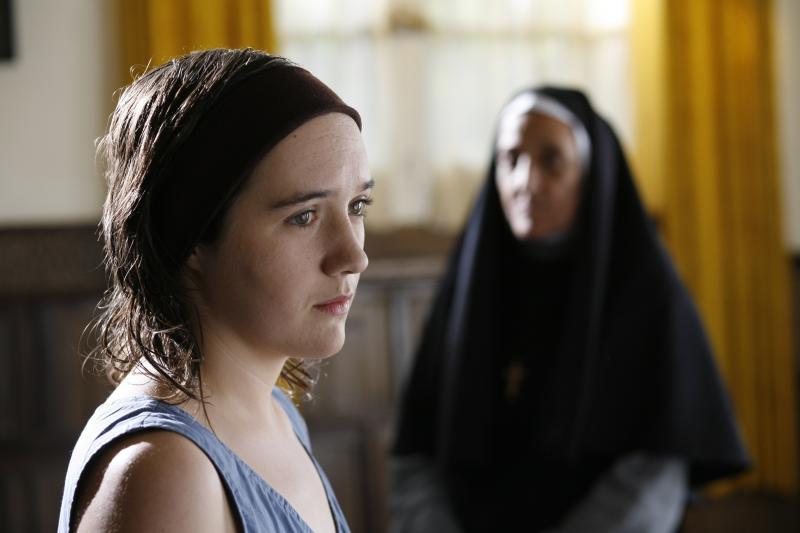
In the name of God, go: Hadewijch (Julie Sokolowski) gets her marching ordersNew Wave Films
Hadewijch of Antwerp was a 13th-century mystic whose poetry had a formative influence on Dutch literature. Though influenced by the courtly love tradition, the subject of her poems was the love of God and the mysteries of the divine. She was probably not a nun but a beguine – a devout noblewoman in a self-denying contemplative order that carried out works of Christian charity. There is a suggestion in her letters that she may have been exiled from her sisters and yearned to rejoin them.
So it is with the novice (Julie Sokolowski) named Hadewijch who’s cast out of her rural monastery at the start of Bruno Dumont’s transfixing fifth film. An excessively devout theology student, she gives her bread to the birds and dresses inadequately in winter, a form of self-mortification that, says the mother superior, makes her “a caricature of a nun”. Instead of taking orders, she is sent off to discover her “true desires”. A man (David Dewaele) who has been doing building work at the monastery, and who is possibly attracted to her, also leaves the premises, to return to prison for breaking parole. They are linked by their need to remake their lives. Their paths will cross eventually, though not in the most obvious way.
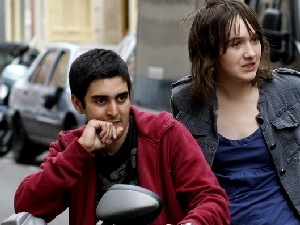
Hadewijch, whose secular name is Céline, returns to the opulent but spiritually dead Paris apartment of her remote mother and cabinet minister father, whom she regards as a patronising “jerk.” She allows herself to be chatted up in a café by three Moslem banlieue boys who marvel at her naïveté. One of them, Yassine (Yassine Salime, right, with Sokolowski), takes her to a gig and vainly tries to kiss her. She later explains to the mystified youth that she’s a virgin in love with God to the exclusion of men and has renounced the idea of sex.
The boy, who’s faithless, and the girl remain close, but she falls under the spell of his older brother, Nassir (Karl Sarafidis), who teaches the Koran. When she attends his class, he dwells on the paradox of God being both visible and invisible, echoing the paradoxical notion of the eternal love of God put forward by the medieval Hadewijch: “Her truest fidelity brings about our fall / Her highest being drowns us in the depths.”
On a daytrip they take to the monastery, Nassir argues that political action, violent if necessary, is essential to faith, and that “God is a sword against injustice.” Passively and somewhat implausibly (for she fears for the innocent), Céline agrees to join his jihad. Suddenly the pair are visiting an unspecified Middle Eastern country where they witness the aftermath of a bombing and meet with the members of a terrorist cell. Back in Paris, they go on a mission…
Whether victims or perpetrators of evil or both, the protagonists of Dumont’s films undergo agonies. For that reason all of them are more or less sympathetic, excepting the heinous American photographer and homosexual rape victim in the crudely symbolic Twentynine Palms (2003). Céline is the most sympathetic yet.
The sobbing girl begs mercy fom God: 'Why do you force me to pursue you incessantly?'
In the film’s most moving scene, following her realisation she has done a terrible wrong, the sobbing girl runs though woods to her church, where the doors are permanently locked, and begs for mercy from God. “Why do you force me to pursue you incessantly, further and further?” she cries. “You have made me pay too high a price.” Dumont is questioning the gods of organised religion and faith that’s corruptible. And then – and it’s entirely in keeping with the film’s emotional trajectory – the redeemer shows himself, not in God but in a flawed fellow human being.
Hadewijch is blessed by an extraordinary performance by Sokolowski, who was an 18-year-old non-actor when Dumont met her at a screening of his 2006 Flanders and who hasn’t appeared in a movie since. As lumpen-looking as all of the director’s main characters, she is frequently shown in close-up by the cinematographer Yves Cape as if had been studying paintings of martyred saints, his images making her radiantly beautiful. The film’s long takes and its spareness and sombreness meanwhile keep Dumont close to the master of suffering and austerity, Robert Bresson.
Watch the trailer to Hadewijch
Add comment
more Film
 The Book of Clarence review - larky jaunt through biblical epic territory
LaKeith Stanfield is impressively watchable as the Messiah's near-neighbour
The Book of Clarence review - larky jaunt through biblical epic territory
LaKeith Stanfield is impressively watchable as the Messiah's near-neighbour
 Blu-ray/DVD: Priscilla
The disc extras smartly contextualise Sofia Coppola's eighth feature
Blu-ray/DVD: Priscilla
The disc extras smartly contextualise Sofia Coppola's eighth feature
 Back to Black review - rock biopic with a loving but soft touch
Marisa Abela evokes the genius of Amy Winehouse, with a few warts minimised
Back to Black review - rock biopic with a loving but soft touch
Marisa Abela evokes the genius of Amy Winehouse, with a few warts minimised
 Civil War review - God help America
A horrifying State of the Union address from Alex Garland
Civil War review - God help America
A horrifying State of the Union address from Alex Garland
 The Teachers' Lounge - teacher-pupil relationships under the microscope
Thoughtful, painful meditation on status, crime, and power
The Teachers' Lounge - teacher-pupil relationships under the microscope
Thoughtful, painful meditation on status, crime, and power
 Blu-ray: Happy End (Šťastný konec)
Technically brilliant black comedy hasn't aged well
Blu-ray: Happy End (Šťastný konec)
Technically brilliant black comedy hasn't aged well
 Evil Does Not Exist review - Ryusuke Hamaguchi's nuanced follow-up to 'Drive My Car'
A parable about the perils of eco-tourism with a violent twist
Evil Does Not Exist review - Ryusuke Hamaguchi's nuanced follow-up to 'Drive My Car'
A parable about the perils of eco-tourism with a violent twist
 Io Capitano review - gripping odyssey from Senegal to Italy
Matteo Garrone's Oscar-nominated drama of two teenage boys pursuing their dream
Io Capitano review - gripping odyssey from Senegal to Italy
Matteo Garrone's Oscar-nominated drama of two teenage boys pursuing their dream
 The Trouble with Jessica review - the London housing market wreaks havoc on a group of friends
Matt Winn directs a glossy cast in a black comedy that verges on farce
The Trouble with Jessica review - the London housing market wreaks havoc on a group of friends
Matt Winn directs a glossy cast in a black comedy that verges on farce
 Silver Haze review - daughters of Albion dealing with damage
Vicky Knight and Esmé Creed-Miles shine in a drama inspired by Knight's tragic past
Silver Haze review - daughters of Albion dealing with damage
Vicky Knight and Esmé Creed-Miles shine in a drama inspired by Knight's tragic past
 Mothers' Instinct review - 'Mad Women'
Sixties suburban duel veers between daftness and spooky power
Mothers' Instinct review - 'Mad Women'
Sixties suburban duel veers between daftness and spooky power
 Godzilla x Kong: The New Empire review - a bit of a monster let-down
Old foes become new friends amid the usual wreckage
Godzilla x Kong: The New Empire review - a bit of a monster let-down
Old foes become new friends amid the usual wreckage
Comments
It's certainly a slow-build
It's certainly a slow-build and has an unusual coda, but the central performance carries this through very well. An interesting and thoughtful film. 3*