
Pires, LSO, Haitink, Barbican Hall | reviews, news & interviews
Pires, LSO, Haitink, Barbican Hall
Pires, LSO, Haitink, Barbican Hall
Transcendent Mozart makes up for some rather bogged-down Britten
Wednesday, 13 February 2013
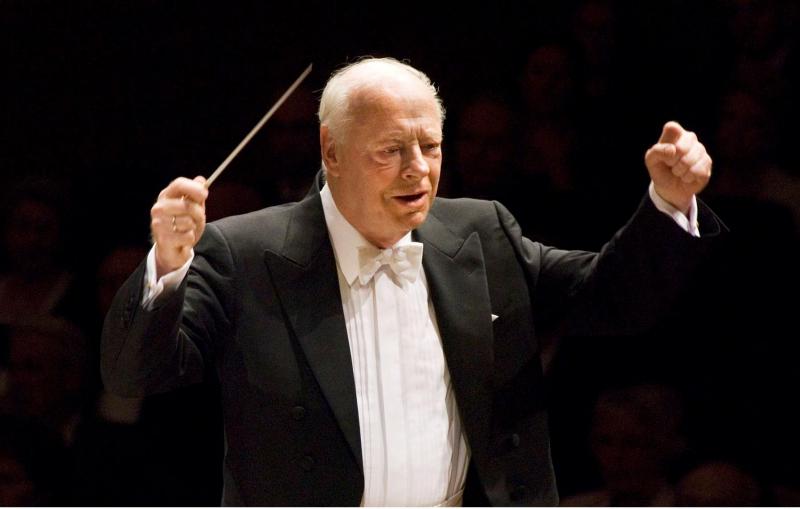
Bernard Haitink: The octagenarian conductor still wields absolute musical authority over his orchestras
It’s not that Bernard Haitink’s tempos are universally slow, it’s just that they often feel that way. When it works the music can be magisterial, immense, but when it doesn’t you find yourself chafing against such unyielding allegiance to restraint.
Last night we saw both sides of the veteran conductor, but a performance of Mozart’s Piano Concerto K453 like the one he conjured with Maria João Pires and the London Symphony Orchestra can banish the memory of any orchestral strife with the merest rococo flourish of its wrist.
Pires is a transformative pianist – so familiar, so innately right, yet never predictable. She’s the pianist you couldn’t imagine. Mozart is her heartland and the delicate joy of the Concerto No 17 in G major lends itself to her particular gift for simplicity. In her hands Mozart’s innocence becomes infinitely allusive, his melodies ripples that break the surface of something much deeper.
The LSO gave Haitink everything he asked for
This is a concerto from the composer of The Magic Flute and The Marriage of Figaro, lively with dialogue and musical drama. But such squalls as there are are easily resolved, and Pires (pictured below) found a supple balance between dignifying their youthful passions and not over-indulging them, aided by characterisation from the wind principals of the LSO and some deft tempo shifts from Haitink. The whole was poised perfection.
 Haitink and Britten isn’t a partnership that works on paper or in practice. Sounding a lot more like Shostakovich than usual, Britten’s Four Sea Interludes never found their stride, miring the composer’s precise sound-pictures in pedantry and over-emphasis. Some unusual choices in orchestral balance saw Dawn and Sunday Morning painted from different and unfamiliar angles, but the effect was curious rather than revealing.
Beethoven’s Symphony No 7 showed us what Haitink does best. Crafting a long-form musical narrative, his isn’t the minutely-finessed reading of Gardiner or Chailly, but the dramatic trajectory stretches organically from the oboe’s expansive opening right through to the final whirling exit of a tutti, making sense of the contradictory moods of this turn around the symphonic ballroom. Barring a smudged opening brass chord in the Allegretto, the LSO gave him everything he asked, carving deep into the fortes of the Allegro con brio and the string march theme of the Allegretto, before casting intensity aside in a furious dash home, with the brass finally giving way to some rather effective vulgarity.
There’s no danger with Haitink, no risk that you’ll spill over the rails. The result is assured and expensive, glowing with musical effort. If it occasionally lacks thrills then these are easy enough to supplement in London’s orchestral scene; the moments of absolute authority he finds are far harder to substitute.
more Classical music
 Bell, Perahia, ASMF Chamber Ensemble, Wigmore Hall review - joy in teamwork
A great pianist re-emerges in Schumann, but Beamish and Mendelssohn take the palm
Bell, Perahia, ASMF Chamber Ensemble, Wigmore Hall review - joy in teamwork
A great pianist re-emerges in Schumann, but Beamish and Mendelssohn take the palm
 First Persons: composers Colin Alexander and Héloïse Werner on fantasy in guided improvisation
On five new works allowing an element of freedom in the performance
First Persons: composers Colin Alexander and Héloïse Werner on fantasy in guided improvisation
On five new works allowing an element of freedom in the performance
 First Person: Leeds Lieder Festival director and pianist Joseph Middleton on a beloved organisation back from the brink
Arts Council funding restored after the blow of 2023, new paths are being forged
First Person: Leeds Lieder Festival director and pianist Joseph Middleton on a beloved organisation back from the brink
Arts Council funding restored after the blow of 2023, new paths are being forged
 Classical CDs: Nymphs, magots and buckgoats
Epic symphonies, popular music from 17th century London and an engrossing tribute to a great Spanish pianist
Classical CDs: Nymphs, magots and buckgoats
Epic symphonies, popular music from 17th century London and an engrossing tribute to a great Spanish pianist
 Sheku Kanneh-Mason, Philharmonia Chorus, RPO, Petrenko, RFH review - poetic cello, blazing chorus
Atmospheric Elgar and Weinberg, but Rachmaninov's 'The Bells' takes the palm
Sheku Kanneh-Mason, Philharmonia Chorus, RPO, Petrenko, RFH review - poetic cello, blazing chorus
Atmospheric Elgar and Weinberg, but Rachmaninov's 'The Bells' takes the palm
 Daphnis et Chloé, Tenebrae, LSO, Pappano, Barbican review - lighting up Ravel’s ‘choreographic symphony’
All details outstanding in the lavish canvas of a giant masterpiece
Daphnis et Chloé, Tenebrae, LSO, Pappano, Barbican review - lighting up Ravel’s ‘choreographic symphony’
All details outstanding in the lavish canvas of a giant masterpiece
 Goldscheider, Spence, Britten Sinfonia, Milton Court review - heroic evening songs and a jolly horn ramble
Direct, cheerful new concerto by Huw Watkins, but the programme didn’t quite cohere
Goldscheider, Spence, Britten Sinfonia, Milton Court review - heroic evening songs and a jolly horn ramble
Direct, cheerful new concerto by Huw Watkins, but the programme didn’t quite cohere
 Marwood, Power, Watkins, Hallé, Adès, Bridgewater Hall, Manchester review - sonic adventure and luxuriance
Premiere of a mesmeric piece from composer Oliver Leith
Marwood, Power, Watkins, Hallé, Adès, Bridgewater Hall, Manchester review - sonic adventure and luxuriance
Premiere of a mesmeric piece from composer Oliver Leith
 Elmore String Quartet, Kings Place review - impressive playing from an emerging group
A new work holds its own alongside acknowledged masterpieces
Elmore String Quartet, Kings Place review - impressive playing from an emerging group
A new work holds its own alongside acknowledged masterpieces
 Gilliver, LSO, Roth, Barbican review - the future is bright
Vivid engagement in fresh works by young British composers, and an orchestra on form
Gilliver, LSO, Roth, Barbican review - the future is bright
Vivid engagement in fresh works by young British composers, and an orchestra on form
 Josefowicz, LPO, Järvi, RFH review - friendly monsters
Mighty but accessible Bruckner from a peerless interpreter
Josefowicz, LPO, Järvi, RFH review - friendly monsters
Mighty but accessible Bruckner from a peerless interpreter
 Cargill, Kantos Chamber Choir, Manchester Camerata, Menezes, Stoller Hall, Manchester review - imagination and star quality
Choral-orchestral collaboration is set for great things
Cargill, Kantos Chamber Choir, Manchester Camerata, Menezes, Stoller Hall, Manchester review - imagination and star quality
Choral-orchestral collaboration is set for great things
Add comment