
Ashkar, Halle Orchestra, de Ridder, Bridgewater Hall, Manchester | reviews, news & interviews
Ashkar, Halle Orchestra, de Ridder, Bridgewater Hall, Manchester
Ashkar, Halle Orchestra, de Ridder, Bridgewater Hall, Manchester
This debut pairing of pianist and conductor promises rich rewards
Friday, 18 January 2013

Pianist Saleem Aboud Ashkar: crispness, clarity and attention to detail
Once upon a time, Gyorgy Ligeti heard a rehearsal performance of a piece of music he wrote soon after graduating from the Franz Liszt Academy of Music in Budapest. Just once. Then it was banned by the Hungarian apparatchiks responsible for the arts and he had to wait another 20 years to hear it played in public.
It was the Concert Romanesc (Romanian Concerto), written in 1951 and drawing from his memories of, and research into, the folk music of the Romanian Transylvania of his boyhood.
It’s a jolly piece altogether, capturing the attractiveness of dances and village bands and incorporating interesting instrumental combinations, like the opening bars from cellos and clarinets. He uses intermittent solos from fiddle and horn, clarinet and cor anglais, and he brings in haunting, slightly off-key-sounding harmonies, nostalgically reflecting boyhood memories. So the piece, in four movements, has melancholy, folksiness and, not least, humour, even though it didn’t tickle the fancy of the repressive regime. I like the description of its molto vivace last movement, quoted in the programme note, from Ligeti’s biographer Richard Steinitz: “A sort of Keystone Kops meets Beijing Opera on the plains of Transylvania”.
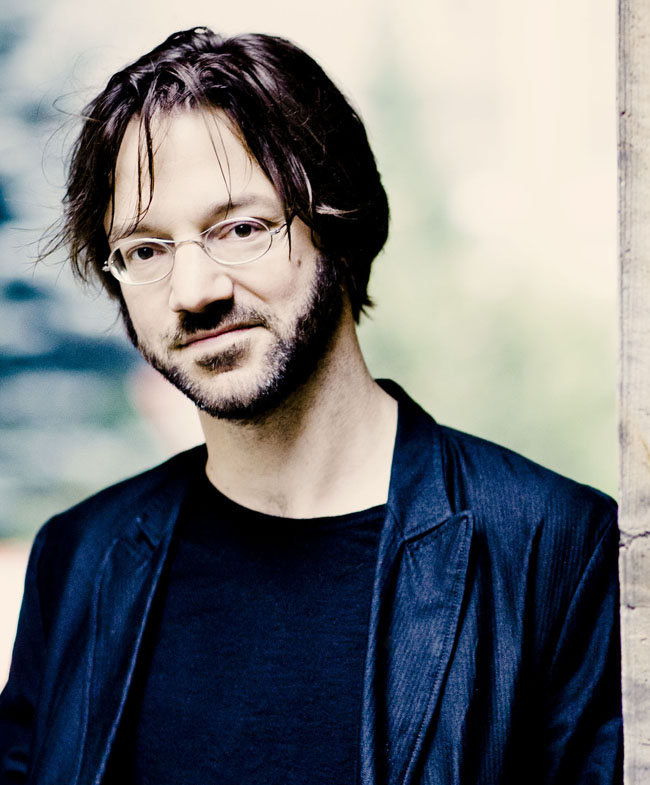 It was an inspired choice by conductor André de Ridder (pictured right) as curtain-raiser to the big guns of Beethoven and Brahms, intelligently linking to the latter’s interest in Hungarian music. Paired for the first time with the Israeli pianist Saleem Abboud Ashkar, de Ridder essayed Beethoven’s Third Piano Concerto.
Ashkar, protégé of Mehta and Barenboim, gave an interpretation that had much to commend it. His playing from the start had crispness and clarity, and I found his cadenza spellbinding, with a plangent tone and flowing glissandi. Ashkar has remarkable dexterity and attention to detail.
As a first outing, the Ashkar/ de Ridder combination didn’t quite hit the heights, but showed enough to indicate that, given more time together, they could make a real impact. The orchestral playing began and ended strongly, bringing out the melancholic and nostalgic, especially in the Largo, before reaching the Rondo Allegro and its exuberant climax. Yet somehow, there was an unevenness overall.
However, de Ridder really came into his own in Brahms’s swansong symphony, the Fourth. He is an unfussy conductor, measured yet expressive, and showed a real grasp and feel for the scale of the work across the four movements. The orchestra responded splendidly, with notable solo contributions, especially from the horns.
The way in which he managed the changes of emphasis in the final movement, with its Bach-inspired variations in the form of a passacaglia with its Baroque structure, showed real mastery.
He is an interesting and innovative young conductor and no newcomer to the Halle, where he spent a year in 2005-6 as Assistant Conductor to Sir Mark Elder. I last saw him a couple of years ago at the Manchester International Festival, when he conducted and orchestrated Damon Albarn’s controversial music theatre piece Monkey: Journey to the West. The versatile de Ridder is one to watch.
The Ligeti was an inspired choice as a curtain-raiser to the big guns of Beethoven and Brahms
rating
Explore topics
Share this article
more Classical music
 Bell, Perahia, ASMF Chamber Ensemble, Wigmore Hall review - joy in teamwork
A great pianist re-emerges in Schumann, but Beamish and Mendelssohn take the palm
Bell, Perahia, ASMF Chamber Ensemble, Wigmore Hall review - joy in teamwork
A great pianist re-emerges in Schumann, but Beamish and Mendelssohn take the palm
 First Persons: composers Colin Alexander and Héloïse Werner on fantasy in guided improvisation
On five new works allowing an element of freedom in the performance
First Persons: composers Colin Alexander and Héloïse Werner on fantasy in guided improvisation
On five new works allowing an element of freedom in the performance
 First Person: Leeds Lieder Festival director and pianist Joseph Middleton on a beloved organisation back from the brink
Arts Council funding restored after the blow of 2023, new paths are being forged
First Person: Leeds Lieder Festival director and pianist Joseph Middleton on a beloved organisation back from the brink
Arts Council funding restored after the blow of 2023, new paths are being forged
 Classical CDs: Nymphs, magots and buckgoats
Epic symphonies, popular music from 17th century London and an engrossing tribute to a great Spanish pianist
Classical CDs: Nymphs, magots and buckgoats
Epic symphonies, popular music from 17th century London and an engrossing tribute to a great Spanish pianist
 Sheku Kanneh-Mason, Philharmonia Chorus, RPO, Petrenko, RFH review - poetic cello, blazing chorus
Atmospheric Elgar and Weinberg, but Rachmaninov's 'The Bells' takes the palm
Sheku Kanneh-Mason, Philharmonia Chorus, RPO, Petrenko, RFH review - poetic cello, blazing chorus
Atmospheric Elgar and Weinberg, but Rachmaninov's 'The Bells' takes the palm
 Daphnis et Chloé, Tenebrae, LSO, Pappano, Barbican review - lighting up Ravel’s ‘choreographic symphony’
All details outstanding in the lavish canvas of a giant masterpiece
Daphnis et Chloé, Tenebrae, LSO, Pappano, Barbican review - lighting up Ravel’s ‘choreographic symphony’
All details outstanding in the lavish canvas of a giant masterpiece
 Goldscheider, Spence, Britten Sinfonia, Milton Court review - heroic evening songs and a jolly horn ramble
Direct, cheerful new concerto by Huw Watkins, but the programme didn’t quite cohere
Goldscheider, Spence, Britten Sinfonia, Milton Court review - heroic evening songs and a jolly horn ramble
Direct, cheerful new concerto by Huw Watkins, but the programme didn’t quite cohere
 Marwood, Power, Watkins, Hallé, Adès, Bridgewater Hall, Manchester review - sonic adventure and luxuriance
Premiere of a mesmeric piece from composer Oliver Leith
Marwood, Power, Watkins, Hallé, Adès, Bridgewater Hall, Manchester review - sonic adventure and luxuriance
Premiere of a mesmeric piece from composer Oliver Leith
 Elmore String Quartet, Kings Place review - impressive playing from an emerging group
A new work holds its own alongside acknowledged masterpieces
Elmore String Quartet, Kings Place review - impressive playing from an emerging group
A new work holds its own alongside acknowledged masterpieces
 Gilliver, LSO, Roth, Barbican review - the future is bright
Vivid engagement in fresh works by young British composers, and an orchestra on form
Gilliver, LSO, Roth, Barbican review - the future is bright
Vivid engagement in fresh works by young British composers, and an orchestra on form
 Josefowicz, LPO, Järvi, RFH review - friendly monsters
Mighty but accessible Bruckner from a peerless interpreter
Josefowicz, LPO, Järvi, RFH review - friendly monsters
Mighty but accessible Bruckner from a peerless interpreter
 Cargill, Kantos Chamber Choir, Manchester Camerata, Menezes, Stoller Hall, Manchester review - imagination and star quality
Choral-orchestral collaboration is set for great things
Cargill, Kantos Chamber Choir, Manchester Camerata, Menezes, Stoller Hall, Manchester review - imagination and star quality
Choral-orchestral collaboration is set for great things
Add comment